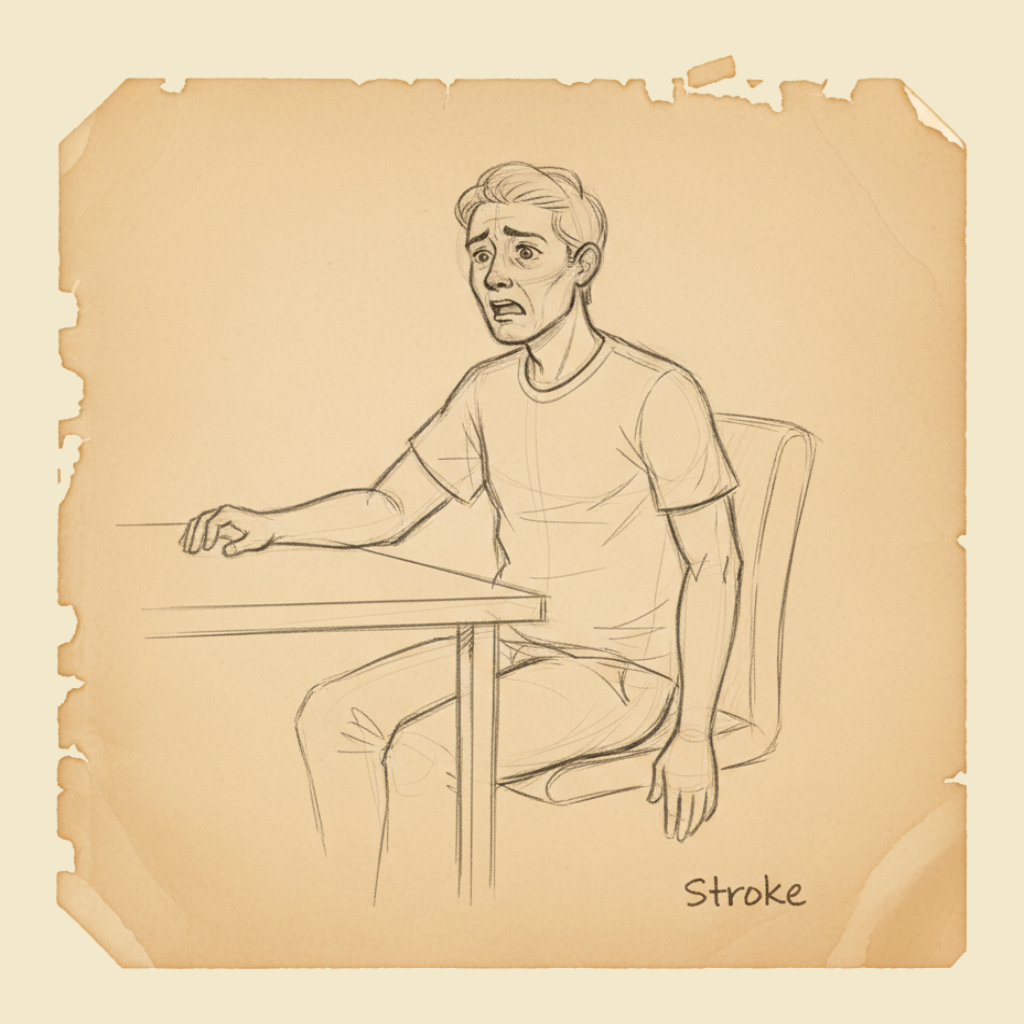
What's actually happening
A stroke is a "brain attack". Part of the brain suddenly loses its blood supply, the cells in that area start to die within minutes, and the functions controlled by that piece of brain — speech, movement of one side of the body, vision, balance, swallowing — stop working. The longer the brain goes without blood, the more cells die, the more permanent the damage. There is a brutal phrase used in stroke medicine: time is brain. G9-2-2
There are two mechanisms, and they look identical from the outside:
- Ischaemic stroke (about 80% of cases) — a clot blocks a brain artery. The brain downstream of the clot loses its blood supply.
- Haemorrhagic stroke (about 20%) — a brain artery bursts and bleeds into the surrounding tissue, both cutting off the supply and damaging the brain with the leaked blood.
The first aider has no way of telling these apart in the field, and that doesn't matter: both are emergencies, both go to the same emergency department by the same ambulance, and the hospital decides which is which with a CT scan in the first ten minutes after arrival. Your job is recognition and speed.
A transient ischaemic attack (TIA) is a "mini-stroke" — a clot that blocks an artery briefly and then breaks up, with all symptoms resolving within minutes to hours. A TIA is not a small problem you can ignore: it is the brain's warning that a full stroke is coming, often within days. Every TIA is a medical emergency.
§ Instructor's note
The single most important number in stroke first aid is the time the symptoms started — not when you noticed, not when you arrived, but the very first moment something was wrong. Modern stroke treatment (clot-busting drugs and clot-retrieval procedures) is gated by hard time windows from symptom onset, typically 4.5 hours for thrombolysis and 6–24 hours for thrombectomy. A casualty who arrives at hospital at 4 hours can still receive treatment that fully reverses the stroke. A casualty who arrives at 5 hours often cannot. Drill the rule: note the time, write it down, give it to the paramedics.
Recognising it — F.A.S.T.
The recognition tool is the F.A.S.T. mnemonic and it is the single most useful piece of first-aid knowledge in this chapter. Use it on anyone who is suddenly behaving oddly, slurring their words, looking confused, or complaining of weakness.
- F — Face. Ask the casualty to smile, or to show their teeth. Does one side of the mouth or face droop? Does the smile look uneven?
- A — Arms. Ask the casualty to raise both arms in front of them and hold them there with their eyes closed. Does one arm drift downwards, or fail to lift at all?
- S — Speech. Ask the casualty to repeat a simple sentence (e.g. "the early bird catches the worm"). Is their speech slurred, jumbled, or absent? Are they confused about words they should know?
- T — Time. If any of the above are present, call 000 immediately, and note the time the symptoms started.
If any one of F, A, or S is positive, treat as a stroke. You do not need all three.
Other signs that should make you suspect a stroke even if F.A.S.T. is borderline:
- Sudden severe headache — "the worst headache of my life", especially with vomiting or stiff neck.
- Sudden vision loss in one or both eyes, or double vision.
- Sudden dizziness, loss of balance, or unsteadiness without an obvious cause.
- Sudden numbness or weakness on one side of the body — face, arm, leg.
- Sudden confusion, difficulty understanding, or trouble finding words.
- Sudden difficulty swallowing.
The word "sudden" is the common thread. A stroke comes on in seconds to minutes, not hours.
If a casualty's symptoms resolve while you are watching — they were slurring their speech five minutes ago, and now they are talking normally — that is almost certainly a TIA, and the casualty is at very high risk of a full stroke in the next hours to days. Call 000 anyway. Do not let the casualty go home, do not let them drive, and do not accept "but I'm fine now" as a reason to stand down.
First-line response
The first-aid sequence for a suspected stroke is short and is built entirely around getting the casualty to hospital as fast as possible. G9-2-2PC 1.3
- Call 000 immediately. Tell the operator "I think this is a stroke" — the dispatcher will route accordingly.
- Note the time the symptoms started. If you don't know — the casualty was found this way — note the time the casualty was last seen well. Write it down. Give it to the paramedics.
- Lay the casualty down with the head and shoulders slightly raised, supported on cushions or a folded coat. About 30 degrees is right.
- Loosen any tight clothing around the neck and chest.
- Do not give them anything to eat or drink. A stroke can affect the swallow reflex, and food or fluid may go into the lungs and cause aspiration pneumonia. This includes water, even if they are thirsty. A damp cloth on the lips is the most you should offer.
- Reassure them. Stroke is terrifying — the casualty knows something is very wrong — and they may be frustrated or distressed at not being able to communicate. Speak slowly, calmly, and explain what is happening.
- Monitor breathing and responsiveness continuously. Be ready to start CPR if they deteriorate.
- If the casualty becomes unresponsive but is breathing, roll into the recovery position. The affected side (the weak side) should be uppermost if possible, so the airway is supported by the unaffected side.
For a casualty with suspected stroke, immediate ambulance transport is the most important first-aid action. Use the F.A.S.T. assessment to identify possible stroke. Note the time of symptom onset (or, if the casualty was found, the time the casualty was last seen well). Do not give the casualty anything by mouth — the swallow reflex may be impaired. The narrow time windows for stroke treatment make speed of presentation to hospital the strongest determinant of outcome.
When to call an ambulance
Call 000 immediately for any of:
- Any positive F.A.S.T. assessment.
- Any sudden severe headache, especially with vomiting, stiff neck, or altered consciousness.
- Any sudden vision loss or double vision.
- Any sudden one-sided weakness, numbness or loss of coordination.
- Any sudden difficulty speaking, understanding, or swallowing.
- Any TIA — even if symptoms have already resolved.
- Any unresponsive casualty whose history is unclear.
- Any time you are unsure.
The default for stroke is to call. There is no situation in which "wait and see" is safer than "call the ambulance".
What not to do
- Do not give the casualty anything to eat or drink — including water, including aspirin, including their own regular medication.
- Do not wait to see if symptoms get better. Time is brain.
- Do not drive the casualty to hospital yourself unless an ambulance is unobtainable. Paramedics begin stroke treatment in the ambulance and route to a stroke-capable hospital, which may not be the closest one.
- Do not dismiss symptoms that have resolved. TIAs are warnings.
- Do not lay the casualty completely flat — keep the head and shoulders slightly raised.
- Do not assume "they're just confused/tired/drunk". Run F.A.S.T. anyway.
If you find a casualty already showing stroke signs and don't know when they started — they were found like this on waking, or in another room — give the paramedics the time the casualty was last seen behaving normally. That time anchors the treatment-window calculation, and "I don't know" is much less useful than "9 pm last night, when they went to bed".
You will rehearse the F.A.S.T. assessment on a partner, practise the recovery-position roll with the affected side uppermost, and run a scenario where a TIA appears to "resolve" so you can drill the rule that resolution does not change the call. F.A.S.T. is a thirty-second skill that has saved lives every time it has been used in time — internalising it is one of the most valuable things this course will give you.
Stroke is the one emergency where the only thing that really matters is the clock. Recognise it with F.A.S.T., write down the time, call the ambulance, and let the people with the clot-busters do the rest. Every minute counts — and every minute saved is brain saved.
— ANZCOR Guideline 9.2.2