What's actually happening
In first aid, shock does not mean "upset" or "frightened". It is a precise medical word for the state in which the circulation has failed to deliver enough oxygen-carrying blood to the body's tissues. Cells starve, organs start to fail, and without treatment the casualty dies. Shock is always a sign that something bigger is going wrong — it is the body's response to an underlying emergency, not a disease in its own right. The first aider's job is to recognise the picture, treat whatever is causing it, and get the casualty to hospital fast. G9-2-3
The causes of shock split into four categories. The category determines the underlying treatment, but the recognition picture and the first-aid response are almost identical:
- Hypovolaemic shock — not enough blood. Heavy external or internal bleeding, fluid loss from major burns, severe vomiting or diarrhoea, dehydration.
- Cardiogenic shock — the heart failing as a pump. Usually a heart attack so big the remaining muscle can't keep up.
- Distributive shock — the blood vessels becoming too leaky or too dilated to maintain pressure. Anaphylaxis, severe infection (sepsis), spinal-cord injury.
- Obstructive shock — something physically blocking the circulation. Tension pneumothorax, massive pulmonary embolism, cardiac tamponade. Rare but rapidly fatal.
§ Instructor's note
The most useful framing for learners is that shock is the body's compensation mechanism visible from the outside. The body is shunting blood away from the skin and gut to protect the brain and the heart, so the casualty looks pale, sweaty, cold and thirsty — those signs are not the shock itself, they are the body's attempt to survive the shock. When the compensation fails (drowsiness, collapse, no blood pressure), the casualty has minutes. Drill the rule: treat the picture early, while the body is still compensating.
Recognising it
The signs of shock are the same regardless of cause, and they progress in a consistent order. Recognising them early is the whole skill.
- Pale, cold, clammy skin — especially the hands, feet, lips, ears. The body has shut down circulation to the surface to protect the core.
- Fast, weak pulse — sometimes called a "thready" pulse. The heart is racing to compensate for the falling pressure.
- Fast, shallow breathing — the body trying to get more oxygen into the bloodstream.
- Thirst. A casualty repeatedly asking for water after an injury or illness is showing one of the earliest reliable signs.
- Restlessness, anxiety, "I feel something is wrong". The brain is sensing the shortage and reacting.
- Nausea, weakness, dizziness, sweating.
- Confusion as the brain itself starts to feel the shortage.
- Drowsiness, collapse, unresponsiveness — late and dangerous. Compensation has failed.
- Cardiac arrest — terminal.
A shocked casualty in the early compensated phase can look surprisingly well — talking, asking sensible questions, perhaps even getting up to walk around. This is not reassurance. Compensation is fragile, and when it breaks the casualty will deteriorate fast. Treat the picture, not the conversation. Any casualty with the signs above needs an ambulance even if they say they are "fine".
First-line response
The first-aid sequence for shock is built around two parallel actions: treat the cause, and support the body while it tries to compensate. G9-2-3PC 1.3
- Call 000 immediately. Shock is a hospital emergency.
- Treat the underlying cause if you can identify it:
- Bleeding → direct pressure (see the bleeding chapter).
- Anaphylaxis → adrenaline (EpiPen) — see the anaphylaxis chapter.
- Major burn → cool with running water, do not let the casualty become hypothermic — see the burns chapter.
- Suspected heart attack → rest, reassurance, aspirin if not contraindicated, ready to start CPR.
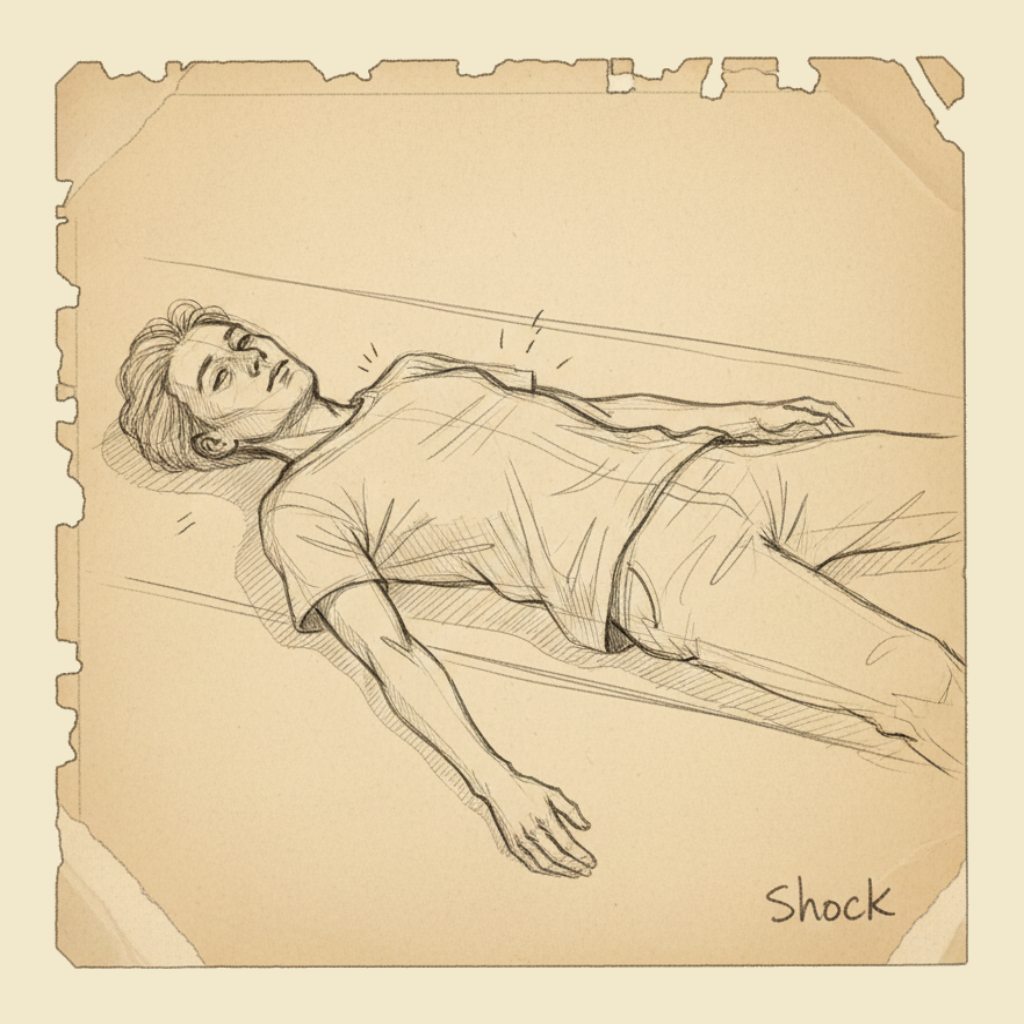
- Lay the casualty down flat on their back on a firm surface.
- If there is no suspected spinal injury and no leg fracture, raise the legs slightly — about 30 cm. This helps return blood from the legs to the central circulation.
- Loosen tight clothing at the neck, chest and waist.
- Keep them warm. Cover with a blanket or coat. Hypothermia worsens shock. Do not apply direct heat such as hot water bottles — this dilates surface blood vessels and dumps the body's reserve to the skin.
- Reassure them. Calm, quiet, confident voice. Anxiety worsens the picture.
- Do not give them anything to eat or drink, no matter how thirsty they are. Shocked casualties often end up needing surgery, and an empty stomach matters. A damp cloth on the lips is the most you should offer.
- Monitor breathing and pulse continuously. Be ready to start CPR if they deteriorate.
- Note what you have seen and done so you can hand over to the paramedics.
For a casualty in shock, the priorities are to call for an ambulance, treat any obvious cause (such as severe bleeding or anaphylaxis), lay the casualty down, keep them warm, and do not give anything by mouth. Raising the legs may be considered if there is no spinal injury or leg fracture. Continuous monitoring is essential — the casualty's condition can change rapidly.
When to call an ambulance
Call 000 immediately for any shock. Specifically, call without hesitation for any of:
- Any casualty showing the shock picture above, regardless of the apparent cause.
- Any heavy external bleeding.
- Any suspected internal bleeding (a significant blow to the chest, abdomen, pelvis, or back).
- Any major burn.
- Any anaphylaxis.
- Any suspected heart attack.
- Any casualty who deteriorates after an injury or illness, even if they initially seemed well.
- Any time you are unsure.
Shock is one of the very few first-aid situations where the answer to "should I call an ambulance?" is always yes.
What not to do
- Do not give the casualty anything to eat or drink.
- Do not apply direct heat — no hot water bottles, no electric blankets, no hot drinks. Insulate, don't heat.
- Do not raise the legs if there is a suspected spinal injury or a leg fracture.
- Do not sit the casualty up. Lying flat is the position the failing circulation needs.
- Do not allow the casualty to walk anywhere "to test how they feel".
- Do not assume an early-shock casualty who looks "fine" doesn't need an ambulance. Treat the picture, not the conversation.
- Do not leave the casualty alone — their condition can change in seconds.
For a shocked casualty who is conscious, lay them flat on their back with legs raised (if no spinal or leg injury). For a shocked casualty who becomes unresponsive but is still breathing, the recovery position takes priority — protecting the airway is more urgent than the position-for-shock. If they stop breathing, start CPR.
You will rehearse the lay-down-and-raise-legs technique on a partner, run a scenario where a bleeding casualty progresses through compensated shock to decompensation so you can drill the recognition pattern, and practise the continuous-monitoring habit that catches deterioration in time. Shock is more about pattern-recognition than technique, and patterns are learned by repetition.
Shock is the casualty's body telling you, in a language you can read with your eyes, that something is taking it apart from the inside. Listen early — call the ambulance, treat what you can, lie them down, keep them warm — and the body will usually hold on long enough for the people who can fix it.
— ANZCOR Guideline 9.2.3