Why sharps get their own chapter
A sharps injury — most commonly a needlestick — is a category of minor wound that has a disproportionate worry attached to it. The puncture wound itself is small, often barely bleeds, and would otherwise be treated as a routine puncture. What makes it different is the possibility that the sharp object was contaminated with somebody else's blood, and that the casualty has therefore been exposed to one of the bloodborne viruses — hepatitis B, hepatitis C, or HIV. The first aider's job is partly the wound management (which is brief) and partly the post-exposure protocol that determines what happens in the hours and days that follow. G9.1.1
Sharps injuries happen in healthcare settings (where staff are at risk from used clinical equipment), in workplaces that handle waste or recycling, in cleaning roles, in education settings (used needles in school grounds), and in everyday life (a child finding a discarded syringe in a park). The first-aid response is the same whatever the setting: clean the wound, encourage bleeding, document the exposure, and access the post-exposure protocol fast.
§ Instructor's note
The teaching point of this chapter is that the wound is the small problem and the exposure is the big one. Learners often focus on the puncture itself and miss the post-exposure response, which is where the real first aid happens. Drill the rule: wash, encourage to bleed, do not scrub or suck, document everything, and access medical care within hours — not days — for post-exposure prophylaxis assessment.
What is in a "sharp"
For first-aid purposes, a sharp is any object capable of penetrating the skin: needles (most commonly), lancets, scalpel blades, broken glass, sharp metal edges, pieces of bone, broken plastic, dental instruments, surgical instruments. The category includes any sharp object that may have been in contact with blood or other body fluids.
The risk of infection depends on three things:
- Whether the source had a bloodborne infection — the great majority of needles in the wider world are not contaminated with hepatitis or HIV, but you usually do not know.
- The amount of blood transferred — a deep, hollow-needle injury with visible blood transfers more virus than a glancing scratch with a solid sharp.
- The virus involved — hepatitis B is the most transmissible of the three, hepatitis C the next, HIV the least, but all three are real risks.
The approximate transmission risks from a single needlestick from a known positive source (in the absence of post-exposure prophylaxis) are:
- Hepatitis B: about 6–30% (depending on the source's viral status), reducible to near zero with prompt vaccination and immunoglobulin if needed.
- Hepatitis C: about 1.8% on average. There is no vaccine, but new direct-acting antiviral drugs treat established infection effectively.
- HIV: about 0.3% (1 in 300 to 1 in 400), reducible to under 0.05% with prompt post-exposure prophylaxis (PEP).
The take-home: the risks are real but not enormous, and the post-exposure interventions substantially reduce them when started quickly. Quick action makes a measurable difference.
Immediate management — the next ten minutes
The first aider's response to a sharps injury is short, structured, and time-critical:
- Move the casualty away from the source if there is any further risk — the discarded needle, the contaminated workspace. The first aider may need to safely contain the sharp itself (see below) but the casualty's wound is the priority.
- Encourage the wound to bleed for a few seconds. Do not suck the wound, do not squeeze it aggressively, do not cut it. The aim is to let any blood that has entered the wound be carried back out by the casualty's own bleeding. A minute of gentle bleeding is plenty.
- Wash the wound thoroughly with soap and running water for several minutes. Soap and water is the right cleaner — it is effective, gentle, and available. Do not use bleach, antiseptic, or harsh chemicals on the wound itself. The aim is to flush mechanically.
- Dry the wound and cover with a clean adhesive dressing. The wound itself is small and does not need elaborate dressing.
- Document the exposure:
- Time and place of the injury.
- The nature of the sharp (needle, broken glass, etc.).
- The depth and visible severity of the wound.
- Any information about the source (a known patient with known status, an anonymous needle in a park, etc.).
- The casualty's identity and the first aider's identity.
- Access the post-exposure protocol immediately. In a workplace, this means following the workplace's incident protocol, which usually involves the workplace's occupational health service, a supervisor, and a designated medical contact. Outside a workplace, it means going to a hospital emergency department or an after-hours GP for assessment. The first hours matter — see below.
What to do with the sharp itself
If the sharp is still present and may be a hazard to others:
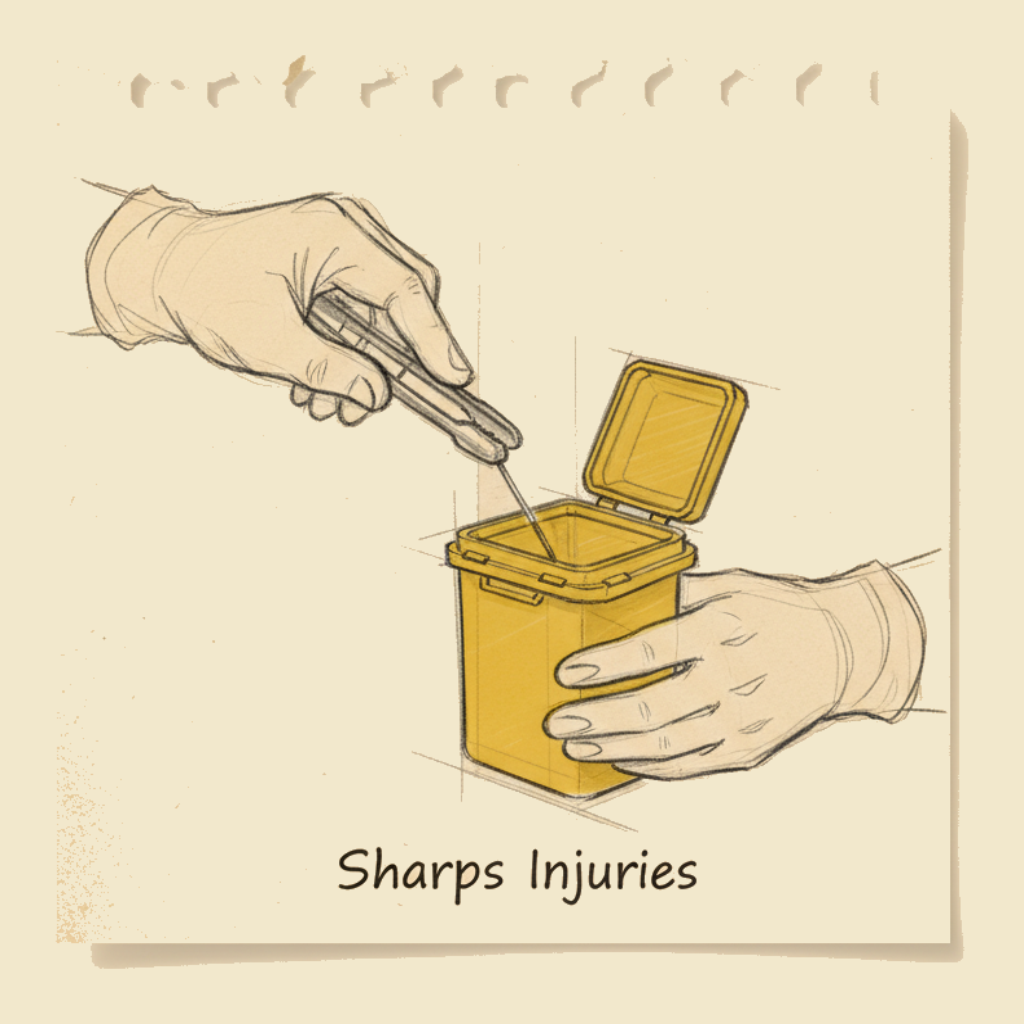
- Do not handle it with bare hands. Use gloves, or pick it up with a tool (forceps, tongs, a piece of card folded into a scoop).
- Do not recap a needle. Recapping is the single most common cause of secondary needlestick injuries; the cap pushes onto the needle and may slip onto a hand.
- Place the sharp in a rigid puncture-proof container — a sharps bin in a healthcare setting, or any rigid container (a glass jar with a lid, a plastic bottle with a tight cap) outside a healthcare setting. Label it as containing a contaminated sharp.
- Take the sharp (or arrange for it to be taken) to the medical assessment so that, if possible, the sharp itself can be tested for bloodborne viruses. This is often more useful than guessing about the source.
- Report the incident to the workplace, the property owner, or the local council if the sharp was found in a public place. Discarded sharps in public places are a public health issue and should be cleared away.
Why "do not suck the wound"
The traditional "first-aid" instinct of sucking a wound to extract whatever might be in it is wrong for sharps injuries (and for snakebites, see the envenomation chapter). It does not effectively remove anything — by the time the casualty notices, any contamination is already in the tissue and not in a small reservoir at the surface — and it introduces oral bacteria into the wound, increasing the risk of infection. It also risks transferring bloodborne pathogens to the rescuer's mouth. Wash, don't suck.
Why "do not squeeze aggressively or cut"
The same logic. Squeezing the wound to extract blood does not remove virus particles — they are in the cells, not floating freely — and aggressive squeezing or cutting damages the tissue and may push contamination deeper. Gentle bleeding (or even just letting the wound bleed naturally for a few seconds) is the right approach. After that, the cleaning step is what does the real work.
Post-exposure prophylaxis — why hours matter
The reason a sharps injury needs same-day medical assessment is the existence of post-exposure prophylaxis (PEP) — medications that can dramatically reduce the chance of bloodborne infection if they are started quickly.
Hepatitis B PEP
If the casualty has been vaccinated against hepatitis B and has documented immunity, no further action is needed. If they have not been vaccinated, or their immunity status is unknown, they will be offered:
- Hepatitis B vaccine (a course of injections starting on the day of exposure).
- Hepatitis B immunoglobulin (HBIG) if the source is known to be hepatitis B positive — this is a passive immunisation that gives immediate antibody protection while the vaccine takes effect.
The vaccine and HBIG together are highly effective if started within 24 hours of exposure, less effective after 72 hours, and not recommended after 7 days.
Hepatitis C PEP
There is no PEP for hepatitis C. The casualty will be tested at baseline and again at 6 weeks, 3 months, and 6 months, and treated with antiviral drugs if they seroconvert. Modern hepatitis C treatment cures the infection in most cases, so even an established infection is not the catastrophe it once was — but the goal is to detect and treat it early.
HIV PEP
HIV post-exposure prophylaxis is a course of antiretroviral medications taken for 28 days, starting as soon as possible after the exposure. The current recommendation is to start within 2 hours if possible, and definitely within 72 hours; after 72 hours the benefit drops sharply. PEP reduces the risk of seroconversion by about 80%, taking the risk from "small but real" to "very small".
PEP is not a casual decision — the drugs have side effects, the course is 4 weeks of daily pills, and not every exposure justifies the cost-benefit. The decision to start PEP is made by a doctor or hospital after assessing the source, the exposure, and the casualty's circumstances. The first aider's job is to get the casualty to the assessment in time for the decision to be possible. Waiting until the next morning to "see how it feels" is the wrong action; PEP loses effectiveness with every hour of delay.
The right destinations for assessment, in approximate order of preference:
- The casualty's workplace occupational health service, if they are in a workplace with one (most healthcare settings).
- A hospital emergency department, which can assess and start PEP immediately.
- A sexual health clinic, many of which offer PEP.
- A general practitioner with experience in PEP — but check first; not all GPs are set up to provide PEP and the time pressure may not allow waiting for an appointment.
If the casualty is uncertain where to go, the emergency department is the right answer. Better to be assessed there and discharged than to delay and lose the PEP window.
If a casualty has been exposed to a sharp that may have been contaminated, the assessment for HIV post-exposure prophylaxis should happen within 2 hours, ideally, and within 72 hours absolutely. After 72 hours the drug regimen is no longer recommended. This is one of the few situations in first aid where a delay of even a few hours significantly affects the casualty's long-term outcome. The first aider's job is to make sure the casualty understands the urgency and gets to the right service quickly — not to send them home to think about it.
The casualty's anxiety — and how to manage it
A sharps injury is one of the most psychologically distressing minor wounds a first aider deals with. The wound is trivial, the casualty knows it is trivial, and yet the implication — I might have just caught HIV / hepatitis from this needle — is genuinely terrifying. The casualty may be:
- Catastrophising — convinced that the worst-case outcome is certain and imminent.
- In denial — refusing to believe the exposure happened or that it matters.
- Withdrawn — too overwhelmed to engage with the practical steps.
- Angry — at whoever discarded the sharp, at themselves for not being careful, at the situation.
- Embarrassed — particularly if the injury is in a context that they find awkward (a healthcare worker who didn't follow their own protocols, a parent whose child found a needle).
The first aider's role is partly the technical (clean, document, refer) and partly the emotional support:
- Be calm and matter-of-fact about the steps. The casualty is taking their cue from you; if you treat the situation as routine, they will be calmer than if you are clearly worried.
- Give realistic information, not reassurance. The risks of infection from a single needlestick are low but not zero, and the casualty deserves to hear that, not "don't worry, it'll be fine". False reassurance erodes trust.
- Emphasise the actions that help — wound cleaning, documentation, rapid medical assessment, post-exposure prophylaxis. The casualty has agency here; they are not just a passive victim of the exposure.
- Acknowledge the fear — "this is scary, and the fact that it's a low-risk situation doesn't make the fear go away. Let's get you to the people who can give you the right information."
- Stay with the casualty through the immediate steps — washing the wound, calling the workplace, arranging the assessment. They may not be in a state to organise themselves.
- Follow up — after the immediate response, check in with the casualty over the following days. The waiting period for confirmatory testing is long (weeks to months) and the psychological burden is real. See the rescuer stress and support chapter for the support principles.
Workplace sharps injury protocols
Most workplaces where sharps injuries are a recognised risk — healthcare facilities, laboratories, waste handling, cleaning services, schools — have a written sharps injury protocol that the first aider should know about and follow. The protocol typically includes:
- The immediate first-aid steps (wash, encourage bleeding, dress).
- The reporting steps (incident form, supervisor notification).
- The medical assessment pathway (where to go, how soon).
- The follow-up testing schedule (baseline, 6 weeks, 3 months, 6 months).
- The counselling and support resources available.
- The post-exposure prophylaxis arrangements, including access to PEP within hours.
- The investigation of the source of the sharp, where possible.
If you work in a setting where sharps injuries are possible, read the protocol now, before you need it. The protocol is much harder to follow under the panic of a real exposure if you have never seen it.
For workplaces without a formal sharps protocol — most non-healthcare workplaces, where sharps injuries are an unexpected event — the default is a hospital emergency department visit. Tell the casualty's manager or supervisor, get the casualty to the hospital, document the incident, and follow up. See also the workplace procedures chapter and the infection control chapter.
The first aider's own exposure
A first aider can also be exposed to a sharp while providing first aid to someone else — for example, when handling a casualty whose pocket contains a hidden needle, or when reaching into a vehicle wreck where there is broken glass. The same protocol applies: wash, document, refer, access PEP assessment within hours.
The first aider's own exposure is sometimes harder to recognise because the focus is on the casualty. Cultivate the habit of checking your own hands and arms after dealing with any incident that involved sharp objects, broken glass, or unknown materials, and treating any unexpected wound as a potential exposure until proven otherwise.
The use of disposable gloves for any first aid that involves blood or body fluids is the most effective preventive measure. Gloves do not stop a needle, but they do reduce the volume of blood that contacts a wound if a needlestick happens, and they protect against the more common exposure routes (broken skin contact, splash to the hand). See the infection control chapter.
Children sometimes find discarded needles in parks, on beaches, or in school grounds. The combination of curiosity and small fingers can produce an exposure that frightens parents and carers more than almost any other minor injury. The protocol is the same as for an adult: wash with soap and running water, encourage gentle bleeding, document the find, and seek prompt medical assessment for hepatitis B vaccination and (depending on the circumstances) HIV PEP discussion. The Australian Department of Health and most state child health services have specific advice for paediatric needlestick and will guide parents through the assessment and follow-up. The fear is usually disproportionate to the actual risk — paediatric seroconversion from a found needle in Australia is extremely rare — but the fear is real and the medical follow-up is appropriate.
Sharps injuries with potential exposure to bloodborne pathogens should be managed by encouraging brief bleeding, washing the wound with soap and running water, and seeking prompt medical assessment for consideration of post-exposure prophylaxis. The wound should not be sucked, scrubbed aggressively, or treated with caustic agents. Documentation of the time, mechanism, and source of the exposure is essential. Where the source of the contamination can be tested, this should be arranged. The casualty should be referred for medical assessment within hours of the exposure, ideally to a service capable of providing post-exposure prophylaxis where indicated.
What not to do
- Do not suck the wound or apply your mouth to it.
- Do not squeeze the wound aggressively or cut it to "extract" the contamination.
- Do not apply bleach, alcohol, or strong antiseptics to the wound itself — soap and water are correct.
- Do not recap a needle. Place it in a rigid container without recapping.
- Do not handle the sharp with bare hands. Use gloves or a tool.
- Do not delay medical assessment. The PEP window for HIV is hours, not days.
- Do not dismiss a sharps injury as "trivial" because the wound is small. The wound is the small problem; the exposure is the real one.
- Do not forget to document the incident — time, place, mechanism, source, casualty, witness.
- Do not leave the casualty to "deal with it themselves". Stay with them through the immediate response and the access to medical assessment.
You will rehearse the sharps injury response on a simulated wound — washing under running water, the bleeding-encouragement (without squeezing), the dressing application, the documentation of the exposure, and the conversation with the casualty about the next steps. You will also rehearse the safe handling of a discarded sharp using gloves and tongs to place it into a rigid container. The technical steps are quick; the conversation with the anxious casualty is the part that benefits most from practice.
A sharps injury is a small wound with a big worry, and the first aider's job is to handle both. The wound gets washed and dressed in a couple of minutes; the worry gets handled by getting the casualty to medical assessment within hours, where post-exposure prophylaxis can be considered. Wash, encourage bleeding, document, refer, support. The PEP window is short and the actions that help are simple — but only if the first aider knows them and acts on them quickly.
— ANZCOR Guideline 9.1.1 (control of bleeding)