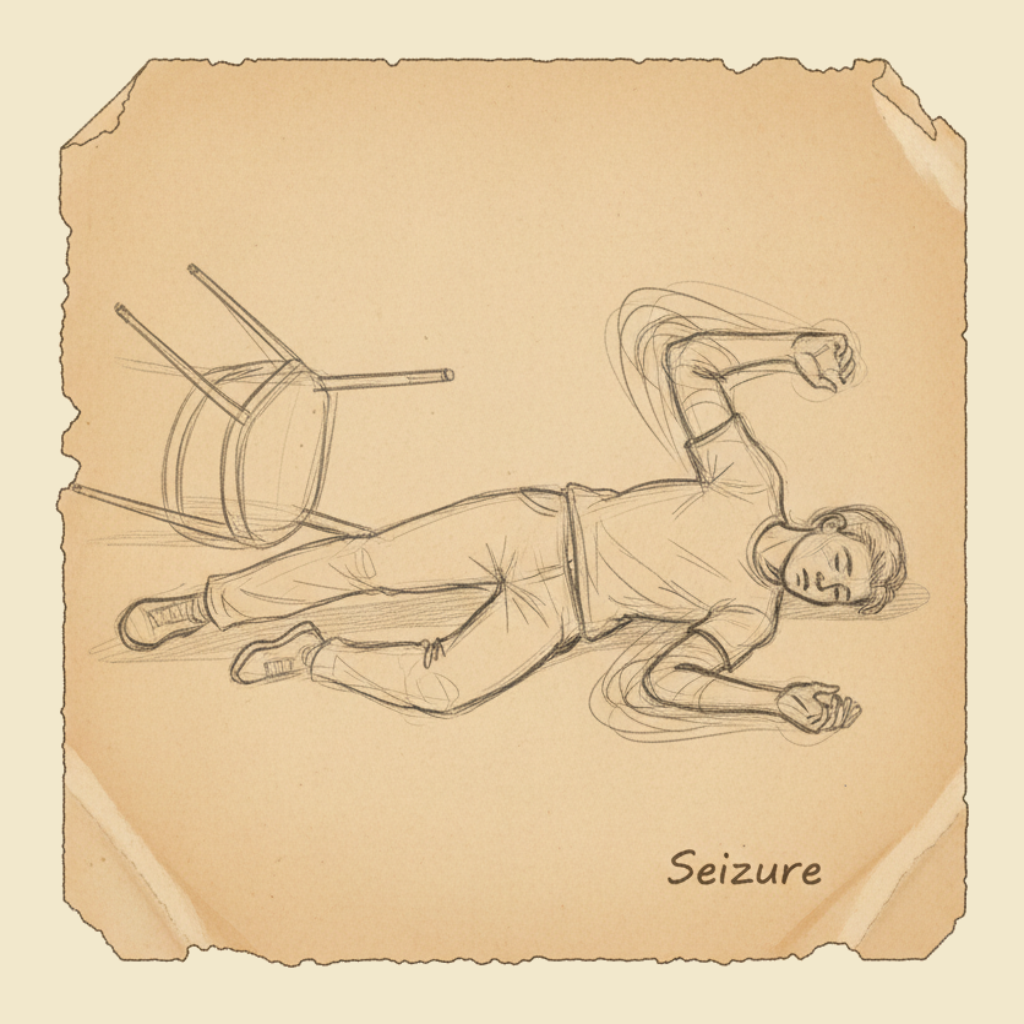
What's actually happening
A seizure is a burst of abnormal, disorganised electrical activity in the brain. The brain normally runs on tightly coordinated electrical signals; a seizure is what happens when those signals fire in chaos, and the visible result depends entirely on which part of the brain is misfiring. Some seizures are the dramatic picture most people imagine: the casualty collapses, the limbs stiffen and then jerk rhythmically, breathing becomes irregular, sometimes the lips turn briefly blue. Others are extraordinarily subtle: a brief blank stare, a few seconds of lip-smacking, a sudden jerk of one arm with no loss of awareness at all. G9-2-4
The causes are wide:
- Epilepsy — the long-term condition of being prone to recurring seizures. The most common reason a first aider will see one.
- Head injury — immediate or delayed.
- Stroke.
- Severe low blood sugar — see the diabetes chapter.
- Severe poisoning or drug/alcohol overdose or withdrawal.
- Heat stroke at very high core temperatures.
- A high fever in a young child — febrile convulsion, a separate but related condition.
§ Instructor's note
The two folk-rules learners come in believing — "hold them down so they don't hurt themselves" and "put something in their mouth so they don't swallow their tongue" — are both wrong, and both cause more injuries than the seizure itself. You cannot swallow your tongue. Restraining a seizing casualty fractures bones and dislocates shoulders. Drill the rule: protect, do not restrain; never put anything in the mouth.
Recognising it
A generalised tonic-clonic seizure (the "classic" full-body picture) follows a stereotyped sequence:
- Sudden collapse, sometimes preceded by a brief cry as air is forced out.
- Loss of consciousness.
- Tonic phase (10–30 seconds): the whole body stiffens. The casualty may stop breathing briefly and the lips may go blue.
- Clonic phase (30 seconds to 2 minutes): rhythmic jerking of the arms, legs, and sometimes the face. Breathing is irregular.
- Possible incontinence, drooling, biting of the tongue or cheek.
- Gradual easing of the jerking, and then the casualty goes limp and is deeply unresponsive.
- The postictal phase (5–30 minutes or longer): drowsiness, confusion, headache, slow recovery to full awareness. The casualty often does not remember the seizure at all.
Other seizure pictures include:
- Absence seizures — a brief blank stare lasting a few seconds, often in children, sometimes mistaken for daydreaming.
- Focal seizures — twitching of one limb or one side of the face, sometimes with altered awareness.
- Complex partial seizures — automatic repeated movements (lip-smacking, fumbling at clothes, walking in circles) with no awareness.
A seizure that lasts more than five minutes, or a second seizure that begins before the casualty has recovered from the first, is called status epilepticus. This is a true neurological emergency — the longer the brain seizes, the more damage is done. Call 000 immediately and time the event from when it started.
First-line response — protect, don't restrain
The first-aid sequence for a generalised tonic-clonic seizure is short, specific, and almost entirely passive. G9-2-4PC 1.3
During the seizure:
- Note the time the seizure started. This is the single most important piece of information for the ambulance.
- Move hard or sharp objects out of the way. Tables, chairs, fire-irons, glass. Make a clearance around the casualty.
- Cushion the head with something soft — a folded jumper, a coat, a cushion, your hand if there's nothing else. The repeated head-banging on a hard floor is one of the main causes of injury in a seizure.
- Loosen anything tight around the neck — a tie, a tight collar, a scarf.
- Do not restrain the casualty. Trying to hold their limbs still does not stop the seizure and can fracture bones.
- Do not put anything in their mouth. Not a wallet, not a wooden spoon, not your fingers. The casualty cannot swallow their tongue. They can bite yours off, and a hard object can break their teeth or block their airway.
- Do not move the casualty unless they are in immediate danger (a road, a fire, water).
- Stay with them and observe what is happening, so you can describe it to the ambulance.
After the seizure stops:
- Roll the casualty onto their side in the recovery position. They will be limp, deeply drowsy, and possibly drooling — the side position protects the airway.
- Check breathing. Most casualties resume normal breathing within seconds of the seizure stopping. If they do not, start CPR.
- Keep them warm and calm. They will be confused, embarrassed, and tired for 5–30 minutes (the postictal phase). This is normal.
- Stay with them until they are fully awake and oriented. Reassure them — they often have no memory of what happened.
- Once they are fully awake, check whether this was a known epilepsy event or something new, and act accordingly.
For a casualty having a seizure, the priorities are to protect the casualty from injury, time the seizure, and place them in the recovery position once the seizure has ended. Do not restrain the casualty, do not put anything in the mouth, and do not attempt to stop the seizure with physical intervention. Call an ambulance for any first-ever seizure, any seizure lasting more than 5 minutes, any second seizure without recovery, any seizure in water, or any injury sustained during the seizure.
When to call an ambulance
Call 000 immediately for any of:
- The casualty's first ever seizure (no known history of epilepsy).
- Any seizure lasting more than 5 minutes.
- Any second seizure that begins before the casualty has fully recovered from the first.
- Any seizure that occurs in water (the casualty has likely inhaled water).
- Any injury sustained during the seizure — head wound, suspected fracture, dislocated shoulder.
- Any seizure in a pregnant casualty.
- Any seizure in a diabetic casualty (may be a severe hypo — see the diabetes chapter).
- Any casualty who is slow to recover or who does not return to their normal level of awareness within 30 minutes.
- Any seizure where you are unsure.
For a known epileptic with a typical seizure that ends within a few minutes and from which they recover normally, an ambulance call is not always required — the casualty often has a personal management plan. Use your judgement.
What not to do
- Do not restrain the casualty.
- Do not put anything in their mouth — fingers, food, water, medication.
- Do not move them unless they are in immediate danger.
- Do not give them anything to eat or drink during or immediately after the seizure.
- Do not leave them alone during the postictal phase.
- Do not dismiss a "minor" seizure (an absence, a brief jerk) — these should still be reported to the casualty's GP or neurologist.
A febrile convulsion is a seizure triggered by a rapid rise in temperature in a young child (usually 6 months to 6 years), most often during the early hours of a viral infection. They are frightening to watch but almost always brief and harmless. The first-aid response is the same as for any seizure — protect from injury, time the event, recovery position afterwards — plus gentle cooling: remove excess clothing and use a tepid sponge if available. Take the child to a doctor afterwards to find the cause of the fever.
You will rehearse the protect-cushion-time sequence on a manikin, practise rolling a postictal casualty into the recovery position, and run a scenario where a "first-ever" seizure presents so you can drill the call-000 decision. The hardest part of seizure first aid is doing nothing during the convulsion itself — most learners feel a powerful urge to act, and the only fix is rehearsal.
A seizure is the body's brain doing something the first aider cannot stop and should not try to. Cushion the head, time the clock, roll them safe when it ends. That is the entire job.
— ANZCOR Guideline 9.2.4