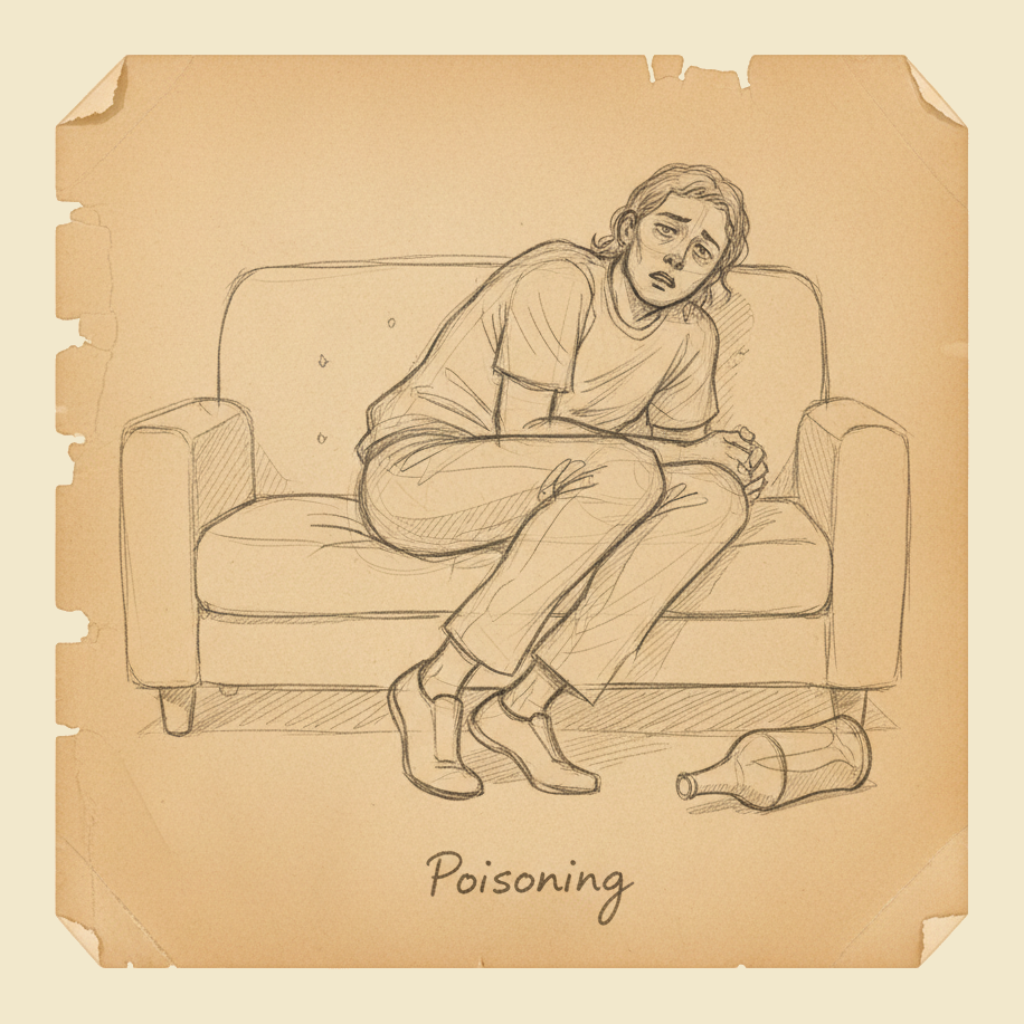
What's actually happening
Poisoning is harm caused by a substance taken into the body that interferes with how it works. The substance can be a household chemical, a medication taken incorrectly, an illicit drug, alcohol, a pesticide, an industrial gas, an unsafe plant or mushroom, or a contaminated food. First aiders sort poisonings by the route of entry because the action is different for each: G9-5-1
- Swallowed — the most common route, especially in toddlers exploring kitchen and laundry cupboards.
- Inhaled — smoke, carbon monoxide, vapours, confined-space gases, glue or aerosol fumes.
- Absorbed — chemicals splashed onto the skin and absorbed through it.
- Injected — drugs of abuse, some medications. (Bites and stings are covered separately under envenomation.)
The single most useful thing a first aider can do for almost any poisoning is call the Poisons Information Centre on 13 11 26 (in Australia). They are open 24 hours, they can identify the substance from the bottle or packet you describe, and they will tell you on the phone exactly what to do — including whether you need to call an ambulance as well.
§ Instructor's note
Drill the number. 13 11 26. It is the only first-aid phone number that isn't 000, and most learners walk in not knowing it exists. Poisons Information is staffed by pharmacists and toxicologists who have the entire MIMS database, the household chemical database, and the up-to-date poison protocols in front of them — they will give you better advice in 30 seconds than any first-aider course can teach in an hour. Teach learners to call Poisons first for anything that isn't obviously life-threatening, and 000 first for anything that is.
Recognising it
The story is usually obvious — somebody saw the casualty drink the bottle, swallow the pills, breathe the fumes. The harder cases are the ones with no clear story: a toddler found near an open cupboard, an adult found unresponsive with no explanation, a worker who collapses inside a tank. The signs to scan for, depending on the substance:
- An empty container, spilled tablets, an open bottle, a chewed berry, a syringe nearby.
- Burns or stains around the mouth — chemical ingestion.
- A chemical smell on the breath or on clothes.
- Nausea, vomiting, abdominal pain.
- Headache, dizziness, confusion, drowsiness.
- Difficulty breathing, coughing, wheezing — inhaled poison.
- A red flush (carbon monoxide) or blue lips (suffocation).
- Fitting, collapse, unresponsiveness.
- Dilated or pinpoint pupils, in known drug-overdose cases.
- Unusual behaviour or hallucinations.
Inhaled poisons take rescuers as readily as victims — carbon monoxide in a closed garage, hydrogen sulphide in a slurry pit, smoke in a house fire, vapours in a confined space. Do not enter a space that has poisoned somebody until you know it is safe. Open doors and windows from outside, call 000, and let trained rescuers with breathing apparatus go in. Every year Australian first aiders die trying to rescue casualties from gases they couldn't see.
First-line response
The action depends on the route of entry. The phone call to Poisons Information (13 11 26) or 000 is part of every sequence below — make it as soon as you can without leaving the casualty. G9-5-1PC 1.3
Swallowed poison
- Call 000 if the casualty is unresponsive, having difficulty breathing, fitting, or rapidly deteriorating.
- Call Poisons Information on 13 11 26 for everything else — they will tell you whether you also need an ambulance.
- Wipe any residue off the lips with a clean cloth.
- Do not make the casualty vomit. This is the single most important rule for swallowed poisons. Many substances do more damage on the way back up — corrosives burn the oesophagus a second time, hydrocarbons get inhaled into the lungs.
- Do not give anything to drink unless Poisons Information specifically tells you to.
- Keep the container, the label, the leftover substance, and any vomit to show the paramedics or describe to Poisons.
- For an unresponsive casualty, roll into the recovery position and start the usual DRSABCD response.
Inhaled poison
- Protect yourself first. Do not enter a confined space with a casualty inside.
- Move the casualty into fresh air if you can do so safely. Open doors and windows.
- Call 000.
- Loosen tight clothing around the neck and chest.
- Monitor breathing and be ready to start CPR.
- Do not assume the air is safe just because it doesn't smell — carbon monoxide and many industrial gases are odourless.
Absorbed poison (skin)
- Wear gloves if you have them — protect yourself from the same chemical.
- Remove contaminated clothing. Cut it off rather than pull it over the head if necessary.
- Irrigate the affected skin with copious running water for at least 20 minutes — longer for alkalis.
- Call Poisons Information for advice on the specific chemical.
- Call 000 for any large area, any altered mental state, or any substance you cannot identify.
Injected poison (drug overdose)
- Call 000.
- DRSABCD. Many overdose deaths are airway and breathing failures — opioids in particular suppress breathing.
- For suspected opioid overdose (pinpoint pupils, slow shallow breathing, blue lips, drowsiness or unresponsiveness in a known user), administer naloxone if it is available and you know how. Naloxone is now sold over the counter in Australia under the brand Nyxoid as a nasal spray.
- Recovery position if unresponsive but breathing.
- Be ready to start CPR.
For all poisonings, the Poisons Information Centre (13 11 26 in Australia) is the first point of advice for any case that is not immediately life-threatening. Do not induce vomiting after a swallowed poison — induced vomiting can cause more damage than the poison itself, particularly with corrosives and hydrocarbons. For unresponsive or rapidly deteriorating casualties, call 000 and provide standard DRSABCD support.
When to call an ambulance
Call 000 immediately for any of:
- Any unresponsive poisoned casualty.
- Any poisoned casualty who is fitting, having difficulty breathing, or rapidly deteriorating.
- Any inhaled poisoning, especially smoke, carbon monoxide, or industrial gas.
- Any drug overdose.
- Any chemical splash to a large area of skin or to the eye.
- Any swallowed corrosive (drain cleaner, oven cleaner, dishwasher tablets, button batteries, bleach).
- Any swallowed petroleum product (petrol, kerosene, lamp oil, eucalyptus oil).
- Any swallowed prescription medication overdose.
- Any child who has swallowed something unknown.
- Any time you are unsure.
For everything else, call Poisons Information on 13 11 26 first.
What not to do
- Do not make the casualty vomit. Ever. The folk advice to "give salt water" or "stick fingers down their throat" is dangerous.
- Do not give the casualty anything to eat or drink unless Poisons Information has specifically told you to.
- Do not give milk after a poison ingestion — it speeds absorption of some substances.
- Do not enter a confined space to rescue an inhalation casualty.
- Do not remove contaminated clothing without protecting your own skin.
- Do not delay irrigation of a chemical skin burn to "find the right rinse" — water now beats anything else later.
- Do not discard the container, vomit, or leftover substance — paramedics need to see them.
A swallowed button battery (the small flat lithium batteries used in remote controls, key fobs, hearing aids, novelty toys) is a true emergency, particularly in a child. The battery can burn through the wall of the oesophagus in as little as two hours. Call 000 immediately, give nothing to eat or drink, and get the child to hospital fast. Do not wait for symptoms.
You will rehearse the call-to-Poisons Information script — what they ask, what to have ready (the container, the casualty's age and weight, the time of ingestion, the symptoms) — and run an unresponsive-casualty scenario where the cause turns out to be poisoning so you can drill the recovery-position-plus-DRSABCD response.
Almost every poisoning has someone on the other end of a phone line who knows exactly what to do. Memorise the number — 13 11 26 — and use it before you do anything irreversible.
— ANZCOR Guideline 9.5.1