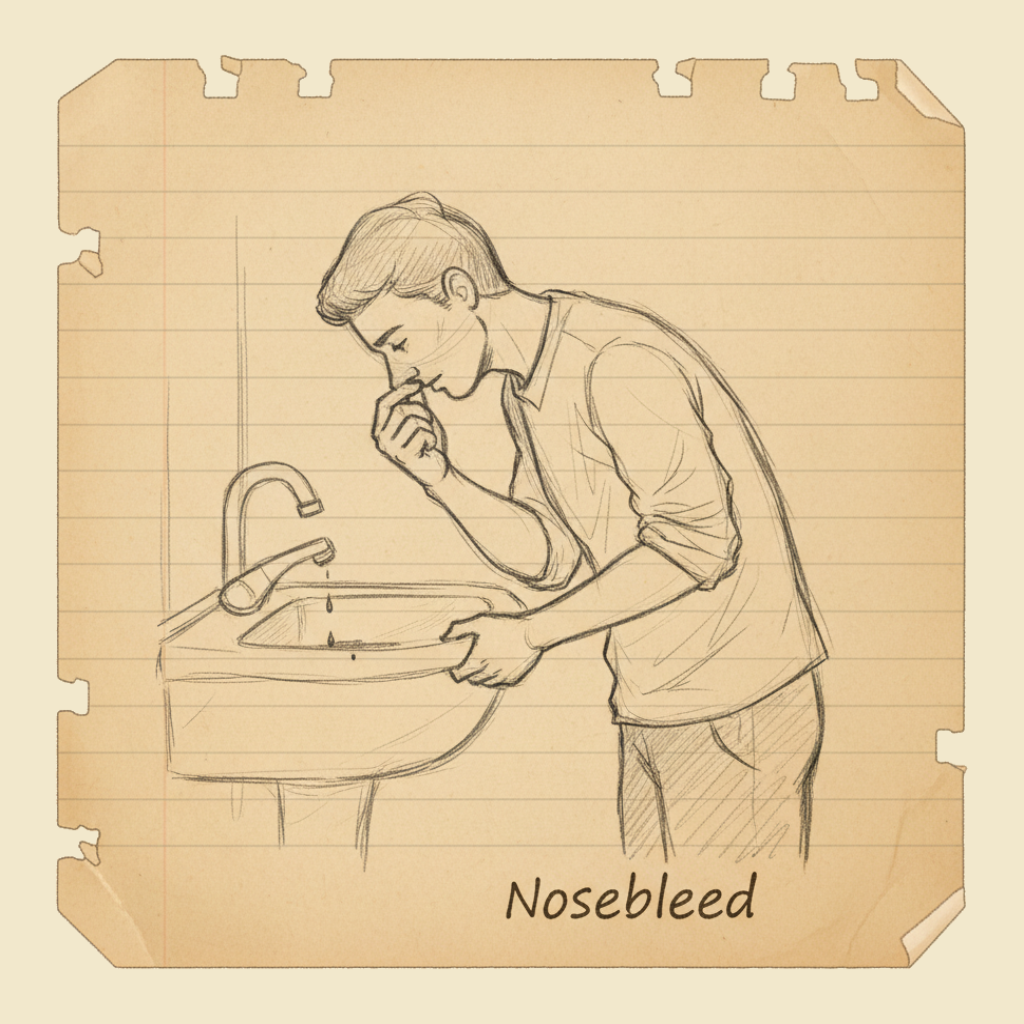
What's actually happening
A nosebleed is bleeding from inside the nose, almost always from a small cluster of fragile blood vessels just inside the front of the nasal septum (an area called Little's area or Kiesselbach's plexus). The lining there is thin, the vessels are close to the surface, and they bleed at the slightest provocation: a knock, a sneeze, vigorous blowing, picking, dry air, irritation, allergies, or sometimes nothing the casualty can name. Most nosebleeds look much more dramatic than they actually are — half a teaspoon of blood mixed into a tissue or running down a chin is alarming out of all proportion to the actual volume lost. G9-1-1
A small minority of nosebleeds come from further back in the nose ("posterior" nosebleeds), where the vessels are larger, the bleed is heavier, and the technique below won't reach the source. Posterior nosebleeds are an ambulance case from the start.
§ Instructor's note
The single thing most casualties get wrong is letting go to look. They pinch for two or three minutes, sneak a peek, see fresh blood, panic, and reset the clock. Drill the rule out loud: ten full minutes by a watch or a clock, no peeking, no exceptions. The clot needs the full ten minutes; lifting the pressure restarts the bleed and you've achieved nothing. Tell the casualty before they start that this will feel like a long ten minutes.
Recognising it
Nosebleeds recognise themselves. The harder skill is recognising the rare nosebleed that needs an ambulance rather than ten minutes of pressure:
- Heavy continuous bleeding that fills tissue after tissue.
- Bleeding from both nostrils that doesn't slow with pressure.
- A nosebleed that follows a significant head injury — the blood may be coming from a skull base fracture, not the nose lining.
- A casualty who is pale, sweaty, dizzy, or feels faint — they have lost more blood than you can see, or it has been going on longer than they admit.
- A casualty on anticoagulant medication (warfarin, apixaban, rivaroxaban, dabigatran, clopidogrel, aspirin) — they may not stop with pressure alone.
- A casualty with a known clotting disorder (haemophilia, von Willebrand disease).
- A nosebleed that has not stopped after 20 minutes of correct pressure.
- Recurrent severe nosebleeds — the casualty needs an ENT review, not another tissue.
First-line response — sit, lean, pinch, time
The standard first-aid sequence for an ordinary nosebleed is short and very effective if it is done correctly. G9-1-1PC 1.3
- Sit the casualty upright. Do not lay them down — gravity helps you, and lying flat lets blood run down the back of the throat.
- Lean them slightly forward. Not back — leaning back sends blood into the throat where the casualty will swallow it (which causes vomiting later) and where you cannot see how much there is.
- Pinch the soft fleshy part of the nose, between thumb and forefinger, just below the bony bridge. Not the bridge itself — bone doesn't compress and the bleeding vessels aren't there. The casualty can do this themselves; sometimes that is more comfortable.
- Hold continuous firm pressure for 10 minutes by the clock. Set a timer if you have one. Do not let go to check. Ten full minutes.
- Ask the casualty to breathe through their mouth and to spit out any blood that runs down the back of the throat rather than swallow it.
- A cold pack wrapped in cloth on the back of the neck or the bridge of the nose can help by constricting the local vessels.
- After ten minutes, release the pressure gently and assess. If the bleeding has stopped, congratulate the casualty and move on to the aftercare advice below. If it is still bleeding, repeat the ten minutes with renewed pressure.
- If after a second ten minutes (twenty in total) the bleeding hasn't stopped, call 000.
For nosebleeds, sustained direct pressure on the soft part of the nose with the casualty sitting upright and leaning slightly forward is the first-line treatment. Pressure should be maintained for at least 10 minutes without interruption. Refer for medical care if bleeding does not stop after 20 minutes of correct first aid, if the casualty is on anticoagulants, or if there are signs of significant blood loss.
Aftercare — don't undo your work
Once the bleeding has stopped, the soft clot in the nose is fragile for several hours and will dislodge if disturbed. Tell the casualty:
- Do not blow the nose for several hours — twelve hours if you can manage it.
- Do not pick at it, sniff hard, or touch the inside of the nose.
- Do not bend forwards or strain (lifting heavy things, straining on the toilet, vigorous exercise) for several hours.
- Do not drink hot drinks for the rest of the day — the heat dilates nasal vessels.
- Avoid alcohol for the rest of the day, same reason.
- Sleep with the head propped up on extra pillows that night.
- If the bleeding restarts, sit, lean forward, and repeat the ten-minute pinch.
When to call an ambulance
Call 000 immediately for any of:
- A nosebleed that does not stop after 20 minutes of correct pressure.
- A nosebleed that follows a significant head injury.
- Heavy continuous bleeding from both nostrils.
- A casualty who is pale, sweaty, dizzy or feels faint.
- A casualty on anticoagulant medication with a nosebleed that won't stop with pressure.
- A casualty with a known severe clotting disorder.
- Any blood coming from the ears as well as the nose after a head injury (suggests a base-of-skull fracture).
- Any time you are unsure.
For recurrent or troublesome nosebleeds in an otherwise well casualty, the GP or an ENT clinic — not the ambulance — is the right next step.
What not to do
- Do not tilt the head back. It sends blood down the throat and you lose track of how much is being lost.
- Do not stuff tissue, cotton wool, or anything else up the nostril. Removing it later restarts the bleed, and small fragments can be inhaled.
- Do not pinch the bony bridge. The bleeding vessels are below it.
- Do not release the pressure to "check on it" before the ten minutes are up.
- Do not apply ice directly to the nose skin — wrap it in cloth.
- Do not let the casualty blow their nose or drink hot drinks for several hours afterwards.
Children get nosebleeds for almost any reason — picking, dry air, a bump, a sneeze. The technique is the same as for adults but the ten minutes will feel like a year. A favourite distraction (a screen, a story, counting fingers) makes the pressure-time tolerable. Reassure them that it always looks worse than it is.
You will rehearse the pinch on yourself with a partner timing — long enough to feel how slowly ten minutes passes when you can't let go. The only way to internalise the "no peeking" rule is to experience how strong the urge to peek becomes around minute four.
The world's most useful nosebleed treatment is a watch and patience. Pinch the soft bit, lean forward, count to ten minutes, and almost every nosebleed stops itself.
— ANZCOR Guideline 9.1.1