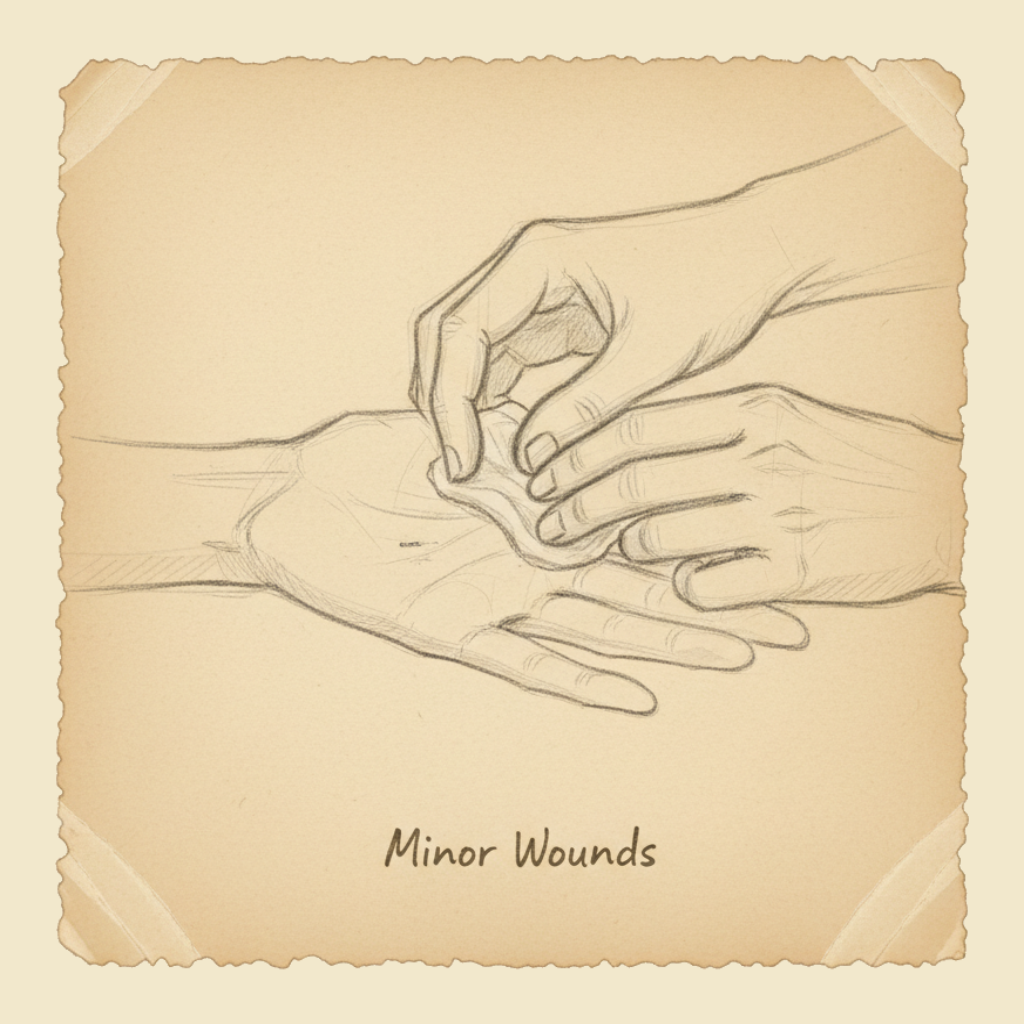
Why minor wounds get a chapter of their own
The bleeding chapter (bleeding) covers the life-threatening end of the wound spectrum — arterial haemorrhage, tourniquets, the catastrophic injury that needs immediate pressure and an ambulance. This chapter is about everything else: the everyday cuts, grazes, blisters, splinters and small punctures that make up the majority of a first aider's actual workload. The wounds are not dramatic, the bleeding is easy to stop, and there is no pressure on the situation — but the management still matters, because a wound that is cleaned and dressed properly heals quickly without complication, and a wound that is ignored, contaminated, or dressed badly turns into an infection, an abscess, a delayed-healing chronic wound, or worse. G9.1.1
The chapter is about the principles of wound care for minor wounds: stopping the small bleeding, cleaning the wound, dressing it appropriately, knowing when to seek medical advice, and recognising the warning signs of infection that develop over the days that follow.
§ Instructor's note
Learners often arrive expecting first aid to be about dramatic interventions, and minor wounds feel anticlimactic. The teaching point is that most first-aid encounters are minor wounds, and the cumulative impact of doing them well — fewer infections, faster healing, less time off work, less scarring — is substantial. The other teaching point is that "minor" is not the same as "trivial". A minor wound that is poorly managed becomes a non-minor wound. Drill the rule: stop the bleeding, clean it properly, dress it cleanly, and tell the casualty what to watch for.
What counts as a "minor" wound
For the purposes of this chapter, a minor wound is one that:
- Is not bleeding heavily — the bleeding can be stopped with brief direct pressure and does not soak through dressings.
- Is shallow — the wound does not penetrate to muscle, bone, or deep structures.
- Is small — usually less than a few centimetres long, and not gaping in a way that would need stitches to close.
- Is not over a critical structure — not on the face in a way that may scar, not over a joint where movement is impaired, not in a place where infection would be particularly serious.
- Is not heavily contaminated — not full of dirt, gravel, rust, animal saliva, or biological material that needs professional cleaning.
- Is in an otherwise healthy casualty — no diabetes, no immunosuppression, no clotting disorders, no recent surgery in the area.
If any of those conditions are not met, the wound is no longer "minor" in the sense that this chapter covers, and the casualty should be assessed by a medical professional. When in doubt, refer.
The most common minor wounds:
- Cuts (lacerations) from kitchen knives, scissors, paper, broken glass.
- Scrapes (abrasions) from falls — knees, elbows, palms.
- Blisters from friction (new shoes, manual labour, sport).
- Splinters — wood, glass, metal fragments.
- Small punctures — from a needle, a thorn, a nail (small puncture wounds are not always minor; see below).
- Bites that have broken the skin without major tissue damage.
- Burns that are first-degree or very small second-degree (covered in detail in the burns chapter).
The principles of minor wound care
The same five principles apply to almost every minor wound, in roughly this order:
- Stop the bleeding.
- Clean the wound.
- Inspect for foreign material.
- Dress the wound appropriately.
- Tell the casualty what to watch for and when to seek further care.
Most of the value of first-aid wound management is in steps 2 and 5 — cleaning thoroughly enough to prevent infection, and educating the casualty so that early signs of trouble are caught quickly. The other steps are mechanical and quick.
Step 1 — stop the bleeding
For a minor wound, brief direct pressure with a clean dressing or gauze pad for a few minutes will stop most bleeding. The casualty (if able) can hold the pressure themselves while the first aider prepares cleaning supplies. Elevation of the injured limb (if practical) reduces blood flow and speeds the stop. If bleeding is heavier than expected for what looks like a minor wound, treat it as more serious — see the bleeding chapter.
Once the bleeding has stopped, do not keep pulling the dressing off to "check" — that breaks the clot and starts the bleeding again. Trust that the pressure is working, leave the dressing in place for a few minutes, and check once.
Step 2 — clean the wound
Cleaning is the single most important step in preventing wound infection. The principles:
- Wash your hands first and put on disposable gloves if available. Handling a wound with unwashed hands introduces bacteria. See the infection control chapter.
- Irrigate the wound with running water — clean tap water is fine for most minor wounds and is at least as effective as saline. The aim is to flush out dirt, debris, and bacteria mechanically. Several minutes of irrigation under a gently running tap is the gold standard.
- The pressure of the irrigation matters — a gentle but persistent flow does the work. Don't blast the wound with high-pressure water (it can drive contamination deeper) and don't dab at it timidly (that doesn't clean).
- Avoid antiseptics in the wound itself — solutions like hydrogen peroxide, iodine in concentrated form, and alcohol can damage healing tissue and slow the recovery. Saline or clean water is gentler and just as effective for cleaning. Antiseptic wipes can be used on the skin around the wound to clean the surrounding area; the wound itself should be irrigated with water or saline.
- Don't scrub the wound — gentle cleaning around the edges is enough. Scrubbing damages tissue and increases pain without improving the cleaning.
- For an abrasion with embedded grit or gravel, more thorough cleaning is needed — sometimes the casualty will need professional help to remove embedded material that can otherwise tattoo the skin permanently as the wound heals over the dirt.
The casualty's pain during cleaning is real but worth tolerating. A wound that is properly cleaned has a much lower risk of infection than one that is not, and the brief discomfort during the clean is repaid in faster healing.
Step 3 — inspect for foreign material
After cleaning, look at the wound carefully. Is there anything still in it — a sliver of glass, a piece of grit, a thorn, a wood splinter? If you can see a foreign body and it is easily removable, take it out with clean tweezers. If it is deep, embedded, or difficult to remove, leave it alone and refer the casualty for medical care — a doctor can remove it under local anaesthetic with sterile instruments, and partial removal that breaks the foreign body is worse than no removal.
Splinters that are visible at the surface and easy to grab can be removed with tweezers in the direction they entered. Sterilise the tweezers first (alcohol wipe, or a flame if you have nothing else). If the splinter breaks off below the skin, refer to a doctor — digging for it with a needle is rarely successful and increases infection risk.
Glass is tricky because it can be invisible. Any wound that may contain glass should be inspected carefully and, if there is any doubt, the casualty should be referred for an X-ray (radio-opaque glass shows up well).
Step 4 — dress the wound
A clean minor wound benefits from a clean, dry, occlusive dressing that:
- Protects the wound from contamination during the first 24–48 hours when the protective scab is forming.
- Absorbs any small ooze of blood or serum.
- Keeps the wound at the right level of moisture — neither too dry (which slows healing and forms a hard scab) nor too wet (which macerates the tissue).
- Stays in place without slipping or being knocked off.
For most small cuts, an adhesive bandage (Band-Aid) is enough — a small absorbent pad with adhesive on either side. Choose one big enough that the absorbent part fully covers the wound and the adhesive part sits on intact skin.
For larger cuts or abrasions, a non-adherent dressing pad (e.g. Telfa) over the wound, secured with tape or a roller bandage, is the standard approach. The non-adherent surface prevents the dressing from sticking to the wound and tearing off the new tissue when removed.
For wounds that need to stay sealed (around joints, on awkward areas), adhesive island dressings or hydrocolloid dressings can keep the wound covered and protected for several days at a time.
Wounds should be redressed if the dressing becomes wet, dirty, or saturated with exudate. Otherwise, leaving the dressing in place for 24–48 hours before changing reduces the risk of disturbing the healing process.
Step 5 — tell the casualty what to watch for
The first aider's job is not finished when the dressing is on. The casualty needs to know:
- Keep the wound clean and dry. Avoid soaking it in baths, swimming pools, or natural water sources for the first few days.
- Change the dressing daily after the first 48 hours, or sooner if it becomes wet or dirty. Each change is an opportunity to inspect the wound.
- Watch for signs of infection (see below) and seek medical advice if any of them develop.
- Tetanus — when did they last have a tetanus booster? If it has been more than 10 years, or if the wound is dirty or punctate, they should see a doctor for an updated booster.
- Don't pick at the scab or peel the dressing off prematurely. Healing happens underneath; let it happen.
- Allow the wound to breathe once the initial healing is well underway (3–5 days for small wounds), but not before.
This patient education is the part of wound care that is most often skipped and most often makes the difference between a wound that heals well and one that doesn't.
Recognising wound infection
A wound becomes infected when bacteria multiply in the tissue faster than the immune system can suppress them. Infection usually develops over 24–72 hours after the injury and produces a recognisable picture:
- Increasing redness around the wound, often spreading outward over hours or days.
- Increasing warmth of the wound and surrounding skin.
- Increasing pain — particularly throbbing or pulsating pain that is worse than expected for the original injury.
- Swelling of the wound and surrounding tissues.
- Pus — yellow, green, or cloudy fluid coming from the wound. (A small amount of clear or pinkish "serous" fluid in the first 24 hours is normal; pus is not.)
- A bad smell from the wound.
- Red streaks spreading from the wound up the limb (this is lymphangitis — bacteria spreading along the lymphatic vessels — and is a serious sign).
- Fever, chills, or general unwellness — indicating systemic involvement.
- Swollen lymph nodes in the area draining the wound (e.g. axillary nodes for an arm wound, groin nodes for a leg wound).
The casualty (or the first aider doing follow-up) should know that any of these signs is a reason to seek medical advice promptly. Early infection treated with oral antibiotics usually resolves in days; late infection — particularly one with systemic involvement, lymphangitis, or red streaks — may need IV antibiotics, surgical drainage, or hospital admission.
If a casualty develops red streaks tracking from a wound up a limb, swollen and painful lymph nodes, fever, or general systemic illness in the days after a wound, this is a sign that the infection has spread beyond the local tissue and is becoming a serious problem. Lymphangitis and cellulitis can progress to sepsis within hours in a vulnerable casualty. The right action is urgent medical assessment — same-day GP, after-hours service, or emergency department depending on severity. Do not "wait and see" overnight.
Tetanus — the silent risk
Tetanus is a serious neurological infection caused by Clostridium tetani, a bacterium that lives in soil, dust, and animal faeces. The bacterium produces a toxin that causes the muscle spasms ("lockjaw") and respiratory failure that historically killed many wound casualties. Modern vaccination has made tetanus rare in Australia, but the risk is not zero, and the immunity from childhood vaccination wears off over time.
Wounds at higher risk of tetanus:
- Punctures and penetrating wounds — small entry wound, deep tract, low oxygen environment, ideal for C. tetani.
- Wounds contaminated with soil, dust, or faeces.
- Wounds caused by animal bites or stings.
- Wounds with extensive tissue damage or dead tissue.
- Burns.
- Wounds that have been left untreated for more than a few hours.
The current Australian recommendation is that anyone with a minor wound and a tetanus booster within the last 10 years probably does not need a further booster, but anyone with a higher-risk wound or a longer interval since their last booster should see a doctor for an updated dose. The first aider's role is to ask about tetanus status and to recommend medical follow-up for any uncertain or dirty wound. The doctor can decide whether the booster is needed.
Specific minor-wound situations
Blisters
Blisters form when friction causes the layers of skin to separate and fluid (serum) to accumulate in the gap. They are usually painful but not serious. Management:
- Intact blisters — leave them intact if possible. The blister roof acts as a sterile dressing for the underlying tissue, and the fluid will be reabsorbed over a few days. Cover with a soft padded dressing to reduce further friction.
- Large or painful blisters that interfere with function — can be drained with a sterilised needle at the edge, leaving the roof intact, then covered with a dressing.
- Burst blisters — clean gently, leave any remaining roof in place, dress with a non-adherent pad. Watch for infection.
- Blood blisters — same approach as serum-filled blisters; do not deliberately puncture them.
Hydrocolloid dressings are particularly good for blisters because they cushion the area, absorb fluid, and stay in place for several days.
Splinters
Most splinters can be removed with sterilised tweezers, pulled out in the direction they entered. Wash and dress the wound afterwards. Splinters that are deep, broken below the skin, or in sensitive areas (face, eyes, hands of a manual worker) should be referred to a doctor.
Small puncture wounds
Puncture wounds — from a nail, a needle, a thorn, a small bite — look trivial on the outside but can carry contamination deep into the tissue and provide an ideal environment for anaerobic bacteria. The first-aid management:
- Encourage gentle bleeding if the wound has stopped — letting a small amount of blood out flushes contamination from the wound tract.
- Wash the surface thoroughly with soap and running water.
- Do not probe deep into the wound — you cannot effectively clean the depths without surgical exposure.
- Dress and cover.
- Refer to a doctor for any puncture wound from a contaminated source, any wound where tetanus status is uncertain, any wound from a needle of unknown origin (because of the risk of bloodborne disease — see the sharps injuries chapter), or any wound that begins to show signs of infection.
Puncture wounds have a higher infection rate than open cuts because the wound is sealed at the surface, trapping bacteria in the depths.
Animal bites
Animal bites (dog, cat, human) almost always need medical assessment because:
- The bacterial load is high — animal mouths contain a wide variety of bacteria, and the closure of the puncture wound traps them.
- Cat bites in particular carry Pasteurella multocida, which causes rapidly progressing infection, and almost always need antibiotic treatment.
- Human bites are also high-risk for the same reasons and may transmit bloodborne disease.
- Tetanus and rabies considerations may apply (rabies is not present in Australia, but some travellers may have been exposed).
The first-aid management of an animal bite is to clean the wound thoroughly with running water, dress it, and refer to a doctor as soon as possible. Most bites need antibiotic prophylaxis, and many need a tetanus booster.
Lacerations needing closure
Some cuts are minor in the sense that they are not life-threatening, but are still beyond the scope of first aid because they need professional closure — stitches, staples, glue, or wound-closure strips. The features that suggest a wound needs closure:
- Length — more than about 1 cm in most areas, more than about 0.5 cm on the face.
- Depth — visible fat or muscle.
- Gaping — the edges do not approximate when relaxed.
- Location — over a joint, on the face, on the palm or sole, on the genitals.
- Cause — caused by a bite, a dirty object, or a high-pressure injury.
The first aid is the same — control bleeding, clean, dress — but the casualty should be referred to a doctor or emergency department, ideally within 6–8 hours of the injury because closure of older wounds is less effective and carries higher infection risk.
Wound closure strips (Steri-Strips, butterfly closures) are useful for holding small wounds together while a casualty is transported to medical care, and for very small wounds in low-tension areas where stitches would be overkill. They are not a substitute for sutures or staples in larger wounds — they do not hold under tension, they fail when wet, and they cannot close gaping or deep wounds properly. If you are uncertain whether a wound needs sutures, treat it as if it does and refer.
Minor wounds that are not actively bleeding heavily should be cleaned with clean running water and covered with a dry, non-adherent dressing. Antiseptic solutions are not generally recommended for the wound itself, although the surrounding skin may be cleaned. Foreign bodies that are not deeply embedded may be removed by the first aider; deeply embedded foreign bodies should be left in place and the casualty referred for medical assessment. The casualty should be advised to monitor the wound for signs of infection — increasing pain, redness, swelling, warmth, or systemic illness — and to seek medical attention if any develop. Tetanus immunisation status should be reviewed and a booster sought if indicated.
What not to do
- Do not use hydrogen peroxide, alcohol, or strong antiseptics in the wound itself — they damage tissue.
- Do not scrub the wound aggressively. Gentle irrigation with running water is the right technique.
- Do not dig for embedded foreign bodies. Refer for professional removal.
- Do not dress a wound that is still actively bleeding heavily without first achieving haemostasis with direct pressure.
- Do not leave an obvious foreign body in a wound that you can easily remove. Use clean tweezers.
- Do not ignore a minor wound just because it is minor. Clean it, dress it, and follow up.
- Do not forget to ask about tetanus status, particularly for dirty or punctate wounds.
- Do not dismiss the early signs of infection as "it's just healing". Increasing redness, pain, or swelling after 24 hours is a warning, not normal recovery.
You will rehearse minor wound management on a partner using simulated wound props — cleaning, foreign-body removal with tweezers, dressing application with a variety of dressing types (adhesive bandages, non-adherent pads with tape, roller bandages, hydrocolloid dressings). You will also practise the patient education conversation — explaining what to watch for, when to seek follow-up, and when a tetanus booster is needed. The technique of dressing application is harder than it looks, particularly on awkward parts of the body, and benefits from physical practice.
Most wounds are minor, and minor wounds heal well if they are cleaned properly and dressed cleanly. The first aider's job is to do the small things — wash with running water, remove the easy foreign bodies, dress with a clean pad, tell the casualty what to watch for — and to recognise when a wound is no longer minor and needs a doctor. The cumulative effect of doing the small things well, across the hundreds of minor wounds a first aider deals with over a career, is fewer infections, faster healing, and less suffering.
— ANZCOR Guideline 9.1.1 (control of bleeding)