What's actually happening
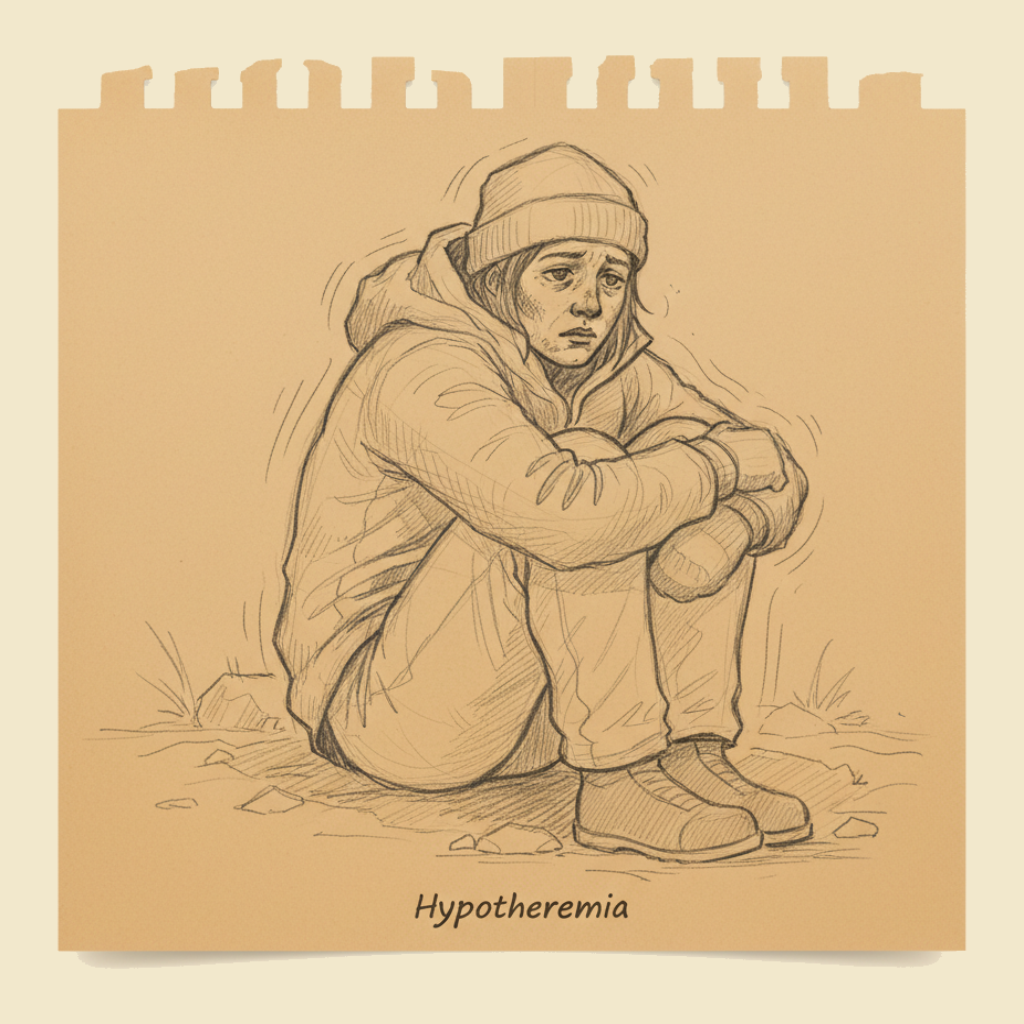
Hypothermia is the opposite of heat stroke: the body is losing heat faster than it can produce it, and the core temperature is falling out of its safe range (normally 36–37.5°C). It does not require Antarctic conditions. Most Australian hypothermia happens in spring and autumn at moderate temperatures (5–15°C) when someone is wet, tired, underdressed, in the wind, or all four — bushwalkers caught out by weather, swimmers pulled from the surf, elderly people in unheated homes, and the casualty of any other emergency lying still on cold ground for an hour. G9-3-3
Heat leaves the body four ways: conduction (touching cold things — wet clothes, cold ground), convection (wind blowing heat off the skin), radiation (an uncovered head and neck radiates heat all the time), and evaporation (sweat or wet clothes drying off the skin). The body fights back by shivering — generating heat from muscle work — and by shunting blood away from the skin to protect the core. When the fuel for shivering runs out, or the heat loss is too fast to keep up with, the core temperature starts to fall, and once it falls below about 35°C the brain itself starts to slow down.
§ Instructor's note
Two counter-intuitive points to drill. First, "wet" matters more than "cold" — a damp casualty in 12°C wind will become hypothermic faster than a dry one in 0°C still air. Second, the colder the casualty, the more fragile they are. A moderately hypothermic casualty whose heart is irritable from the cold can go into ventricular fibrillation from a rough movement that wouldn't bother a healthy person. The instinct is to bundle them into a car as fast as possible; the right move is slow, careful, gentle handling.
Recognising it
The picture changes as the core temperature falls.
Mild hypothermia (core 32–35°C):
- Shivering — the body's main heat-generating tool, usually obvious.
- Cold, pale skin, especially on the hands, feet, ears, lips.
- Slight confusion, irritability, slurred speech.
- Fumbling fingers, difficulty with simple tasks like zipping a jacket.
- The casualty is still able to help themselves — walking, talking, complaining.
Moderate to severe hypothermia (core below 32°C):
- Shivering stops — the body has run out of fuel. This is not improvement.
- Drowsiness, apathy, "I just want to sit down for a minute".
- Uncoordinated movements, stumbling, falls.
- Slow, weak pulse and slow shallow breathing.
- Confusion progressing to unconsciousness.
- Paradoxical undressing in some severe cases — the casualty begins removing their clothes, a sign of brain dysfunction not recovery.
- Cardiac arrest at very low temperatures.
Learners often misread "the shivering has stopped" as "the casualty is warming up". The opposite is true. Shivering is the body's defence; when it stops, the body has either run out of fuel or the core is too cold for the muscles to work. A casualty whose shivering has stopped and who is now drowsy is in severe hypothermia and is now at risk of cardiac arrest.
First-line response — shelter, dry, insulate
The first-aid sequence is built around stopping further heat loss and rewarming gently. The "gently" matters. G9-3-3PC 1.3
- Move the casualty out of the wind and rain if you can do so safely. A car, a tent, a building, a sheltered hollow.
- Get them off the cold ground. Anything insulating between the casualty and the ground — backpacks, a foam mat, a folded coat, branches — significantly reduces conductive heat loss.
- Replace wet clothing with dry, or if you have nothing dry, wring out the wet clothes and put them back on under a wind layer. Anything is better than wet against the skin.
- Wrap the casualty including the head and neck in blankets, a sleeping bag, or a thermal blanket. Cover everything but the face. The head loses a disproportionate share of body heat.
- Add insulation, not direct heat. A blanket cocoon traps the casualty's own heat and lets them rewarm gradually. Direct heat applied to cold limbs sends cold acidic blood back to the heart and can trigger arrest ("rewarming shock").
- If they are alert and can swallow safely, give warm sweet drinks — not alcohol, not caffeine. The sugar fuels shivering and the warm liquid is comforting. Soup is ideal.
- Handle them very gently — especially moderate or severe cases. No bumping, no rough lifting, no horseplay.
- Call 000 for any moderate or severe hypothermia, any casualty who is not improving, or any case where you are unsure.
For hypothermia, the priority is to prevent further heat loss and rewarm passively by insulating the casualty. Active rewarming with hot baths, hot water bottles directly on the skin, or vigorous rubbing is not recommended in the field — they can cause "afterdrop" (cold blood from the limbs returning to the core) and rewarming shock. Handle moderate-to-severe hypothermic casualties extremely gently to avoid triggering ventricular fibrillation.
Cardiac arrest in hypothermia — "not dead until warm and dead"
A casualty who is severely hypothermic may have a pulse so slow and weak you cannot find it. Their breathing may be barely detectable. Their pupils may be dilated. They may look dead and not be.
ANZCOR's guidance is unambiguous: a hypothermic casualty is not pronounced dead until they have been rewarmed and are still dead. If you cannot detect normal breathing after a careful 30–45 second check:
- Start CPR. Same 30:2 rhythm as standard CPR.
- Continue until the casualty recovers, the ambulance takes over, or you are physically unable to continue.
- Apply an AED if available — but expect that defibrillation may not work until the casualty has been rewarmed in hospital. Continue CPR regardless.
- Do not give up early. Cold-water and avalanche survivors have been resuscitated after more than an hour of arrest and recovered fully.
When to call an ambulance
Call 000 immediately for any of:
- Any moderate or severe hypothermia (drowsy, confused, no longer shivering, slow pulse).
- Any hypothermic casualty who is unresponsive or in cardiac arrest.
- Any hypothermic casualty who is not improving with passive rewarming.
- Any hypothermic casualty who is also injured.
- Any hypothermic child or elderly person.
- Any time you are unsure.
What not to do
- Do not rub the skin to "warm them up". It causes pain and shifts cold blood back to the core.
- Do not put a moderately or severely hypothermic casualty in a hot bath. The afterdrop can cause arrest.
- Do not apply hot water bottles or chemical heat packs directly to cold skin. If you must use them, place them on the trunk (armpits, chest, groin), wrapped in cloth, never on the limbs.
- Do not give alcohol — it dilates surface blood vessels and dumps the body's reserve heat to the skin.
- Do not give caffeine — it acts as a diuretic and worsens dehydration.
- Do not allow a recovering casualty to "walk it off". Rest, food, warmth.
- Do not assume a cold and pulseless casualty is dead. Start CPR and continue all the way to hospital.
Casualties pulled from cold water are usually both drowning and hypothermia cases. Treat the drowning first (5 initial breaths, then standard CPR — see the drowning chapter) and the hypothermia second. Do not stop CPR because the casualty is "too cold to save" — the cold may be the very thing protecting their brain.
You will rehearse the insulation cocoon (blanket, foam mat, sleeping bag, head covering) on a partner, practise the gentle-handling lift, and run a scenario where a hypothermic casualty deteriorates so you can drill the watch-and-act habit. The blanket-wrap is harder than it looks because nobody ever practises wrapping a stationary person fully — it takes deliberate effort.
The slogan for hypothermia first aid is short: handle gently, rewarm slowly, and don't give up. The cold heart is fragile and the cold brain is patient — your job is to give both of them time.
— ANZCOR Guideline 9.3.3