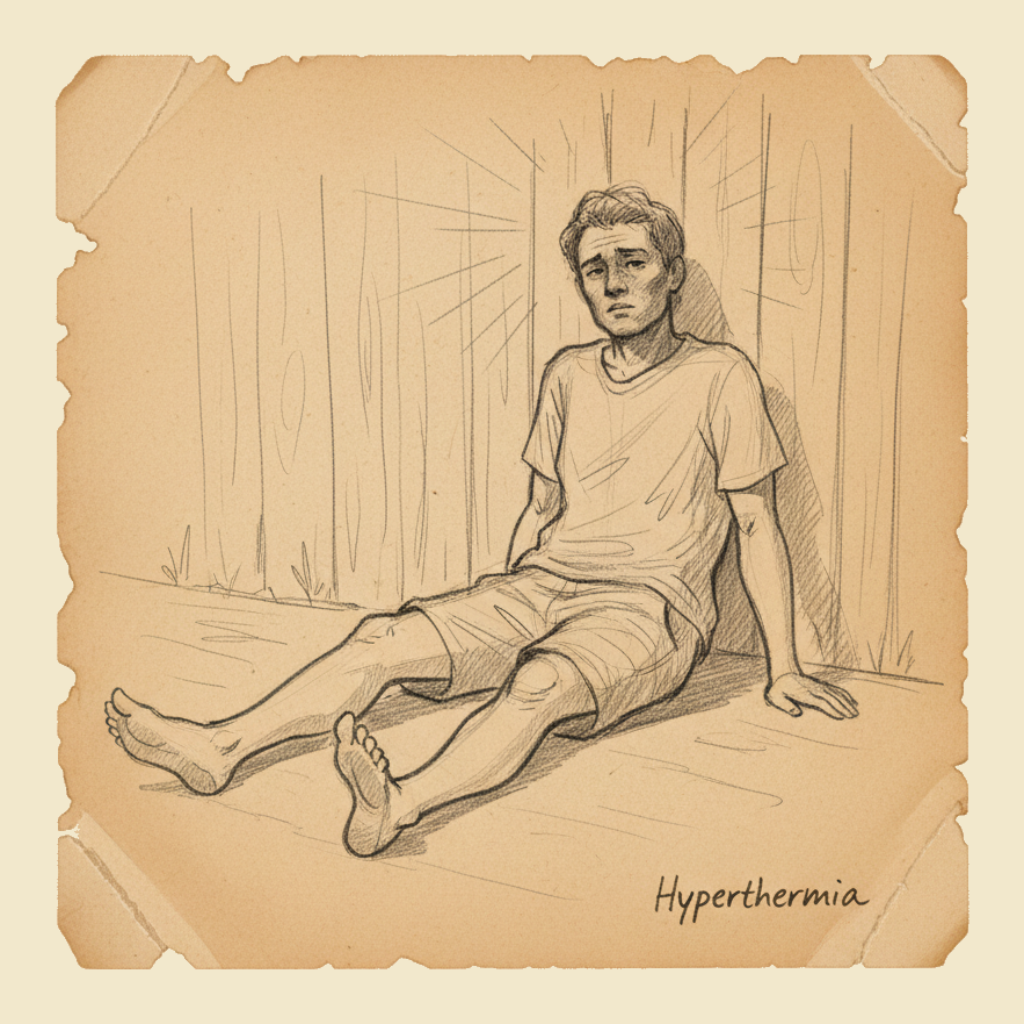
What's actually happening
Hyperthermia is the umbrella word for any state in which the body's core temperature has climbed above its safe range (normally 36–37.5°C). It is not the same as a fever — a fever is the body deliberately resetting its own thermostat upwards in response to infection; hyperthermia is the body losing the fight to stay cool. In an Australian summer it happens to bushwalkers, marathon runners, outdoor workers in PPE, frail older adults in unairconditioned units, and — every year, tragically — children left in cars. G9-3-4
The body's main defence against heat is sweating: sweat evaporates off the skin and carries heat away with it. The defence fails in two ways:
- Humidity — when the air is already saturated, sweat can't evaporate and the cooling effect collapses. This is why a 32°C humid Brisbane afternoon is more dangerous than a 38°C dry Adelaide one.
- Dehydration — when the body has run out of water, it can't make sweat in the first place.
Once sweating fails, the core temperature climbs fast, and once the core passes about 40°C the brain starts to cook. This is heat stroke, and it has minutes to be reversed.
§ Instructor's note
The single most important teaching point for hyperthermia is that cooling beats transport. The instinct is "they look really sick, get them to hospital fast" — but the casualty's odds depend almost entirely on how cold they are by the time they reach the emergency department, not how quickly. Drill: cool first, cool while you wait, cool in the ambulance, cool all the way to hospital. Time-to-cool is the variable that matters.
Recognising it
There are two pictures and the difference between them is one decisive sign: mental state.
Heat exhaustion (early — sick but lucid):
- Heavy sweating, soaked clothes.
- Pale, cool, clammy skin even though the casualty feels hot.
- Fast, weak pulse.
- Headache, dizziness, nausea.
- Muscle cramps, especially in the legs and abdomen.
- Weakness, fatigue, "I have to sit down".
- The casualty is still mentally clear — orientated, talking sensibly, embarrassed about needing help.
Heat stroke (the emergency — any altered mental state):
- Core temperature above 40°C — too hot to touch the skin comfortably.
- Hot, flushed skin. Often dry because sweating has stopped, but sometimes still wet from earlier — don't rely on this sign alone.
- Fast bounding pulse, rapid breathing.
- Confusion, staggering, irrational behaviour, slurred speech. This is the decisive sign.
- Headache, nausea, vomiting.
- Seizures.
- Collapse and unconsciousness.
Any change in mental state in a hot, flushed casualty is heat stroke until proven otherwise. A bushwalker who starts saying odd things, a worker on a roof who seems "off", a runner who can't focus — treat as heat stroke and start cooling now. Do not wait for the casualty to collapse before believing it.
First-line response — cool fast
The first-aid sequence is the same shape for both heat exhaustion and heat stroke; it just escalates harder for the more serious one. G9-3-4PC 1.3
- Stop the activity. Get the casualty to sit or lie down.
- Move them to a cool, shaded place — under a tree, into a building, into an air-conditioned car. Out of the sun.
- Remove excess clothing. Down to singlet and shorts if possible.
- Start cooling. Several methods, in rough order of effectiveness:
- Cold-water immersion — if you have a pool, a creek, a bath, or a horse trough, immerse the casualty up to the neck in cool (not iced) water. This is the gold standard for severe heat stroke and is dramatically faster than anything else.
- Wetting and fanning — soak the casualty all over with cool water and fan them vigorously. The evaporation does the work. A spray bottle and a piece of cardboard work; a hose and a fan work better.
- Cold packs wrapped in cloth to the neck, armpits, and groin — the big blood vessels run close to the skin in these places.
- Cool wet towels changed frequently — second-rate compared with the above but better than nothing.
- If the casualty is alert and can swallow, give cool water in small frequent sips. Not iced. Not a giant glass at once (vomiting). For heat exhaustion in an athlete, an electrolyte drink is ideal.
- For suspected heat stroke, call 000 immediately and keep cooling continuously until the ambulance arrives. Do not stop cooling because you have called.
- Monitor for seizures and unresponsiveness — if either occurs, manage the airway, put them in the recovery position, and continue cooling.
For heat stroke, immediate aggressive cooling is the most important first-aid action, and time-to-cool is the strongest predictor of survival and neurological outcome. Cold-water immersion is the most effective field method where available; spraying with water and fanning is the recommended alternative. Do not delay cooling to arrange transport — cool the casualty where they are, and continue cooling all the way to definitive care.
When to call an ambulance
Call 000 immediately for any of:
- Any suspected heat stroke (any change in mental state in a hot, flushed casualty).
- Any heat exhaustion casualty who does not improve within 30 minutes of cooling and rest.
- Any heat exhaustion casualty who is vomiting and cannot keep fluids down.
- Any hyperthermic casualty who has had a seizure.
- Any hyperthermic child or elderly person who is more than mildly unwell.
- Any hyperthermic casualty whose breathing or circulation deteriorates.
- Any time you are unsure.
What not to do
- Do not delay cooling to arrange transport. Cool first.
- Do not use ice-cold water on a conscious adult — it causes shivering (which generates more heat) and skin vasoconstriction (which slows the cooling). Cool, not iced.
- Do not rely on a temperature reading from an ear or forehead thermometer — they are unreliable in heat stroke. Trust the picture, not the number.
- Do not give the casualty alcohol, caffeine, or sugary drinks at full concentration.
- Do not force fluids on an unresponsive casualty.
- Do not let a recovering casualty go back into the heat the same day. Heat exhaustion makes you more vulnerable to a worse episode for the next 24–48 hours.
The temperature inside a parked car on a 30°C day can climb above 60°C within fifteen minutes, and a child's smaller body and less efficient heat regulation means they can develop heat stroke in minutes. Never leave a child or an animal in a parked car, even with the windows cracked, even briefly. If you find a child in a hot car, get them out immediately, call 000, and start cooling.
You will rehearse the wet-and-fan technique on a partner with a spray bottle, identify the cold-pack placement points (neck, armpits, groin), and run a scenario where heat exhaustion progresses to heat stroke so you can practise recognising the mental-state shift. The decisive judgement is "is this person still themselves?" — drilling that question under fatigue is the whole game.
Heat stroke is one of the few emergencies where a first aider with a hose and a fan can save a life that would otherwise be lost. Cool fast, cool first, cool all the way to hospital — minutes matter, and the casualty's brain is on the clock.
— ANZCOR Guideline 9.3.4