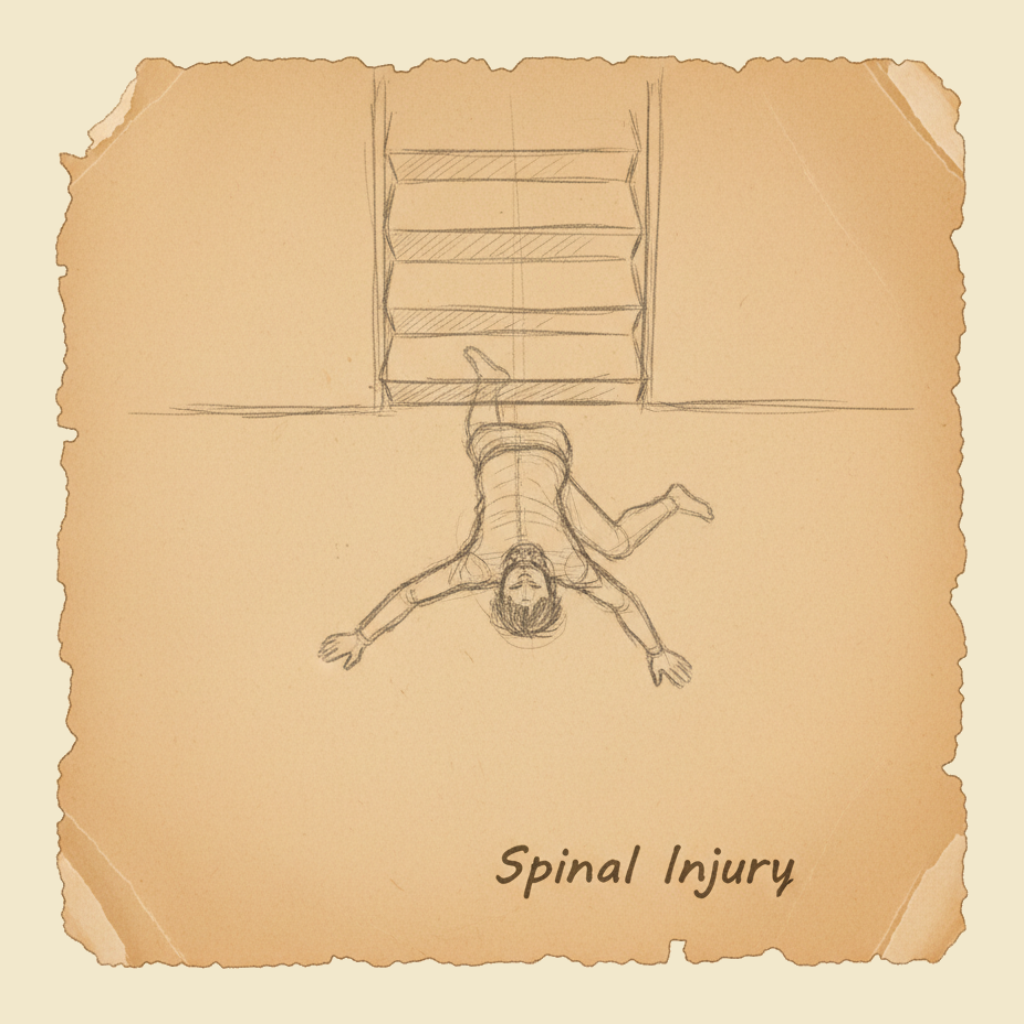
What's actually happening
A spinal injury is damage to any part of the spine — the bones (vertebrae), the ligaments holding them together, the discs between them, or the spinal cord running through them. A head injury is damage to the skull or the brain inside it. The two are tightly connected because the same forces that hit a head usually involve the neck, and because a damaged brain can stop protecting the rest of the body.
What makes spinal injury different from any other fracture is the cord. The spinal cord carries every nerve signal between the brain and the body, and once it is severed or crushed that damage is permanent — the level of the injury determines what the casualty will be able to do for the rest of their life. A first aider who moves a partially-injured spine the wrong way can turn a sprain into paraplegia. The whole chapter is built around that fact. G9-1-6
For head injuries, the danger is bleeding inside the skull. The brain sits in a fixed-volume box, and any bleed inside that box raises the pressure on the brain itself. The casualty may seem fine for fifteen minutes, an hour, or several hours after the injury and then deteriorate fast — this is the picture every parent of a child who has hit their head needs to know about.
§ Instructor's note
The two emotional traps for first aiders here are opposite ones. With a suspected spine, the trap is "but I should do something" — and they roll the casualty, lift the head, straighten the neck, and cause damage. With a head injury that looks minor, the trap is "they're walking and talking, they're fine" — and they send them home without warning anyone to watch for the delayed deterioration. Drill: spines are protected by not moving; heads are protected by watching for hours.
Recognising it — when to suspect a spinal injury
Suspect a spinal injury after any high-energy mechanism, even if the casualty seems fine:
- A fall from height (anything more than standing height for an adult, or above the casualty's own head for a child).
- A motor vehicle accident, motorbike or pushbike crash.
- A rugby tackle, scrum collapse, or any contact sport with neck loading.
- A dive into shallow water.
- Any significant blow to the head.
- Any blow to the back or neck.
- An elderly person who has fallen, even from standing height — osteoporotic spines fracture easily.
- Any unconscious casualty whose injury history you don't know.
The signs of a spinal injury in a conscious casualty:
- Pain or tenderness in the neck or back at the injury site.
- Weakness, numbness, or pins and needles in the arms, legs, hands or feet.
- An inability to move a limb.
- A burning or electric-shock feeling in the limbs.
- In serious cases, loss of bladder or bowel control.
Recognising it — head injury
The signs of a significant head injury, in roughly the order they appear:
- Loss of consciousness at the time — even briefly. "Knocked out for a couple of seconds" is a head-injury case.
- Confusion, repetitive questioning, or inability to remember the event.
- Headache that gets worse rather than better.
- Nausea or vomiting, especially repeated vomiting.
- Drowsiness, difficulty being roused.
- Unequal pupils.
- Clear fluid or blood from the nose or ears — a sign of a base-of-skull fracture.
- Seizure.
- Slurred speech, weakness on one side, double vision — signs the brain itself is affected.
- Bruising behind the ears ("Battle's sign") or around the eyes ("raccoon eyes") — late and serious.
Some serious head injuries (particularly extradural haemorrhage) follow a classic pattern: the casualty is knocked out briefly, wakes up, walks around for an hour or two looking fine, and then deteriorates rapidly. This is called the lucid interval and it has killed many casualties whose families thought they had got away with it. Any casualty who has been knocked out — even briefly — needs medical assessment, and someone needs to watch them for at least 24 hours.
First-line response — spinal injury
The first-aid sequence for any suspected spinal injury is built around not moving the casualty. G9-1-6PC 1.3
- Tell the casualty not to move. "Stay still — help is on the way." Reassure them.
- Call 000.
- Leave them in the position you found them. If they are face-down and breathing, they stay face-down. Do not turn them onto their back to "make them more comfortable".
- Support the head and neck in the position they are in, gently, with your hands on either side. Do not pull on the head, do not try to straighten the neck, do not turn it. This is "manual in-line stabilisation" and your only goal is to stop the head from rolling further.
- Keep them warm. Cover with a coat or blanket without disturbing them.
- Watch their breathing continuously. Be ready to act if it stops.
- Wait for the ambulance.
If you have to move them — because they are not breathing, because the scene is unsafe (fire, traffic, water), or to roll an unresponsive casualty into the recovery position — keep the head, neck and back in alignment as a single unit. Roll them like a log, with one rescuer controlling the head if there are two of you. Both rescuers move together on a count.
For a casualty with a suspected spinal injury, the priority is to keep the head, neck and spine in neutral alignment without applying traction. Manual in-line stabilisation by an attending first aider is preferred to improvised cervical collars, which have been shown to cause more harm than good in untrained hands. Airway management always takes priority over spinal precaution — an unresponsive casualty whose airway is compromised must be rolled into the recovery position even at the risk of moving the spine.
First-line response — head injury
For a casualty with a head injury who is conscious and breathing:
- Sit or lie them down somewhere quiet.
- Apply a cold pack wrapped in cloth to any visible bump (not directly on the skin).
- Control any scalp bleeding with direct pressure (scalp wounds bleed a lot — see the bleeding chapter).
- Watch them. Note their level of awareness, ability to remember the event, and whether things are getting better or worse.
- Do not give pain relief beyond paracetamol — aspirin and ibuprofen affect clotting and can worsen any internal bleed.
- Arrange medical assessment for any of the warning signs above, or for any loss of consciousness at all.
For a casualty with a head injury who is unresponsive but breathing, treat as a spinal injury as well: support the head and neck, leave them in the recovery position if they are already in it (or roll them into it as a log if not), and call 000.
When to call an ambulance
Call 000 immediately for any of:
- Any suspected spinal injury.
- Any head injury with loss of consciousness, even briefly.
- Any head injury with confusion, vomiting, drowsiness, seizure, or unequal pupils.
- Any clear fluid or blood from the nose or ears after a head injury.
- Any worsening headache after a head injury.
- Any high-energy mechanism, even if the casualty looks fine.
- Any time you are unsure.
What not to do
- Do not move a casualty with a suspected spinal injury unless their life is in immediate danger.
- Do not try to straighten or realign the neck or back. Support in the position found.
- Do not put a hard collar on a casualty unless you are trained to fit one — improvised collars cause more harm than they prevent.
- Do not lift the casualty into a sitting position to "see how they are".
- Do not give a head-injured casualty alcohol, sedatives, or sleep medication — and do not let them go home alone.
- Do not assume a child who has hit their head and is now playing happily is fine. Watch them for the next 24 hours.
Children's heads are larger relative to their bodies than adults', and the brain is still developing — they are at higher risk of significant injury from what looks like a "minor" knock. The threshold for medical assessment of a child's head injury is lower than for an adult. Repeated vomiting, drowsiness that is not the usual nap time, or any change in behaviour after a head bump is an emergency department visit.
You will rehearse manual in-line stabilisation on a partner, practise the log-roll into the recovery position with one rescuer controlling the head, and run a scenario where a head-injured casualty deteriorates over time so you can drill the watch-and-reassess habit. The log-roll is the trickiest manoeuvre in the chapter and it is significantly easier with two rescuers than one.
The most useful thing a first aider can do for a possible spinal injury is the least active thing they will do all day. Stop, hold, reassure, wait. The ambulance brings the equipment — you bring the stillness.
— ANZCOR Guideline 9.1.6