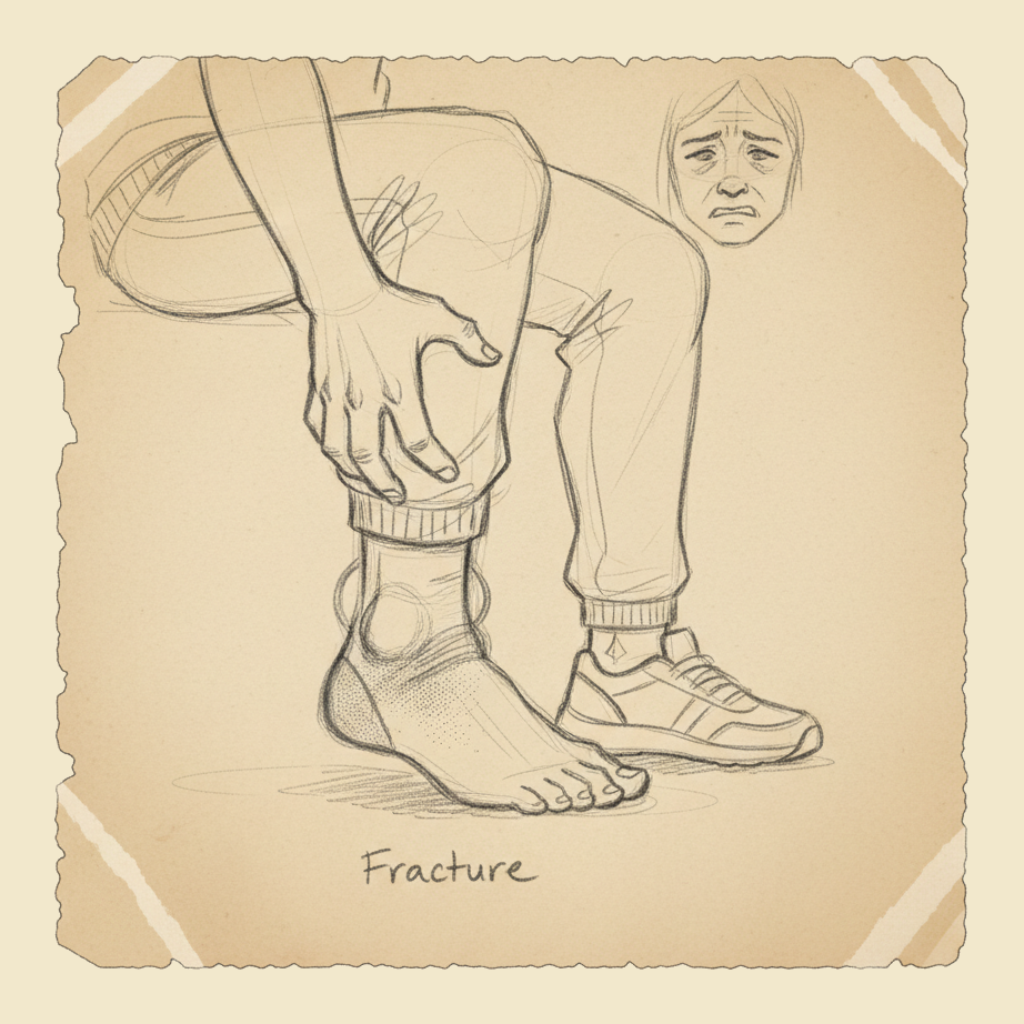
What's actually happening
A fracture is a break in a bone — anything from a hairline crack invisible without an X-ray to a snapped-clean-through bone poking out of the skin. A sprain is damage to the ligaments that hold a joint together, usually from twisting it past its normal range. A strain is damage to a muscle or tendon. From a first aider's point of view all three look similar — pain, swelling, loss of use, sometimes a deformed shape — and the field treatment for all three is the same. Telling them apart is a hospital job. G9-1-2
Fractures come in two flavours that do matter to the first aider:
- Closed fractures have the skin intact above the break.
- Open (or "compound") fractures have the bone exposed, or a wound in the skin overlying the break. Open fractures are at much higher risk of infection and are an immediate hospital case.
§ Instructor's note
Spend zero time trying to make learners diagnose "fracture or sprain". The whole question is pointless in the field — the action is the same regardless. The questions that do matter are: is the skin intact, is there a deformity, and are the fingers or toes past the injury still warm and pink? Drill those three.
Recognising it
The signs of a fracture or significant joint injury, in roughly the order they appear:
- Pain at the site, worse when the limb is moved or pressed.
- Swelling and bruising that develops over minutes to hours.
- Loss of normal use — the casualty can't or won't use the limb.
- An obvious deformity — a wrong angle, a shortening, a step in the bone, a dropped wrist.
- A snap that the casualty heard or felt at the moment of injury.
- A grinding feeling ("crepitus") that the casualty may describe but you should never test for.
- An exposed bone end or a wound over the break site — this is an open fracture.
- Cold, pale, blue or numb fingers or toes past the injury — circulation or nerve compromise. This is an emergency in its own right.
The most important secondary check after any limb injury is whether the circulation past the break is intact. Press a fingernail or toenail past the injury — it should blanch white and then pink up again within two seconds. If it doesn't, or if the digit is cold, blue, pale or numb, an artery or nerve may be compromised. Loosen any bandages, support the limb in the position it was found, and call 000 immediately — this is now a time-critical injury, not a routine one.
First-line response — rest, immobilise, support
The first-aid sequence for any suspected fracture or significant joint injury is built around three words. G9-1-2PC 1.3
- Stop the casualty moving the limb. Get them to sit or lie down.
- Support the injured part by hand at first — your hands above and below the injury, holding it steady in the position it is in.
- Control any bleeding with direct pressure around the wound — never directly on an exposed bone end. See the bleeding chapter for the full sequence.
- Cover any open fracture wound with a clean non-stick dressing, then pad around the bone end and bandage gently.
- Immobilise the limb in the position you found it. Options:
- A broad-arm sling for an injured collarbone, upper arm, or forearm.
- A collar-and-cuff sling for an injured upper arm or shoulder.
- Tying the injured leg gently to the uninjured one ("buddy splinting") for a leg injury.
- A rigid splint (a stick, a rolled magazine, a piece of cardboard) bandaged firmly above and below the break — never directly over it — for a long-bone fracture.
- Apply a cold pack wrapped in a cloth (not directly on the skin) for swelling and pain — 20 minutes on, 20 off.
- Check fingers/toes past the injury every 15 minutes for warmth, colour and sensation. If they go cold, pale or numb, loosen the bandages.
- Treat for shock. Keep the casualty warm and still. Do not give anything to eat or drink — they may need surgery.
- Call an ambulance for anything more than an obvious finger or toe.
The first-aid management of a fracture is built around the principles of rest, immobilise, and support. Do not attempt to push a deformed bone back into alignment, do not push an exposed bone end back under the skin, and do not test for crepitus. Cover open wounds, immobilise in the position found, and arrange medical care.
Sprains and strains — RICER
For an obvious soft-tissue injury (a rolled ankle, a wrenched knee, a pulled hamstring) where the casualty can still move the joint and there is no deformity, the standard first-aid mnemonic is RICER:
- Rest — stop using the limb.
- Ice — wrapped, 20 minutes on, 20 off.
- Compression — a firm (not tight) bandage.
- Elevation — raise the injured part above the level of the heart.
- Referral — see a doctor or physio if there is significant pain, swelling, or any doubt.
The opposite is sometimes taught as HARM — what not to do in the first 48 hours: Heat, Alcohol, Running, Massage. All four increase the swelling.
If there is any doubt whether it's a sprain or a fracture — a snap heard, an obvious deformity, inability to bear weight, severe pain — treat it as a fracture and seek medical assessment.
When to call an ambulance
Call 000 immediately for any of:
- Any open fracture (exposed bone or wound over the break).
- Any deformed limb.
- Any suspected fracture of the skull, spine, pelvis, hip, or femur.
- Any injury where the fingers or toes past the break are cold, pale, blue or numb.
- Any casualty who cannot be moved safely.
- Any casualty showing signs of shock.
- Any fracture where you are unsure.
For an isolated finger or toe fracture in an otherwise well casualty, the GP or after-hours clinic is usually enough.
What not to do
- Do not try to push a deformed bone back into place. It is held by muscle, ligament and nerves you can't see, and you can do real damage.
- Do not push an exposed bone end back under the skin. Pad around it.
- Do not test for the grinding feeling ("crepitus"). The casualty may describe it; you do not provoke it.
- Do not give the casualty anything to eat or drink — they may need surgery.
- Do not apply a cold pack directly to the skin. Wrap it.
- Do not apply a bandage so tight that it cuts off circulation. Re-check fingers and toes every 15 minutes.
A triangular bandage can be tied as a broad-arm sling (forearm horizontal across the chest, supporting the wrist and elbow) for forearm and wrist injuries, or as a collar-and-cuff sling (forearm angled steeply upward across the chest with the hand near the opposite shoulder) for upper-arm and shoulder injuries. The collar-and-cuff lets gravity help align an injured humerus or shoulder. Both techniques are easier to do than to read about — practise them.
You will tie broad-arm and collar-and-cuff slings on a partner, splint a long-bone "fracture" using a rolled magazine and bandages, and rehearse the circulation check past an injury. The sling work is the most fiddly skill in the chapter and the only way to get it is reps.
Bones forgive almost any first-aider mistake except moving them and pushing them back into place. Splint where they lie, check the fingers, call the ambulance — that's the whole job.
— ANZCOR Guideline 9.1.2