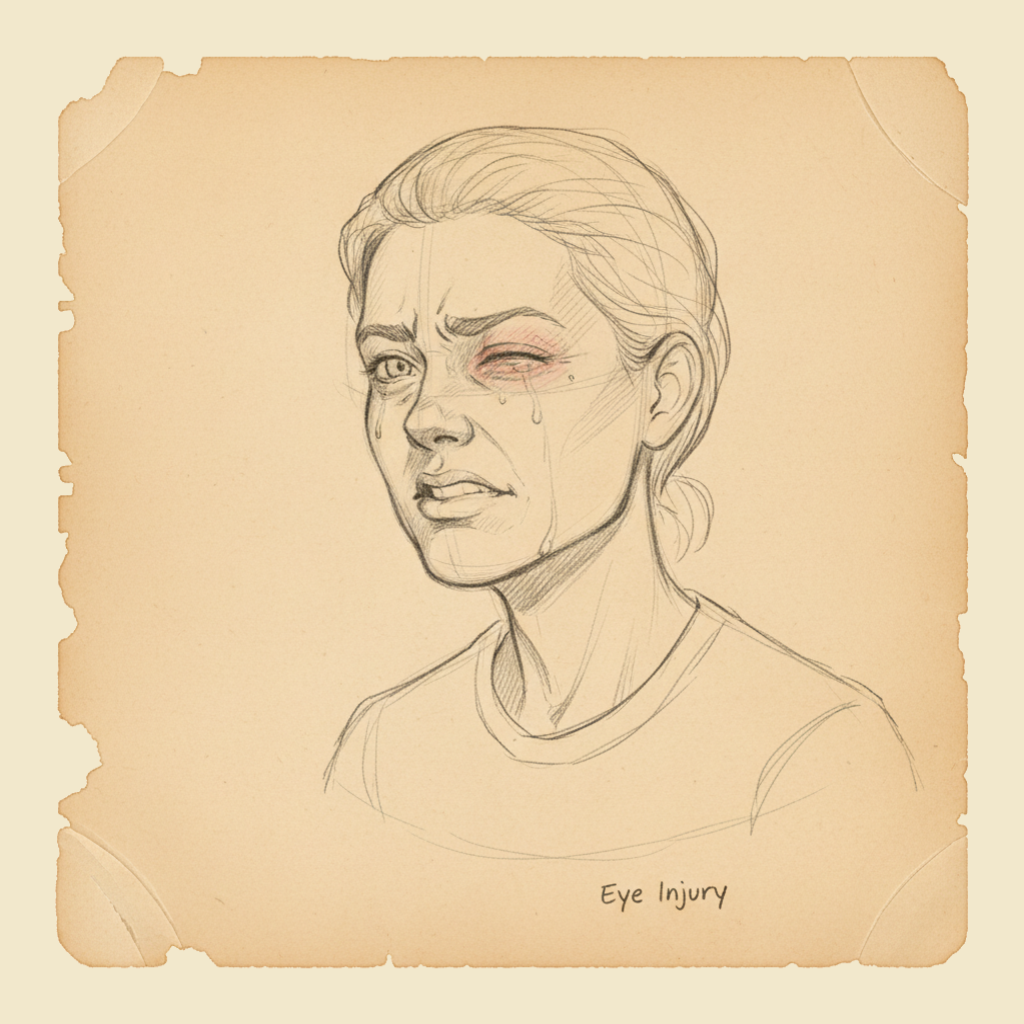
What's actually happening
An eye injury is any damage to the eyeball, eyelid, or the structures around them. First aiders treat all of them with the same baseline caution because the eye is small, has very little reserve, and is built around fluid-filled chambers that don't tolerate pressure. The four categories you'll see in the field, in roughly the order of frequency:
- Foreign body — grit, an eyelash, sawdust, an insect.
- Chemical splash — cleaning products, pool chemicals, bleach, garden chemicals, cement, oven cleaner.
- Blunt impact — a fist, a ball, an airbag, a fall.
- Penetrating injury — a nail, a wire, broken glass, a fishing hook.
Each one has its own response, and getting them confused makes things worse — particularly trying to "rinse out" a penetrating injury or "pluck out" something embedded.
§ Instructor's note
The instinct learners bring in is to do something to the eye itself — touch it, rub it, dab it, peer into it. The whole chapter is built on the opposite reflex: protect the eye from yourself. The eye does most of the work; you provide irrigation, padding, and a ride to hospital. The Hippocratic version of "first do no harm" was practically written for eyes.
Recognising it
The casualty's report is usually all you need — they know they got something in their eye, or were splashed, or were hit. The signs to scan for once you arrive:
- Pain, watering, blinking — the eye trying to clear itself.
- Redness of the white of the eye.
- A visible foreign body on the white or under the eyelid.
- Blurred or lost vision.
- Blood pooling inside the front of the eye ("hyphaema") after a blunt impact — looks like a half-moon of red across the iris.
- An obviously irregular pupil, a protruding object, a bleeding wound — penetrating injury, hospital case.
- Chemical residue on the face, lashes, or glasses.
First-line response — by category
The treatment changes per category, so identify the category first.
Foreign body
For a small loose foreign body — grit, an eyelash, sawdust:
- Encourage the casualty to blink several times. Tears do most foreign-body removal for free.
- Pull the upper eyelid out and down over the lower — this often sweeps the foreign body free.
- If blinking doesn't clear it, irrigate gently with clean water or sterile saline, from the inner corner of the eye outwards so contamination flows away from the unaffected eye.
- For something visible under the lower lid that hasn't moved, the corner of a clean tissue can lift it off.
- Do not try to remove anything embedded in the eyeball — that is a hospital job. Treat as a penetrating injury (below).
Chemical splash
This is the time-critical one. Every second the chemical stays in contact, it is dissolving tissue. G9-1-6
- Start irrigating immediately — before you call the ambulance, before you do anything else. Hold the casualty's head under a tap, a shower, a hose, or pour clean water from a jug. Cup of water from a desk if that's all you have, then upgrade.
- Continue continuous irrigation for at least 20 minutes. Longer for alkalis (drain cleaner, oven cleaner, cement, ammonia) which keep penetrating until they are completely rinsed away — irrigate for 30 minutes or more if you can.
- Hold the eyelids open if the casualty can't or won't keep them open themselves. The chemical is doing damage under the lids too.
- Irrigate from the inner corner outwards so the chemical doesn't flow into the unaffected eye.
- Keep irrigating all the way to the ambulance. Do not stop because the casualty says it feels better.
- Call 000.
Alkali chemical burns to the eye (drain cleaner, oven cleaner, cement, ammonia, lime) are more dangerous than acid burns of the same strength. Acids cause an immediate surface burn that limits how deep they go; alkalis dissolve through the tissue and keep going for hours. Irrigate for longer — 30 minutes minimum, an hour if you can.
Blunt impact
For an eye hit by a fist, a ball, or any blunt object:
- Sit the casualty down, somewhere quiet, head supported.
- Cover the injured eye loosely with a clean pad. No pressure.
- Rest both eyes if possible — even mild movement of the good eye moves the injured one.
- Watch for delayed signs — blurred vision, blood inside the eye, double vision, loss of vision. Any of these are an ambulance call.
- Cold pack to the surrounding bony rim (not the eyeball) for swelling.
Penetrating injury
This is the one where the wrong move has the worst consequences. The rule is do not pull, do not press, do not rinse. PC 1.3
- Call 000 immediately.
- Sit the casualty down and keep them as still as possible.
- Do not remove the embedded object, even if it looks small or loose. It may be the only thing holding the eye intact.
- Build padding around the object — rolled bandages, gauze, anything clean — to support it without loading it. Tape the padding in place. The object should not move.
- Cover the uninjured eye too, with a loose pad. The eyes move together; if the good eye looks around the injured one moves, and that movement can be catastrophic.
- Reassure the casualty — being unable to see is terrifying, and panic makes the eyes move.
- Wait for the ambulance. Do not try to transport the casualty yourself unless it is unavoidable.
For chemical eye injuries, immediate continuous irrigation with clean water for at least 20 minutes is the most important first-aid action and should not be delayed for any other step. For penetrating injuries, do not remove the foreign object and do not apply pressure — pad around the object to support it and cover both eyes to prevent sympathetic movement.
When to call an ambulance
Call 000 immediately for any of:
- Any chemical splash to the eye.
- Any penetrating eye injury.
- Any visible blood inside the eye after a blunt impact.
- Any loss or blurring of vision after an injury.
- Any embedded foreign body that won't blink or rinse out.
- Any eye injury in a child where you cannot get a clear story.
- Any time you are unsure.
What not to do
- Do not try to remove an embedded object. Pad around it.
- Do not apply pressure to an injured eye, ever. The eyeball is fluid-filled and pressure ruptures it.
- Do not rinse a penetrating injury — it can wash debris deeper in.
- Do not rub an eye that has had a chemical splash. Irrigate.
- Do not use cotton wool or fluffy material as a dressing — fibres get into the eye.
- Do not delay irrigation for a chemical splash to find "proper" saline. Tap water now beats sterile saline in five minutes.
If the casualty wears contact lenses and has had a chemical splash, irrigate over the lens first — getting water onto the eye is more urgent than removing the lens. The lens can come out (or be removed at hospital) once irrigation is established.
You will rehearse irrigation technique on a face shield or partner, practise the build-padding-around-an-object technique using a pen as a stand-in for an embedded foreign body, and drill the cover-both-eyes step which learners routinely forget. You will also handle a saline irrigation bottle so the technique is in your hands before you ever need it.
The eye is small enough that almost anything you do to it can make things worse. The only two things that reliably make things better are running water for chemicals, and keeping your hands off it for everything else.
— ANZCOR Guideline 9.1.6