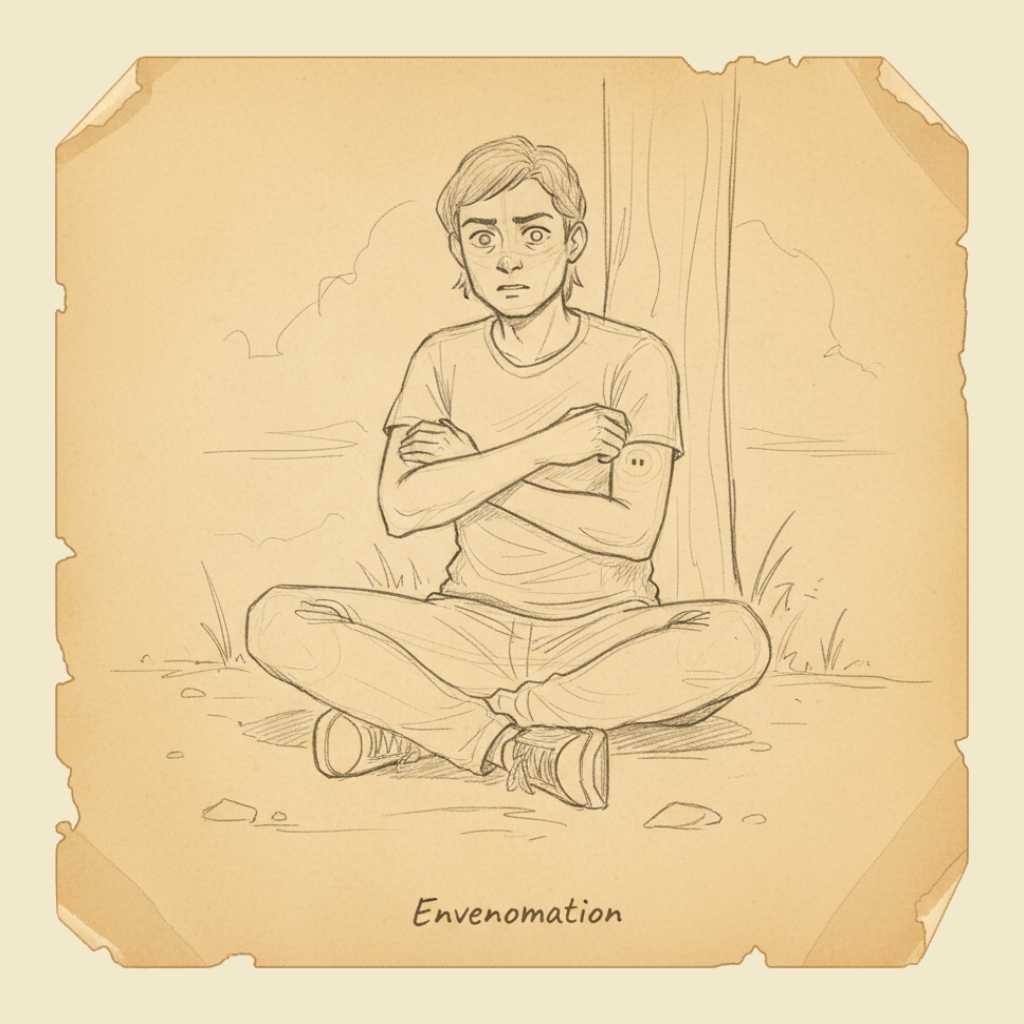
What's actually happening
Envenomation is the medical word for being poisoned by a bite or sting from an animal that produces venom. Venom is not the same thing as poison: poison is something you swallow or absorb, venom is something that's injected — through fangs, a stinger, a barb, a tentacle. The body's response depends on what was injected and where it travels next, and for several Australian creatures the path matters as much as the dose. G9-4-8
For snake and funnel-web venom, the substance moves through the lymphatic system rather than the bloodstream — the slow drainage network that runs alongside the veins and is driven by muscle movement. That single biological fact is the reason snake-bite first aid is built around two ideas: immobilise the casualty so the lymph stops moving, and wrap the bitten limb under firm pressure to physically squeeze the lymph channels closed. Done well, the technique buys hours — sometimes long enough for the casualty to reach hospital and antivenom before any significant venom reaches the heart.
§ Instructor's note
The single biggest mental adjustment learners need is that envenomation first aid is not a single technique. The Pressure Immobilisation Technique (PIT) is brilliant for snakes and funnel-webs and wrong for almost everything else. Drill the rule: identify the creature first, then choose the technique. A list of creatures and their matched techniques is below — the list is short and it is worth memorising.
Recognising it
A casualty with a confirmed bite or sting is easy. The harder cases are the ones where nobody saw it happen — a hiker who collapses on the trail, a child who comes in from the garden complaining of a sore leg, a swimmer pulled from the water with a faint red mark. The signs of significant envenomation, in roughly the order they appear:
- A puncture mark, scratch or paired fang marks at the site, sometimes invisible.
- Local pain, swelling, redness, or numbness around the site.
- Headache, nausea, vomiting, sometimes within minutes.
- Sweating, dizziness, blurred vision.
- Muscle weakness, drooping eyelids, difficulty swallowing or speaking — neurotoxic signs from snake or funnel-web venom.
- Bleeding from the gums or nose, easy bruising — coagulation failure from snake venom.
- Collapse, seizure, cardiac arrest — late and life-threatening.
Many Australian snake bites cause no immediate pain at all. A casualty who says "I didn't really feel anything" after walking through long grass and is now nauseous and sweating is a snake-bite case until proven otherwise. Treat first; identify later.
First-line response — Pressure Immobilisation Technique
For any snake bite (all Australian snakes), any funnel-web spider bite, any blue-ringed octopus bite, and any cone shell sting, the first-aid technique is the same and it is the most important skill in the envenomation chapter: G9-4-8PC 1.3
- Call 000 immediately. Do not wait to see how the casualty does.
- Keep the casualty completely still. Lay them down. Do not let them walk, even one step. Walking is the single worst thing they can do — it pumps lymph back toward the heart and accelerates the envenomation.
- Apply a broad pressure bandage directly over the bite site, at the same firm tension as a sprained-ankle bandage. Mark the bite site on the bandage with a pen if you can.
- Continue the bandage up the entire limb, from the toes (or fingers) all the way to the groin (or armpit), at the same firm tension. Use a second bandage if the first doesn't reach.
- Splint the limb so it cannot move at all — a stick, a rolled magazine, a piece of wood, anything rigid bandaged firmly to the limb.
- Mark the time the bandage was applied. Hospital staff need to know.
- Wait for the ambulance. Do not move the casualty unless their life is in immediate danger.
The Pressure Immobilisation Technique is the recommended first aid for bites by all Australian venomous snakes, funnel-web spiders, blue-ringed octopus, and cone shells. The technique is designed to slow the lymphatic spread of neurotoxic venom. Do not wash the bite, cut it, suck it, apply an arterial tourniquet, or attempt to catch or kill the snake — modern hospital antivenoms are polyvalent and identification is no longer needed.
The creature-specific rules
The PIT is wrong for several common Australian envenomations. Use the table below.
Redback spider: painful, slow-onset envenomation. PIT is not used (it traps the venom and increases pain). Apply a cold pack for pain relief, give simple analgesia, and arrange medical assessment — hospital antivenom is available but not always needed.
Other spider bites (white-tail, huntsman, mouse spider unconfirmed): clean the site, cold pack for pain, watch for systemic symptoms, seek medical advice if anything beyond local pain develops.
Box jellyfish (tropical northern Australia, summer): douse the stung area thoroughly with vinegar for at least 30 seconds before attempting to remove any tentacles. Vinegar inactivates the undischarged stinging cells (nematocysts) so removing the tentacles doesn't fire more venom. Then call 000 and start CPR if needed — box jellyfish stings can cause cardiac arrest.
Irukandji jellyfish (tropical, often invisible): vinegar, then call 000. Pain and severe systemic symptoms ("Irukandji syndrome") can develop over 30 minutes.
Bluebottle (Pacific man-o'-war, common on east coast beaches): do not use vinegar — it makes bluebottle stings worse. Rinse the area with sea water (not fresh water — fresh water also fires more nematocysts), pick off any visible tentacles with a stick or gloved hand, then immerse the affected area in hot water (45°C — as hot as the casualty can tolerate without scalding) for 20 minutes for pain relief.
Stonefish, bullrout, other venomous fish: immerse in hot water (45°C) for pain relief; the venom is heat-labile and breaks down. Call 000 for stonefish — antivenom is available.
Bee, wasp, ant stings: scrape out any visible stinger with a fingernail or card edge (don't pinch — it injects more venom). Cold pack for pain. Watch for anaphylaxis — see the anaphylaxis chapter.
Tick (paralysis tick): do not pull it out — handling the tick can cause it to inject more saliva. Use a freezing spray (ether-containing products like Wart-Off Freeze or Lyclear Scabies) to kill the tick in place; it will fall off on its own. For embedded ticks in known allergic individuals, seek medical removal.
When to call an ambulance
Call 000 immediately for any of:
- Any suspected snake bite, anywhere in Australia, regardless of how the casualty looks.
- Any funnel-web, blue-ringed octopus or cone shell suspected envenomation.
- Any box jellyfish or Irukandji sting.
- Any stonefish sting.
- Any envenomation with systemic signs (vomiting, sweating, weakness, breathing difficulty, collapse).
- Any envenomation in a child or an elderly person.
- Any anaphylactic reaction to a sting.
- Any time you are unsure of the creature.
What not to do
- Do not wash the bite. Hospitals can use venom on the skin to identify the snake species via a venom-detection kit.
- Do not cut the bite, suck the venom, or apply an arterial tourniquet — these are obsolete techniques that cause more damage than the bite.
- Do not try to catch or kill the snake. You don't need to identify it — antivenom is polyvalent — and you might be the second casualty.
- Do not let a snake-bite casualty walk anywhere. Carry them on a stretcher if you must move them.
- Do not use vinegar on a bluebottle, or sea water on a box jellyfish. The wrong rinse fires the wrong cells.
- Do not pull out an embedded tick.
Bee, wasp, ant and (occasionally) jellyfish stings are common triggers for anaphylaxis. If at any point a sting casualty develops a swollen face, breathing difficulty, hives, or collapse, treat for anaphylaxis: lay them down, give an EpiPen if available, call 000. See the anaphylaxis chapter for the full sequence.
You will rehearse the Pressure Immobilisation Technique on a partner — applying the bandage at the right tension over a marked bite site, extending it the full length of the limb, and adding a splint. Tension is the part learners get wrong: too loose and the venom escapes, too tight and you cut off circulation. The "sprained ankle" reference point is the easiest cue.
Australian envenomation first aid is built on a single counter-intuitive idea: stop the casualty from doing anything. No walking, no rushing, no first-aider improvisation. Bandage, splint, wait. The ambulance will do the rest.
— ANZCOR Guideline 9.4.8