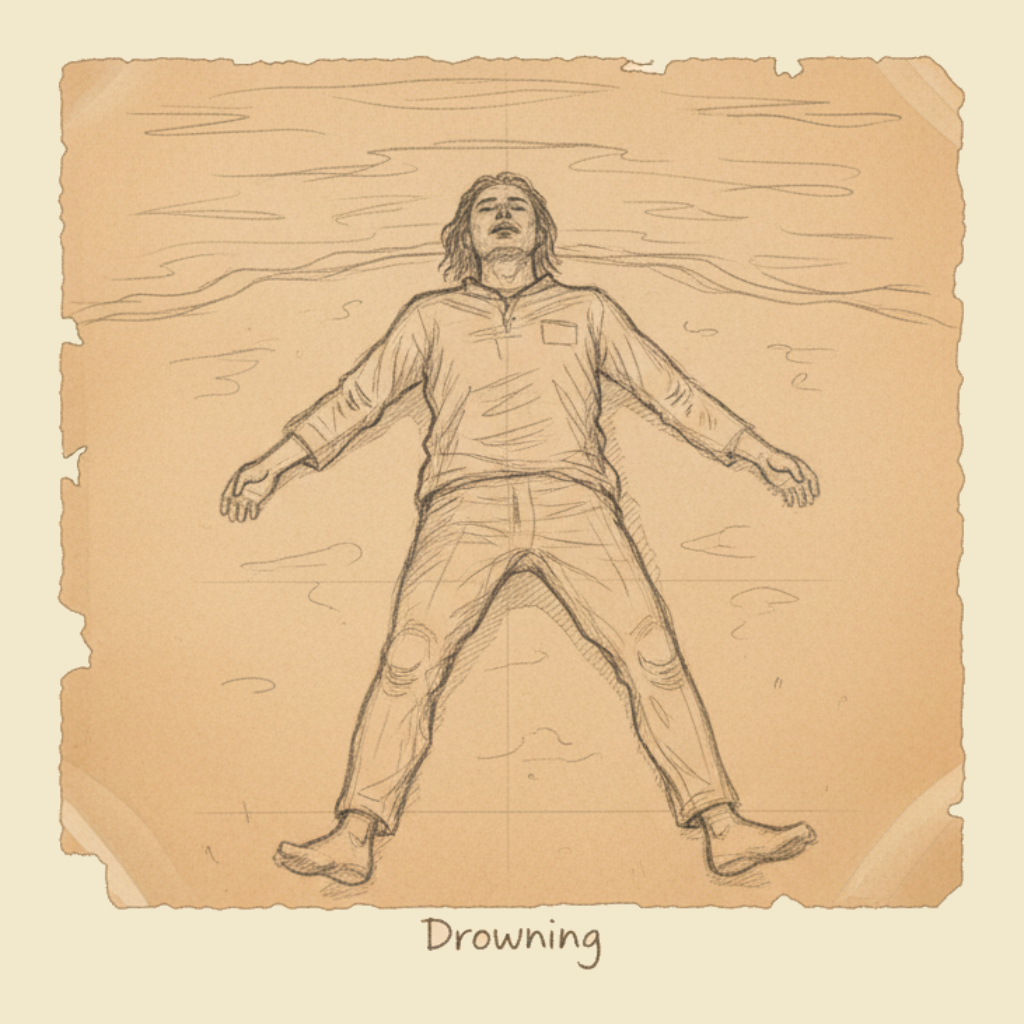
What's actually happening
Drowning is technically defined as respiratory impairment from immersion or submersion in liquid. In plain English: the airway has gone under water, the casualty is breathing the wrong thing, and the body is being starved of oxygen from the outside in. Drowning is a process, not an event. It can be interrupted at any stage — the earlier you interrupt it, the better the outcome — which is why everything that follows is built around speed. G9-3-2
The crucial physiological point for first aiders is the order in which things go wrong. In a heart attack, the heart fails first and then the breathing follows. In drowning, the breathing fails first — water in the airway, laryngospasm, hypoxia — and the heart stops because there is no oxygen left to run it. That order is why drowning CPR starts with breaths, not compressions: the casualty needs the oxygen back before anything else will work.
§ Instructor's note
The Hollywood picture of drowning — splashing, shouting, waving — is almost always wrong. Real drowning is quiet. The casualty is vertical in the water, head tilted back, mouth at or just below the surface, arms pressing down trying to lift the airway, with no spare breath to call for help. Children drown in seconds and silently. Teach learners to recognise the silence as the warning sign, not the absence of one.
Recognising it
The signs of active drowning, in roughly the order they appear:
- Head low in the water, mouth at or below the surface.
- Head tilted back, mouth open as the casualty tries to breathe.
- Eyes glassy, unfocused, or closed.
- Vertical body position with no kicking — they are not swimming, they are climbing an invisible ladder.
- No call for help — the breath is needed for breathing, not shouting.
- Hair in front of the face that they are not brushing away.
- Apparent "play" that doesn't quite look right — especially in children.
A person in trouble in the water has about 20–60 seconds before they go under for good. If you are not certain, ask "Are you alright?" If they don't answer, assume they aren't.
Drowning rescuers drown. Every year in Australia adults die trying to save children, parents, or strangers from rip currents, flooded creeks, and backyard pools. Rule one is throw, don't go: throw a rope, a flotation aid, a pool noodle, a length of garden hose, anything that floats and reaches. Only enter the water if you are a trained, capable swimmer with a flotation device, and even then take one with you for the casualty.
First-line response — the drowning sequence
ANZCOR's drowning sequence is built around the priority of getting oxygen back into the casualty as fast as possible, and it deliberately breaks the standard CPR rhythm to do so. G9-3-2PC 1.3
- Get them out of the water safely. Throw before you go. Call 000 either before or while you are doing this.
- Lay them on their back on a firm, flat surface. A pool deck, a beach, the grass — somewhere you can do CPR.
- Check for response and normal breathing using the standard DRSABCD check. Tilt the head, lift the chin, look-listen-feel for ten seconds.
- If they are unresponsive and not breathing normally, give 5 initial rescue breaths. This is the step that's different from the usual CPR sequence. Each breath should make the chest rise visibly. If the first breath doesn't go in, reposition the head and try again.
- Then start the normal CPR cycle: 30 compressions and 2 breaths, continuing until the casualty recovers, the ambulance arrives, an AED tells you otherwise, or you are physically unable to continue.
- Apply an AED as soon as one is available. Dry the chest before placing the pads — the conductive gel needs skin contact, not water.
- Expect vomiting. It is extremely common in drowning resuscitation. Roll the casualty onto their side, clear the mouth, and continue.
For a casualty rescued from drowning who is unresponsive and not breathing normally, give 5 initial rescue breaths before starting chest compressions, then continue with standard CPR (30:2). The priority is restoring oxygenation to a casualty whose arrest is hypoxic in origin. Do not attempt to drain water from the lungs — it is not effective and delays the resuscitation that matters.
When to call an ambulance
Call 000 immediately for any of:
- Any casualty rescued from drowning who is unresponsive.
- Any casualty rescued from drowning who needed any rescue breathing or CPR, even if they have since recovered and look perfectly well.
- Any casualty who was unconscious or vomited in the water.
- Any drowning involving a child of any age.
- Any cold-water drowning or one with suspected hypothermia.
- Any time you are unsure.
Every drowning casualty who has needed any rescue breathing should be assessed in hospital, full stop. Secondary drowning — delayed respiratory problems caused by water in the lungs, sometimes hours after the rescue — is a real and dangerous phenomenon, and the only way to detect and treat it is in hospital.
What not to do
- Do not enter the water unless you are trained, capable, and have a flotation device. Throw, don't go.
- Do not attempt to drain water from the lungs by tipping the casualty upside down or pressing on the abdomen. It doesn't work, it delays CPR, and it causes vomiting.
- Do not skip the 5 initial breaths for a drowning casualty in arrest — this is the one place CPR sequence changes.
- Do not apply AED pads to a wet chest. Dry first.
- Do not decide a casualty who has been pulled out and "seems fine" doesn't need hospital. They do.
Casualties pulled from cold water — especially children — have occasionally survived submersions of 30 minutes or more with full neurological recovery, because the cold-water diving reflex slows the metabolism and protects the brain. Never give up on a cold-water drowning. Continue CPR all the way to hospital and let the paramedics make the decision.
You will rehearse the 5-initial-breaths variation on a manikin, practise rolling and clearing a vomiting casualty, and work the dry-the-chest step on an AED trainer. The drowning variation is one of the most-confused points in first aid because it differs from "ordinary" CPR — drilling it is the only fix.
Drowning is the one emergency where the casualty needs air more than they need anything else, and where the rescuer is in more danger than they realise. Throw before you go. Five breaths first. And get them to hospital even if they look fine.
— ANZCOR Guideline 9.3.2