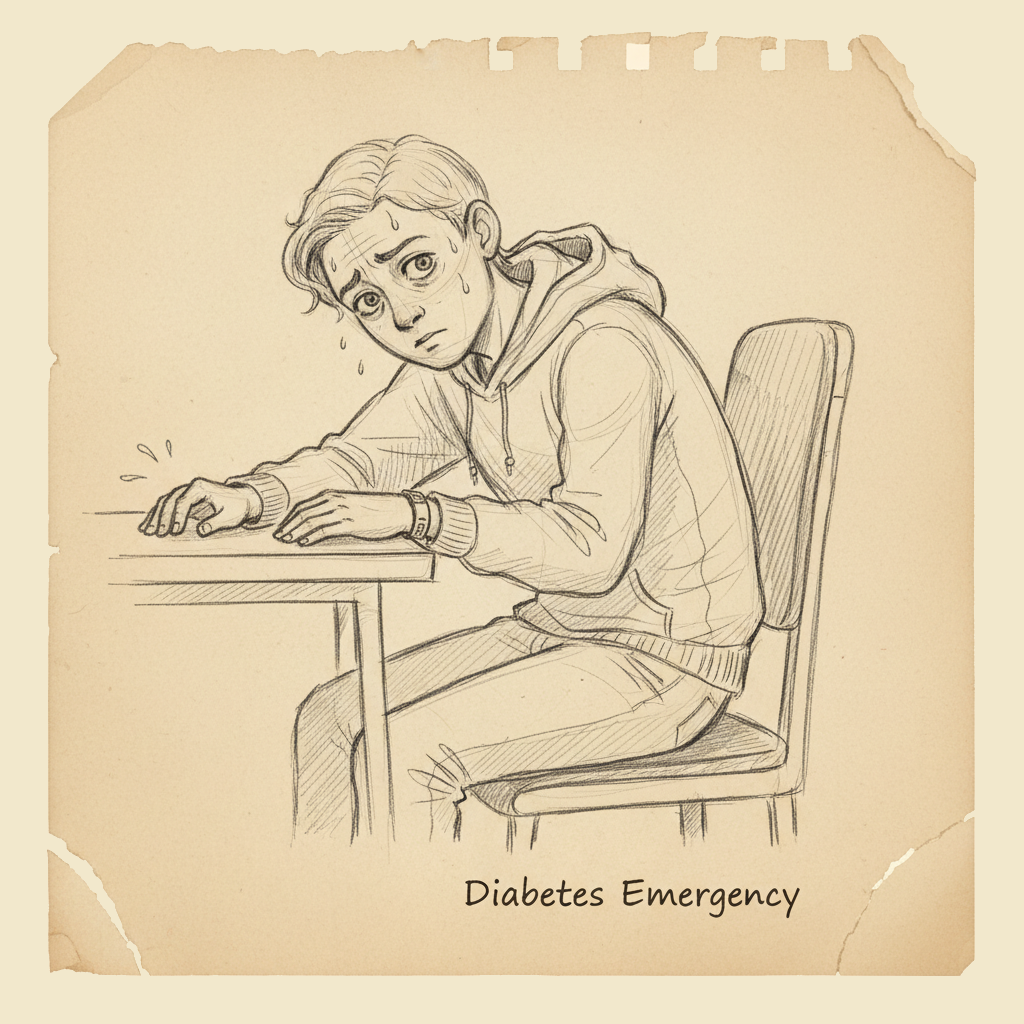
What's actually happening
Diabetes is a long-term condition in which the body cannot keep its blood-sugar level in the normal range. Glucose is the fuel every cell in the body runs on, and insulin is the hormone that lets glucose cross from the blood into the cells. In type 1 diabetes the pancreas no longer makes insulin and the casualty must inject it to live. In type 2 diabetes the body still makes insulin but the cells respond poorly; it is managed with diet, exercise, tablets, and sometimes insulin as well. G9-2-9
First aiders almost never have to diagnose diabetes — the casualty already knows. What they have to do is recognise its two emergencies and act on the right one fast.
- Hypoglycaemia ("hypo", low blood sugar) — the brain is starving for fuel. Comes on in minutes, usually after a missed meal, extra exercise, or a normal insulin dose with too little food behind it. This is the urgent one.
- Hyperglycaemia (high blood sugar) — the body has too much glucose in the blood and not enough insulin to use it. Comes on over hours to days. Just as dangerous, but the timeline gives you space.
§ Instructor's note
The single most important thing to teach is the rule "when in doubt, treat for hypo." A glucose dose given to a hyperglycaemic casualty barely moves the needle on a problem that's already been brewing for days. A glucose dose withheld from a hypoglycaemic casualty kills them in minutes. The two errors are not symmetrical, so the answer is not symmetrical either.
Recognising it
The two emergencies look different in tempo and in the picture they present.
Hypoglycaemia (low — fast, urgent):
- Pale, sweaty, shaky. A cold sweat on the forehead, the hands trembling.
- Hungry, weak, dizzy. Often the casualty's first warning to themselves.
- Confused, irritable, uncoordinated. Looks like drunkenness — slurred speech, stumbling, behaving out of character.
- Headache, blurred vision.
- Seizure, then unresponsiveness — late and life-threatening.
Hyperglycaemia (high — slow, dangerous):
- Thirst, dry mouth.
- Frequent urination that has been going on for hours or days.
- Fatigue, weakness, blurred vision.
- A fruity, acetone-like smell on the breath (the body burning fat for fuel because it can't use the glucose).
- Deep, rapid, sighing breathing — Kussmaul breathing — the body trying to blow off acid.
- Drowsiness, confusion, then unresponsiveness.
A hypoglycaemic casualty in public is routinely mistaken for drunk and walked past. Slurred speech, an unsteady gait, irritability and confusion are the picture of both. If you have any reason to believe a confused person might be diabetic — a medic-alert bracelet, an insulin pen in their bag, a friend saying "she's diabetic" — treat for hypo first and ask questions later.
First-line response — give sugar
The first-aid action for any suspected diabetic emergency is the same shape, and it leans toward the hypo because the hypo is the killer in your timeframe. G9-2-9PC 1.3
If the casualty is conscious and can swallow safely:
- Sit them down. A casualty whose blood sugar is dropping may collapse.
- Give a fast-acting sugar — about 15 grams of glucose. Examples:
- Half a glass (150 mL) of regular (not "diet") soft drink or fruit juice.
- 6–7 jelly beans.
- 3 teaspoons of sugar or honey.
- A glucose gel or tablets if the casualty carries them.
- Wait 10–15 minutes and watch. They should improve visibly — colour returning, speech clearing, awareness coming back.
- If there is no improvement, give another fast-acting sugar dose and call an ambulance.
- Once they have improved, give a longer-acting carbohydrate — a sandwich, a piece of fruit, a few biscuits — to keep the level steady. The hypo will come back in an hour if you don't.
If the casualty is unresponsive, having a seizure, or cannot swallow safely:
- Call 000.
- Put them in the recovery position.
- Do not put anything in their mouth — no food, no drink, no glucose gel rubbed on the gums (the choking risk outweighs the absorption).
- Monitor breathing and be ready to start CPR if they deteriorate.
For a conscious casualty with a suspected diabetic emergency, give a fast-acting glucose source by mouth. If it is a hypoglycaemic episode, recovery is rapid and complete. If it is a hyperglycaemic episode, the small additional glucose dose causes no significant harm, and the casualty needs medical care regardless. When the cause is unclear, treat for hypoglycaemia.
When to call an ambulance
Call 000 immediately for any of:
- Any unresponsive diabetic casualty.
- Any diabetic casualty who is fitting.
- Any casualty who does not improve within 10–15 minutes of a glucose dose.
- Any casualty with the deep, sighing breathing and fruity breath of advanced hyperglycaemia.
- Any first-ever diabetic emergency in someone not previously known to be diabetic.
- Any time you are unsure.
What not to do
- Do not give insulin. Insulin is a prescription medication; the dose is calibrated to the individual; getting it wrong can kill them. Even if there's an insulin pen in the casualty's bag, that's their job, not yours.
- Do not give a "diet" or sugar-free drink. The whole point is the sugar.
- Do not put anything in the mouth of an unresponsive casualty.
- Do not assume drunkenness. Test the assumption by treating for hypo.
- Do not let a casualty who has just recovered from a hypo drive themselves anywhere. They need food, rest, and someone to keep an eye on them for the next hour.
Children with type 1 diabetes can drop into a hypo very quickly, especially after sport. If a child with known diabetes is suddenly tearful, pale, irritable or "not themselves", give a fast-acting sugar without waiting to be sure. Their parents and teachers will already have a hypo plan — follow it.
You will rehearse the conscious-casualty sugar sequence, practise putting an unresponsive diabetic into the recovery position on a manikin, and run a scenario where the cause is ambiguous so you can drill the "treat for hypo when unsure" rule under stress.
If you can remember one thing about diabetic emergencies, remember this: a conscious diabetic gets sugar. That single rule covers nine cases out of ten and the tenth needs an ambulance anyway.
— ANZCOR Guideline 9.2.9