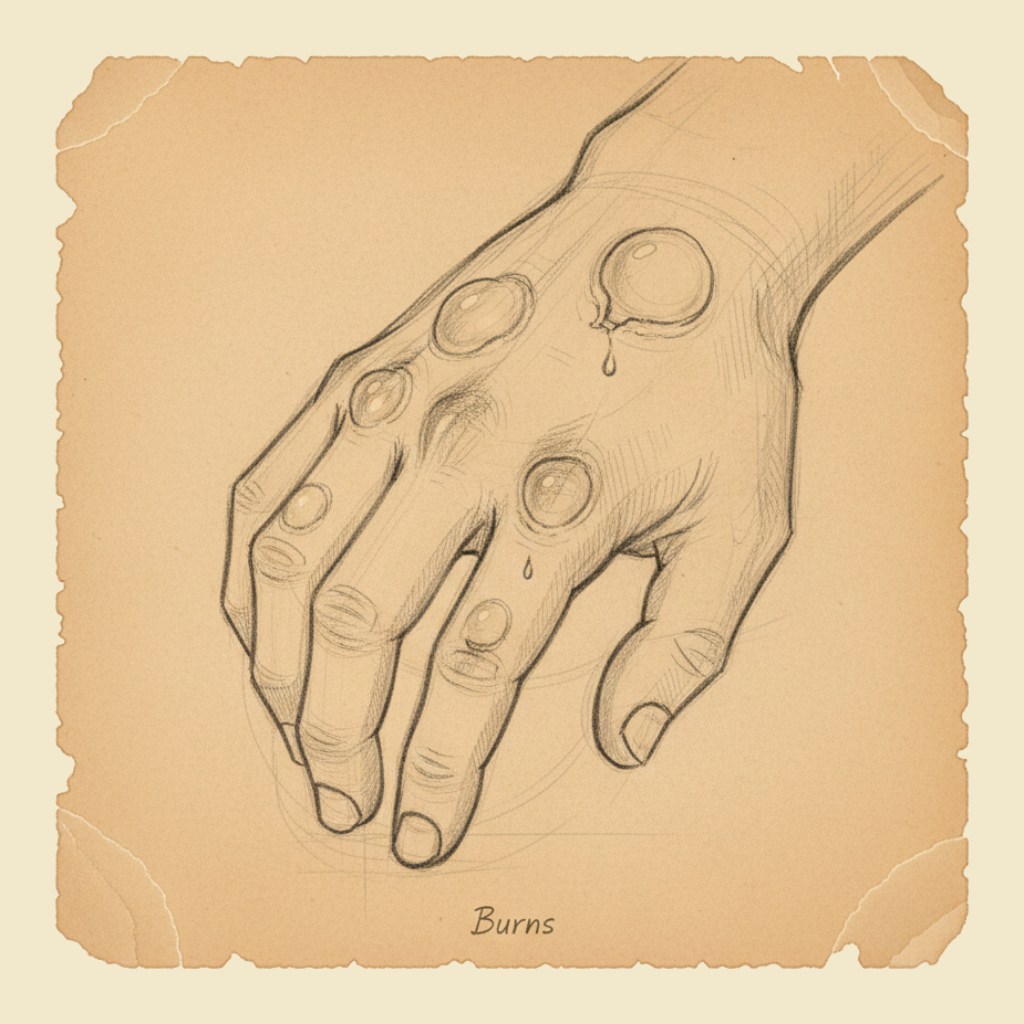
What's actually happening
A burn is the destruction of tissue by an outside agent — most often heat, but also chemicals, electricity, friction, and radiation (including the Australian sun). When skin is heated past about 44°C, the proteins inside its cells start to denature; past 60°C the damage is more or less instant. The crucial thing for first aiders to understand is that the damage keeps progressing after the heat source is gone, because the hot tissue holds residual heat and continues to cook the layers underneath. Cooling the burn under running water doesn't just make it feel better — it physically stops that progression and is the difference between a burn that heals and one that scars. G9-1-3
Burns are graded two ways: by depth (how far down the damage reaches) and by area (how much of the body surface is involved). First aiders don't need to grade burns precisely — that's a hospital job — but you do need to recognise the picture so you know how seriously to take it.
- Superficial — red, dry, painful, no blisters. Sunburn is the classic example.
- Superficial partial-thickness — wet, blistered, very painful. The skin is breached.
- Deep partial-thickness — paler, drier, less painful (the nerves are damaged).
- Full-thickness — white, brown, leathery or charred; often painless in the centre because the nerves are gone, ringed by painful partial-thickness burn at the edge.
§ Instructor's note
The painlessness of a deep burn is the trap. Learners look at a casualty who isn't screaming and downgrade the severity in their head. Drill the opposite: a calm casualty with a pale leathery patch is more concerning, not less. Pain means the nerves are still working.
Recognising it
The recognition step for burns is mostly about deciding whether this is a "rinse it under the tap and put a plaster on" graze or a "call the ambulance now" emergency. The flags that escalate a burn:
- Larger than the casualty's palm. The palm (fingers excluded) is roughly 1% of body surface area — a useful field measure.
- Located on the face, hands, feet, genitals, or over a joint. These areas scar in ways that cause permanent disability.
- Deep — pale, leathery, painless, or charred.
- Caused by electricity or chemicals — both have damage that runs deeper than the visible surface and need hospital assessment regardless of how the skin looks.
- On a child or an elderly person. Less reserve, faster fluid loss, less margin for error.
- Circumferential — all the way around a limb, finger, or chest. Swelling can cut off circulation or restrict breathing.
- Any sign of inhalation injury — singed nasal hair, soot around the mouth, a hoarse voice, a cough. The airway is the priority and it can swell shut.
First-line response — cool, cover, call
ANZCOR's first-aid sequence for thermal burns is built around three steps, in order: G9-1-3PC 1.3
- Stop the burning. Remove the casualty from the heat source. For clothing on fire, the old rhyme still works: stop, drop and roll, or smother the flames with a blanket. For a scald, get the wet hot clothing off the skin — it is still cooking them.
- Cool with running water for 20 minutes. Cool, not cold. Tap temperature is right; ice is wrong. Run the water over the burn, not on it from a great height — you don't want to add impact damage. Twenty minutes is the magic number and it works for up to three hours after the burn happened, so don't decide it's "too late" if the casualty has been in the car for twenty minutes.
- Remove jewellery and loose clothing from the burned area while the water is running. Burns swell fast and a ring on a burned finger becomes a tourniquet within an hour. Anything stuck to the burn — leave it.
- Cover loosely. Cling film (plastic wrap) is ideal — it doesn't stick, it lets the hospital see the burn, and it keeps contamination out. A clean, non-fluffy dressing is the next-best option. Loose, not tight.
- Keep the rest of the casualty warm. Twenty minutes of running water on a burn cools the whole casualty, especially a child, and hypothermia is a real risk. Wrap the unburned parts in a blanket while you irrigate.
Cool running water applied to a thermal burn for 20 minutes within three hours of the injury is the single most effective first-aid intervention. It reduces the depth of the burn, the need for surgery, and the eventual scar. Do not use ice, iced water, butter, oils, lotions, toothpaste, egg white, or any traditional remedy — they trap heat, increase damage, or cause infection.
Chemical and electrical burns
These two are special cases and the first-aider response shifts.
Chemical burns: brush off any dry powder before you add water, then irrigate continuously with running water for at least 20 minutes, longer for alkalis (drain cleaner, cement, oven cleaner) which keep penetrating until they're rinsed completely away. Remove contaminated clothing wearing gloves if you can. Do not try to neutralise a chemical with another chemical — the reaction generates more heat. For chemical burns to the eye, see the eye injuries chapter.
Electrical burns: the burn you can see is the entry/exit wound. The damage you can't see runs along the path the current took through the body and is almost always worse. Make sure the power is off before you touch the casualty — for low-voltage household current, throw the switch; for high-voltage (powerlines, substations), stay back at least 6 metres and call 000. Once safe, treat any visible burn with cool running water and call an ambulance regardless of how minor it looks. Electrical injury can cause cardiac arrest hours later — every electrical-burn casualty goes to hospital.
When to call an ambulance
Call 000 immediately for any of:
- Any burn larger than the casualty's palm.
- Any burn to the face, hands, feet, genitals or a joint.
- Any deep burn (pale, leathery, painless, or charred).
- Any burn on a child or an elderly person.
- Any electrical or chemical burn.
- Any burn with signs of inhalation injury or where the casualty was in a confined space with smoke.
- Any circumferential burn.
- Any burn where you are unsure.
Keep cooling under running water while you wait. Twenty minutes minimum.
What not to do
- Do not use ice or iced water — it causes cold injury underneath the burn and makes the damage worse.
- Do not apply butter, oil, lotion, toothpaste, egg white, flour, or any folk remedy. They trap heat and cause infection.
- Do not burst blisters. They are sterile dressings the body has already made.
- Do not peel off clothing that is stuck to the burn — irrigate around it and leave it for the hospital.
- Do not apply a tight or fluffy dressing. Cling film, loose.
- Do not decide a burn is "too small" to bother cooling. Twenty minutes for any thermal burn that isn't a trivial graze.
Children burn faster (their skin is thinner), lose body heat faster (their surface-area-to-volume ratio is higher), and can become hypothermic during the 20 minutes of cooling. Wrap the unburned parts of the child in a blanket or towel during irrigation, and call an ambulance for any burn larger than a 20-cent coin on a child under five.
You will rehearse the cool-cover-call sequence on a burns trainer, practise applying cling film to an irregular burn, and time a full 20-minute irrigation so you understand how long it actually feels. Learners who have only ever cooled a burn for "a couple of minutes" routinely underestimate how much time the rule actually demands.
Twenty minutes of cool running water is worth more than every cream, salve and miracle remedy ever invented. It is also the one thing the casualty can't do for themselves once they're in shock — so you do it, and you do it for the full twenty minutes.
— ANZCOR Guideline 9.1.3