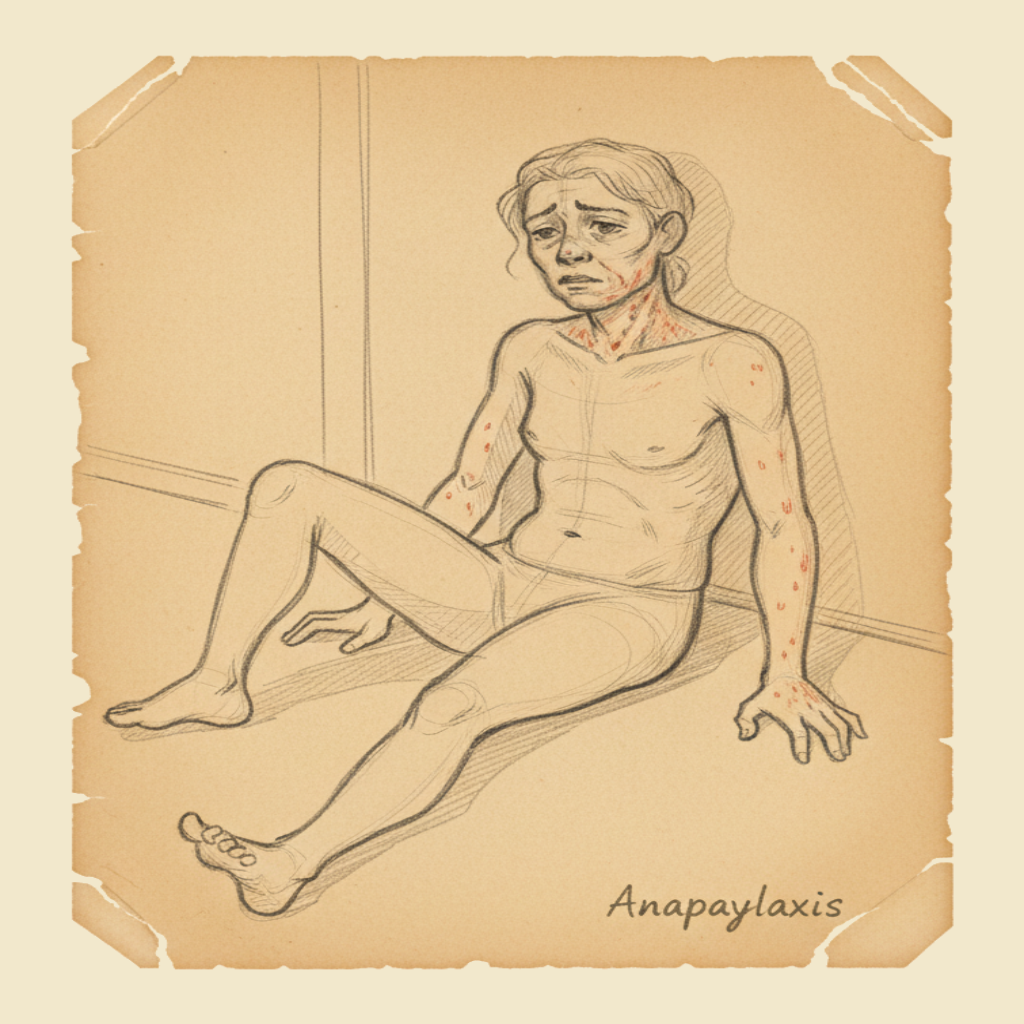
Recognising it early
Most allergic reactions are mild — a runny nose, an itchy rash, a swollen lip after a bee sting. Anaphylaxis is different. It is a whole-body reaction that can close the airway, drop blood pressure, and progress from "feeling odd" to unconscious in minutes.
The casualty may first describe a vague sense that something is not right before any visible signs appear. Trust that feeling. Recognising it early — and treating it quickly — is the single most important skill in this chapter. G9-2-7PC 1.3
§ Instructor's note
In the face-to-face classroom we ask students to remember the four zones in order — A, B, C, D — because under stress, lists fail and patterns hold.
The four zones to scan, in order:
- Airway. Swelling of the tongue, throat or voice; difficulty swallowing; hoarse voice or persistent cough.
- Breathing. Wheeze, persistent cough, or noisy breathing. The casualty may say their chest feels tight.
- Circulation. Pale and floppy in young children; dizziness, collapse, or loss of consciousness in adults.
- Skin. Hives, welts, sudden flushing — but skin signs may be absent in up to 20% of cases. Their absence does not rule anaphylaxis out.
If any one of airway, breathing or circulation is affected, treat as anaphylaxis and give adrenaline immediately. Do not wait for a second sign. Do not wait for skin changes.
First-line response
The priority is to remove the trigger if you can, lay the casualty flat, and give the adrenaline auto-injector without delay. Do not let the casualty stand or walk — sudden upright posture after collapse has been linked to fatal outcomes. G9-2-7
If the casualty is pregnant, lay them on their left side to keep the weight of the uterus off the major vessels. If they are struggling to breathe, sitting up is acceptable — but they must not stand.
Adrenaline given via an auto-injector into the outer mid-thigh is the first-line treatment for anaphylaxis in any setting. Antihistamines and asthma puffers are not a substitute and must not delay adrenaline.
You will practise using a trainer EpiPen on a manikin's thigh, through clothing, with an instructor watching for grip, angle, and the full ten-second hold. This is the only way to build the muscle memory you need under stress.
A worked sequence
For an adult who has collapsed with suspected anaphylaxis, the order matters:
- Lay flat (or left side if pregnant); raise legs if tolerated.
- Administer adrenaline auto-injector into outer mid-thigh, through clothing.
- Call 000 and request an ambulance.
- Stay with the casualty. Second dose after five minutes if there is no improvement.
If in doubt, give the adrenaline. The risk of giving it when it wasn't needed is low. The risk of not giving it when it was needed is death.
— ANZCOR Guideline 9.2.7