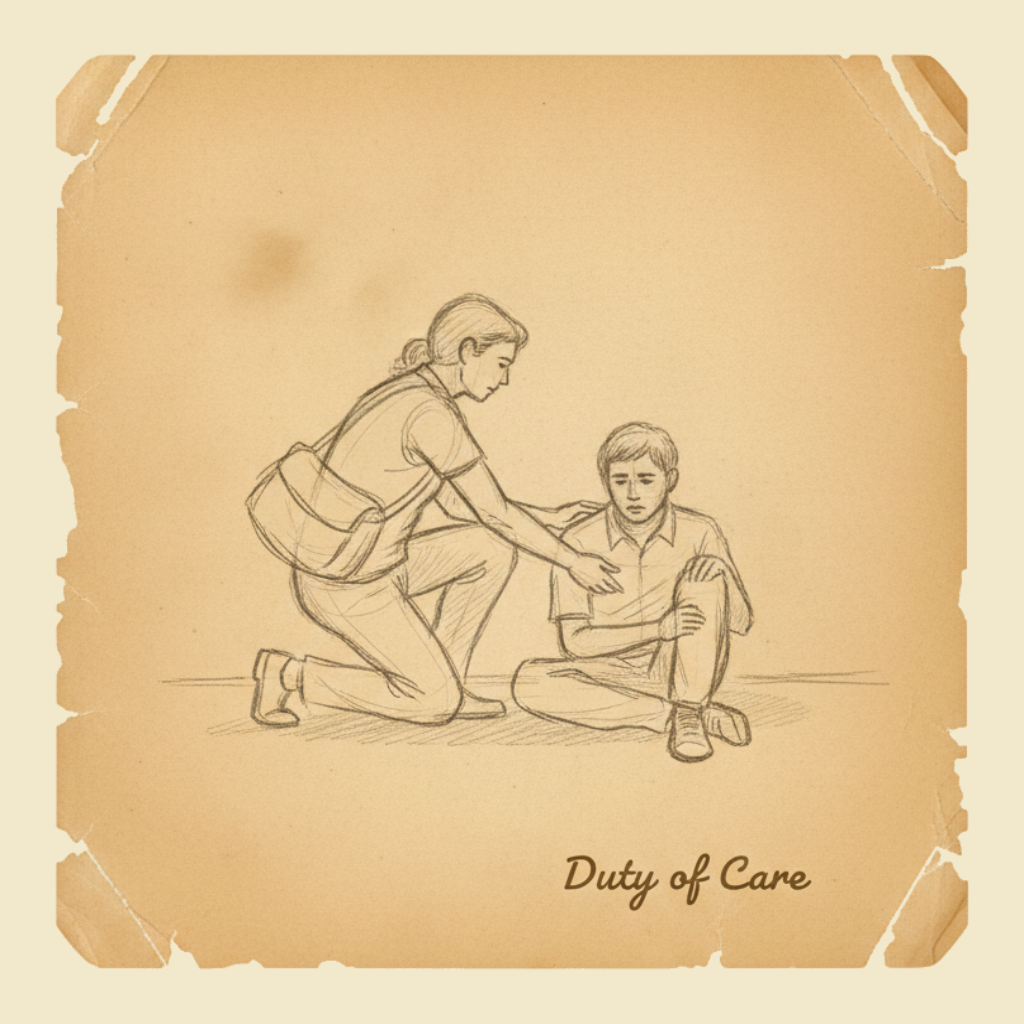
What duty of care is (and isn't)
A duty of care is the legal obligation to take reasonable care to avoid causing harm to another person. In Australia, the duty arises whenever a relationship between two people is one in which it is reasonably foreseeable that one person's actions (or inactions) could harm the other. A doctor has a duty of care to their patient, a teacher to their student, an employer to their worker — and a first aider, once they take on the role of helping a casualty, to that casualty.
Two things to be very clear about up front, because they are the most commonly misunderstood pieces of the framework:
- In most Australian states, there is no general legal duty for a member of the public to start helping a stranger. A passer-by who walks past a collapsed casualty without acting may be morally questionable, but they are not legally liable in tort for their inaction. The major exceptions are the Northern Territory, where Section 155 of the Criminal Code does create a positive duty to provide assistance in life-threatening situations, and certain professional roles where the duty is built into the role itself.
- Once you do start helping, the picture changes. You have voluntarily taken on the role, and from that moment on you owe the casualty a duty to provide care that is reasonable for someone with your level of training. You cannot simply abandon them halfway through — that would be a breach.
The combination matters: the law doesn't force you to help, but it doesn't let you start and then walk off without good reason either.
§ Instructor's note
Learners often arrive convinced that "duty of care" means they will be sued if anything goes wrong. The teaching point is the opposite: in 30+ years of Good Samaritan legislation in every Australian jurisdiction, there is no recorded case of a layperson being successfully sued for first aid given in good faith within their level of training. The legal system is structured to encourage helping, not to punish it. The risk of being sued for trying is approximately zero; the risk of not trying — moral, professional, and human — is real. Drill the rule: the law is on the side of the helper.
When the duty arises
The duty of care to a casualty arises in any of these situations:
- You volunteer to help. A passer-by who kneels down beside a collapsed casualty in the street has, by that act, taken on the duty.
- You are the designated first aider at your workplace, on the roster, and an incident occurs during your hours. Your employment establishes the duty before you ever see the casualty.
- You are in a role with a built-in duty — teacher, childcare worker, lifeguard, paramedic, nurse, police officer, ambulance officer. The role itself carries the duty.
- You have a pre-existing relationship of responsibility — parent and child, guardian and ward, instructor and student in a structured activity, supervisor and trainee.
- You have created the danger — you put the hazard there, you knocked the casualty over, your dog bit them. You then have a duty to help fix what your action caused.
In day-to-day workplace first aid, the relevant trigger is usually the second one: you are on the roster, you are at work, and an incident occurs. The duty exists from the moment you arrive on shift, not from the moment the casualty falls.
What "reasonable care" actually means
The duty is not to provide perfect care or expert care. It is to provide reasonable care for a person with your training and resources, in the circumstances. The legal phrase is "the standard of care of a reasonable person of like training in like circumstances" — and this is the part that matters most for first aiders, because it sets the benchmark exactly where it should be.
Concretely:
- A first aider with HLTAID011 training is held to the standard of a competent HLTAID011-trained first aider — not to the standard of a paramedic, a nurse, or a doctor.
- A workplace first aider responding with the kit they actually have is judged on what is reasonable with that kit — not on what they might have done with hospital equipment.
- A first aider working in difficult conditions (poor light, restricted access, distressed bystanders, limited time) is judged in those conditions, not as if they had a calm, well-lit emergency department.
- Following the ANZCOR guidelines is, by construction, evidence of reasonable care. The guidelines exist because the resuscitation peak body has already worked out what reasonable practice is. A first aider who does what the guideline says has met the standard.
Things that would fall below the standard:
- Doing nothing because you "didn't want to get involved", once you had taken on the role.
- Acting clearly outside your training (giving an injection, making a diagnosis, performing a procedure you've never been taught).
- Ignoring an obvious safety step (failing to check the scene for danger, not calling an ambulance when ANZCOR says to).
- Leaving the casualty before help arrives, without handing over to someone equally or better trained.
Good Samaritan protection
Every Australian state and territory has Good Samaritan legislation — laws that protect a person who provides first aid in good faith from civil liability for any harm caused by that first aid, provided they were not acting under the influence of drugs or alcohol and were not grossly negligent. The names of the Acts vary:
- NSW — Civil Liability Act 2002, Part 8
- Victoria — Wrongs Act 1958, Section 31B
- Queensland — Civil Liability Act 2003, Section 26
- WA — Civil Liability Act 2002, Section 5AD
- SA — Civil Liability Act 1936, Section 74
- Tasmania — Civil Liability Act 2002, Section 35B
- ACT — Civil Law (Wrongs) Act 2002, Section 5
- NT — Personal Injuries (Liabilities and Damages) Act 2003, Section 8
The wording differs slightly between jurisdictions but the substance is the same: a person who, in good faith and without expectation of payment, provides first aid or emergency assistance to a casualty is not personally liable in civil law for any injury or damage caused, as long as they acted honestly, were not impaired, and did not depart wildly from what a reasonable person would have done.
The protection has two important consequences:
- The risk to a first aider acting in good faith is essentially nil. The legislation was deliberately enacted to remove the legal disincentive to helping.
- The protection only covers honest, sober, within-training action. It does not cover a person who is drunk, who deliberately harms the casualty, or who acts so far outside their training as to be reckless.
Note that Good Samaritan law applies to individuals providing voluntary assistance. A workplace first aider acting in their employed role is covered by a different but parallel layer — the employer's vicarious liability and the workplace's insurance — which has the same practical effect: an honest first aider doing their job within their training is not personally exposed.
Where the duty ends
A duty of care, once taken on, runs until one of the following happens:
- The casualty no longer needs care — they have recovered, they are walking and talking and refuse further help (see consent chapter), or the situation that triggered the duty has resolved.
- You hand the casualty over to someone equally or better trained — paramedics, a nurse, a doctor, another HLTAID-trained first aider taking over. The handover is the legal moment your duty transfers to them. Always do an explicit verbal handover — "this is the casualty, this is what happened, this is what I did, this is what I'm worried about" — both because it's good practice and because it documents the transfer.
- You are physically unable to continue — exhaustion, your own injury, a hazard developing on scene that forces you to retreat. The duty doesn't require you to put yourself in danger.
- Continuing would put others in danger that outweighs the benefit to the casualty.
What does not end the duty:
- The casualty being "difficult" or refusing to cooperate (unless they are a competent adult refusing all care — see consent chapter).
- Your shift ending. If you're mid-resuscitation when 5 pm rolls around, you don't walk out. You keep going until handover.
- Being uncomfortable. Reasonable care is a duty even when the situation is unpleasant.
The handover to paramedics is the legal moment your duty of care transfers. Make it explicit: don't just step back when they arrive, give them a verbal summary — name, age, what happened, what you found, what you did, what the casualty's condition is now, any concerns. This is good clinical practice (paramedics rely on it to start their own assessment) and it is the documentary record that you handed over rather than abandoned. If you can write a quick note for the incident register at the same time, do.
Children, vulnerable casualties, and the higher duty
The duty of care owed to a child or other vulnerable casualty (an elderly person with dementia, a person with a cognitive disability, an unconscious adult) is higher than the duty owed to a competent adult. The reason is that the casualty cannot fully advocate for themselves, and the first aider is therefore more responsible for ensuring they receive appropriate care.
For first-aid purposes this mostly means:
- Always lean toward calling an ambulance when in doubt.
- Always stay until appropriate care arrives — do not leave a child or vulnerable casualty alone.
- Notify the parent, guardian, or substitute decision-maker as soon as is practical.
- Document carefully — vulnerable casualty incidents tend to be reviewed more carefully later.
The duty across roles — workplace, voluntary, and incidental
Three common patterns of duty for someone with first-aid training:
- Workplace first aider on duty. Duty arises from your employment. Your workplace's insurance covers your actions; your training defines the standard. This is the most common pattern and the one most learners on this course will encounter.
- Member of the public coming across an incident. No pre-existing duty until you start helping. Good Samaritan legislation protects you the moment you do. You can stop when handing over to anyone equally or better trained.
- Off-duty health professional or first aider. The same as the member-of-the-public case in most jurisdictions — although a higher training level may, by raising the "reasonable person of like training" benchmark, also raise the standard you are held to. A nurse who provides first aid at the side of the road is judged by the standard of a reasonable nurse, not a reasonable layperson. The protection is still there; the bar is just commensurate.
In all three cases the trigger is the same (you take on the role of helping), the standard is the same (reasonable care for someone with your training), and the protection is the same (Good Samaritan legislation, plus workplace insurance if relevant).
Documenting your way to a clean conscience
Documentation is the unsung hero of duty-of-care protection. A first aider who has filled in the workplace incident register on the day, kept brief notes during the response, and handed over verbally to paramedics has built a contemporaneous record that speaks for itself. A first aider with no written record has to reconstruct events from memory months later, which is far harder and far less convincing.
The workplace procedures chapter covers the incident register in detail. The shorthand for duty-of-care purposes is: write it down on the day, stick to the facts, and keep it confidential in line with the privacy and confidentiality chapter.
If there is one duty-of-care failure mode that actually does come up in workplace first-aid investigations, it is abandonment — a first aider who started helping, became overwhelmed or distracted, and walked away without handing over. Abandonment is not the same as deciding the scene is unsafe and retreating, and it is not the same as passing the casualty to a more qualified rescuer. It is leaving without anyone equivalent or better in your place. The protection is simple: never leave a casualty unattended unless you have to call for help and there is no-one else; and always do an explicit verbal handover when you do step away.
A rescuer providing first aid has a moral and, where the duty has been assumed, a legal obligation to provide care to the standard of a reasonable person of like training in like circumstances. Where Good Samaritan legislation applies, a rescuer acting in good faith and without gross negligence is protected from civil liability. The duty continues until the casualty no longer needs care, or until handover to another person equally or better qualified.
What not to do
- Do not start helping and then walk away without handing over.
- Do not act outside your training because you feel pressured to "do more".
- Do not assume Good Samaritan legislation covers reckless or impaired action — it doesn't.
- Do not be afraid to act because you might be sued. The legislation is structured to protect you.
- Do not treat the duty as a burden — treat it as the framing that makes your role professional, protected, and recognised.
- Do not skip the documentation. The incident register is the duty-of-care paper trail.
You will work through a small number of case-study scenarios that test the edges of duty of care — the stranger collapsed in a public place, the casualty who refuses help, the moment of handover to paramedics, the "off-duty" rescue. The aim is not legal training; it is to build the instinct to act within your training, document what you did, and hand over cleanly. The actual law is friendlier than its reputation, and the chapter is mostly about getting comfortable enough to use it.
Duty of care is not a trap. It is the framing the law uses to recognise the role you have voluntarily taken on, hold you to a reasonable standard for someone with your training, and protect you when you act in good faith. It exists to make first aid possible, not to make it dangerous.
— ANZCOR Guideline 10.5 (legal and ethical issues)