Why this matters
A first aider is, by definition, in contact with strangers' blood, vomit, saliva, urine and faeces, often in unplanned circumstances and with no idea of the casualty's medical history. Some of those fluids can carry infections — hepatitis B, hepatitis C, HIV, norovirus, COVID-19, influenza, less common things — that can pass to the rescuer through a cut, a splash to the eye, an inhaled droplet, or a needle-stick. The risk per incident is low; the risk per career, accumulated over hundreds of incidents, is real. G9-1-1
The opposite direction matters too. A first aider's hands carry their own bacteria, and a fresh wound is exactly the place those bacteria least belong. Wound infections after first aid are far more common than disease transmission to the rescuer, and they are nearly always preventable with clean hands and clean dressings.
The framework that controls both directions of risk is called standard precautions, and it has one rule: treat every casualty's blood and body fluids as potentially infectious, every time, regardless of who they are. No assessment of "do they look sick", no asking about HIV status, no exceptions for friends and family. Standard, every time.
§ Instructor's note
"Standard precautions" is the modern rebranding of what used to be called "universal precautions" — the change in language reflects the realisation that asking the rescuer to make case-by-case judgements about which casualties were "high-risk" was both ineffective and discriminatory. The current word is standard because the precautions are the same for every casualty, full stop. Drill the rule: gloves go on for everyone, not just the ones who look unwell.
What standard precautions actually are
The core of standard precautions for a first aider is short:
- Hand hygiene — wash hands or use alcohol-based hand rub before and after every contact with a casualty.
- Personal protective equipment (PPE) — gloves always; eye protection and a face shield/mask when there is any chance of splash, spray or rescue breaths.
- Safe handling of sharps — never re-sheath a needle, never pass a sharp from hand to hand, always use a sharps container.
- Safe handling of waste — bagged disposal of contaminated dressings, gloves and wipes; clean-up of spills with appropriate absorbent and disinfectant.
- Cleaning and disinfection of surfaces and reusable equipment between uses.
- Respiratory hygiene — cover coughs and sneezes, and use a mask if you or the casualty has respiratory symptoms.
That is the whole framework. Everything below is detail on how to apply it as a first aider.
Gloves — the single most important thing
Disposable nitrile gloves (or latex, if no-one in the room has a latex allergy — and you cannot assume) are the single most useful piece of PPE in a first-aid kit. Two pairs live in every Australian-standard first-aid kit, and you should put on at least one pair before touching any casualty whose injury involves blood, vomit, faeces, urine, or open broken skin.
How to use them properly:
- Put them on with clean hands. If your hands are visibly contaminated already, wipe them on a clean cloth first.
- Check for tears as you pull them on. A torn glove is worse than no glove because it gives a false sense of security.
- Double-glove if you anticipate heavy contamination (a major bleed, a vomiting casualty), or if the gloves you have are thin.
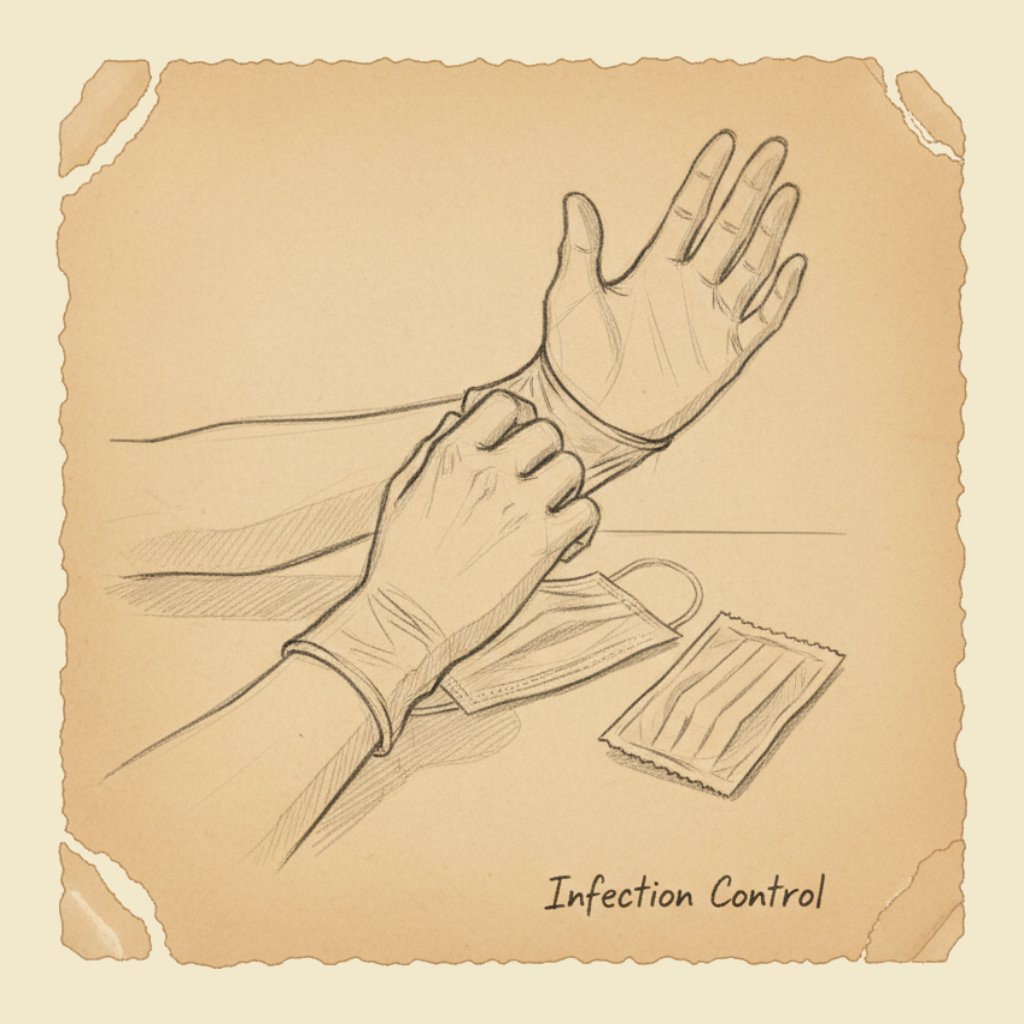
- Take them off carefully. Pinch the cuff of one glove, peel it off inside-out into your other gloved hand, then slide a bare finger inside the cuff of the second glove and peel that one off over the first. The contaminated surface ends up rolled inside, away from your skin.
- Bin them in a sealable bag, then wash your hands.
- Never reuse them. Gloves are single-use, single-casualty.
Gloves are not magic. They protect your skin from contact, but they do not protect you from a needle that goes through them, and they do not stop you from contaminating something else with your gloved hand. If you adjust your glasses, scratch your face, or answer your phone with a contaminated glove, you have just bypassed the protection.
Hand hygiene
Hand washing is the single most effective infection-control measure ever invented, and it is free. The rule:
- Wash hands with soap and running water for 20 seconds (about the time it takes to hum Happy Birthday twice) before and after every casualty contact, after removing gloves, and after any contact with body fluids.
- If running water isn't available, use an alcohol-based hand rub (60% alcohol or higher) and rub until dry — but note that alcohol rubs do not work on visibly soiled hands or on norovirus, so soap and water is always the better option when available.
- Cover any cuts or grazes on your own hands with a waterproof dressing before you put gloves on. Your skin is your barrier; broken skin is the most likely route for infection into you.
Eye and face protection
Most first-aid contact is hand-to-casualty and gloves are enough. But two situations call for face protection:
- Splash or spray risk — major bleeding, projectile vomiting, a casualty coughing blood, a chemical incident. Goggles or a face shield protect the eyes and mucous membranes, which are an easy entry route for blood-borne viruses.
- Rescue breaths — modern first-aid kits include a resuscitation face shield (a thin plastic sheet with a one-way valve) or a pocket mask. Use it. The valve is the barrier between you and the casualty's airway and reduces the (already low) risk of disease transmission during mouth-to-mouth substantially. ANZCOR makes the point that the absence of a shield is not a reason to skip rescue breaths in a known casualty — but having one in the kit and using it is always preferable.
Sharps
A "sharp" is anything that can puncture skin — a needle, a scalpel blade, broken glass, a piece of jagged metal. Sharps are the single most dangerous infection-control hazard a first aider faces, because a puncture wound bypasses every other barrier you have set up.
The rules:
- Never re-sheath a used needle. The act of putting the cap back on is the most common needle-stick mechanism. Drop the whole syringe, uncapped, straight into a sharps container.
- Never hand a sharp to another person. Place it on a tray or surface for them to pick up.
- Use a rigid, puncture-proof, yellow-and-black sharps container for disposal. Most workplaces have one in the first-aid room.
- Pick up broken glass with a brush and dustpan, not with your fingers, even gloved.
- If you find a discarded needle in the community — a public toilet, a park — do not touch it. Call the local council or police; they have professional disposal services.
If you do sustain a needle-stick injury, see the sharps injuries chapter for the wash-encourage-bleed-report-test sequence.
A needle-stick injury from an unknown casualty is a medical emergency, even though it does not feel like one. The window for post-exposure prophylaxis against HIV is short — ideally within 1–2 hours, and definitely within 72. After washing the wound, get to your GP, the emergency department, or a sexual health clinic the same day. Document the incident in your workplace incident report on the day it happens — if you need workers' compensation later, the contemporaneous record is what will support your claim.
Cleaning up spills
Body-fluid spills — a blood pool, a vomit puddle, a wet patch from urine or faeces — need to be cleaned up after the casualty has been moved or treated, and the basic process is the same regardless of which fluid:
- Glove up (and add eye protection if the spill is large or there is any splash risk).
- Cover the spill with absorbent material — paper towel, absorbent granules from a spill kit, or a commercial spill pad. Let it soak.
- Scoop the bulk into a biohazard bag with a brush and pan, or a piece of stiff cardboard.
- Disinfect the area with a hospital-grade disinfectant or a freshly-made 1:10 bleach solution (1 part household bleach to 9 parts water). Leave the disinfectant on the surface for the contact time on its label — usually 5 to 10 minutes — before wiping dry.
- Bag and seal all contaminated material as clinical waste. Most workplaces have a yellow biohazard waste stream; if not, double-bag and seal in regular waste.
- Strip your gloves (carefully, as above) and wash your hands.
Workplaces in Australia are required by Work Health and Safety law to have a documented spill response and a spill kit accessible to first aiders. If yours doesn't, that is the kind of thing for the workplace procedures chapter.
Respiratory hygiene and the post-COVID layer
Since the COVID-19 pandemic, ANZCOR and the broader public health community have folded respiratory hygiene into standard precautions explicitly. The rules are short:
- Cover coughs and sneezes — yours and the casualty's — with a tissue or the inside of an elbow.
- Wear a surgical mask if you have respiratory symptoms yourself (and stay away from casualties altogether if you can).
- Wear a surgical mask on the casualty — a "source-control" mask — if they are coughing in close proximity to you, particularly if they are febrile.
- Position yourself off to the side rather than directly in front of a coughing casualty's face when possible.
- Ventilate the room if you can — open a window, open a door — when treating a casualty in close quarters.
None of this changes the fundamental rule that ANZCOR resuscitation protocols come first. If a casualty needs CPR, they need CPR — you do not delay compressions to look for a mask.
Rescuers should apply standard precautions for the prevention of infection during resuscitation and first aid. These include hand hygiene, the use of personal protective equipment (gloves, eye protection, face shield or pocket mask), safe handling and disposal of sharps, and the cleaning of any contaminated equipment or surfaces. The risk of disease transmission to the rescuer during CPR is very low, and concern about transmission should not be a reason to withhold resuscitation from a casualty who needs it.
Documentation and reporting
Any incident in which a first aider has been exposed to a casualty's blood or body fluids — needle-stick, splash to the eye, blood through a torn glove, mouth-to-mouth without a shield — needs to be documented in the workplace incident register on the day it happens. The record should include the date, time, mechanism of exposure, the body fluid involved, the action taken (washing, post-exposure prophylaxis, GP review) and the names of everyone involved. The workplace procedures chapter covers the legal reporting framework in detail.
When to call for medical help (for yourself)
For the rescuer, after a body-fluid exposure, see your GP or an emergency department the same day if:
- You sustained a needle-stick or other sharp injury from an unknown source.
- A casualty's blood entered your eye, mouth, or an open wound on your skin.
- You performed mouth-to-mouth on a casualty without a barrier and the casualty had visible blood in or around the mouth.
- You are not up to date with your hepatitis B vaccinations.
- You are pregnant and were exposed to any body fluid.
The treating clinician will run a risk assessment, offer post-exposure prophylaxis if appropriate, and arrange follow-up testing. None of this is something to "wait and see" on.
What not to do
- Do not decide a casualty is "low risk" and skip the gloves. Standard precautions are standard.
- Do not re-sheath needles. Ever.
- Do not use an alcohol hand rub on visibly soiled hands — wash with soap and water first.
- Do not wear the same gloves between casualties, or to make a phone call mid-treatment.
- Do not clean a body-fluid spill without PPE because "it's only a bit".
- Do not delay CPR because you can't find a face shield. Resuscitate first; the disease risk is far smaller than the cardiac arrest risk.
- Do not leave contaminated sharps or waste loose in a bin. Use the sharps container or biohazard bag.
Workplace first aiders in Australia should be up to date with the three-dose hepatitis B vaccination course. If your job involves regular first-aid duties, your employer may be required to offer it free of charge as part of your role-specific health surveillance — ask your health and safety officer. Tetanus boosters every ten years are also worth keeping current, given how often a first aider's own hands meet broken glass, jagged metal and scratches in the field.
You will rehearse glove-on / glove-off technique until removing a contaminated glove cleanly is automatic, practise the hand-hygiene scrub, and run through a body-fluid spill clean-up using a simulated spill kit. Most learners are surprised by how easy it is to contaminate yourself during glove removal — the technique is the whole point of the drill.
Standard precautions are the most boring part of first aid, and the most important. The casualty in front of you will get better whether or not you put gloves on. The next casualty, and the one after that, depend on you still being healthy enough to help them.
— ANZCOR Guideline 10.5 (rescuer safety)