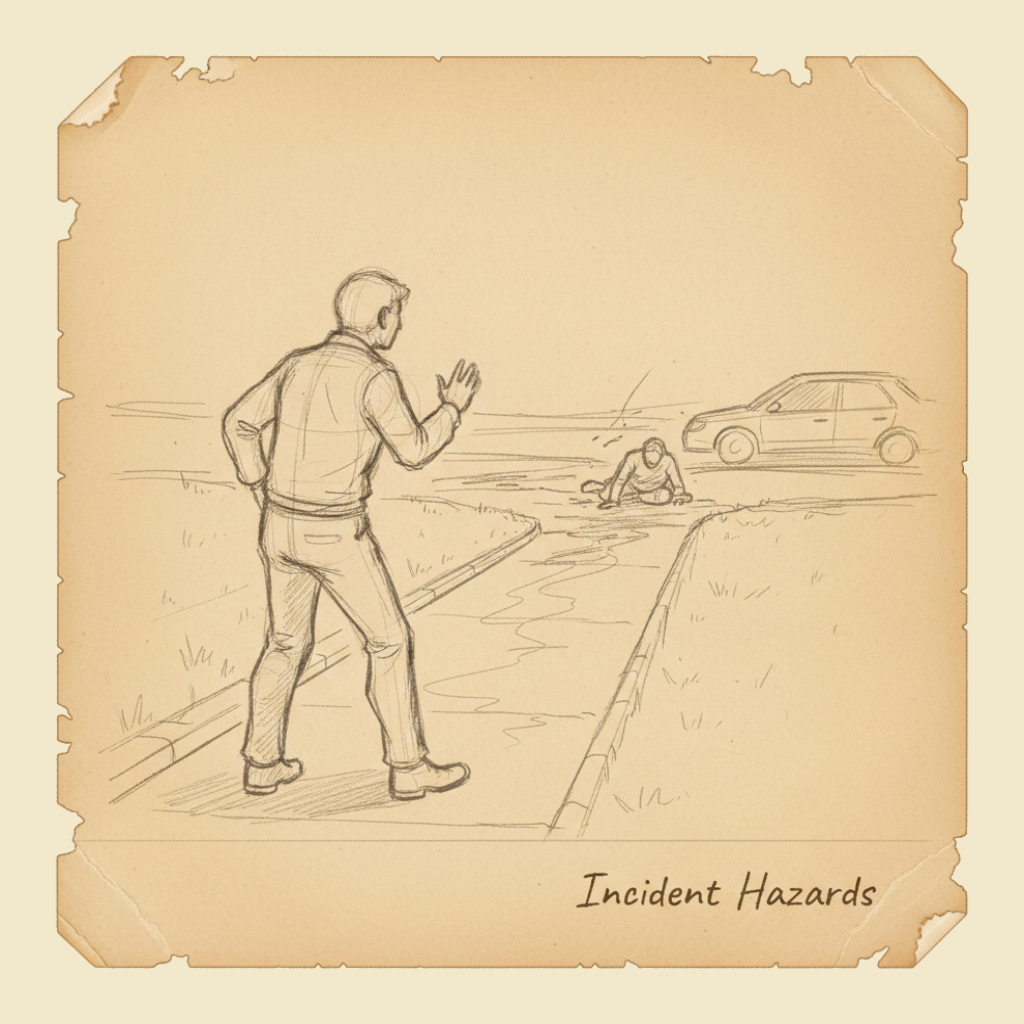
Why this is the first step, every time
Every first-aid protocol in this course — bleeding, burns, choking, CPR, snake bite, stroke — opens with the same word: DRSABCD. The D is for Danger, and it comes before everything else for a reason. The single most common way first aiders get hurt is by rushing to a casualty without checking what hurt the casualty in the first place. Electricity is still live. The car is still on fire. The dog is still in the room. The fume that knocked them out is still in the air. G9-1-1
ANZCOR's basic-life-support framework is explicit about this: the rescuer's safety comes first, the bystanders' safety comes second, and the casualty's safety comes third. That ordering sounds heartless and isn't. A first aider who walks into a danger zone and becomes the second casualty has not helped — they have made the incident harder to resolve, slowed the ambulance response, and put more people at risk.
§ Instructor's note
Learners often resist the "danger first" rule on emotional grounds — surely you'd just run in? The teaching point is that the rule exists precisely because the human instinct is to run in. Protocols are not for the calm moments; they are for the panicked ones, when your judgement is the worst it will be all year. The two-second pause to scan for danger is the most expensive habit to build and the most valuable.
What "hazard" actually means
A hazard is anything at the scene that could hurt you, the bystanders, or the casualty further. The categories you should mentally run through are short and the same every time:
- Traffic. Roads, driveways, car parks, forklifts, bicycles. Cars do not stop just because you are kneeling next to a casualty.
- Electricity. Downed power lines, exposed wiring, an appliance still plugged in. Assume any wire is live until proven otherwise.
- Fire and smoke. A burning building, a vehicle fire, smouldering material. Smoke kills more people than flame.
- Water and currents. Surf, rivers, pools, flooded ground. A current that pulled the casualty under will pull you under too.
- Fumes and gases. Chemical spills, carbon monoxide in enclosed spaces, fuel vapour, anhydrous ammonia, silo and tank atmospheres. If a casualty has collapsed in a confined space, assume the air is what knocked them down.
- Falling or unstable structures. Scaffolding, machinery, trees, vehicles balanced precariously, building rubble.
- Sharp objects. Broken glass, needles, jagged metal, sharps in waste.
- Animals. A dog defending an injured owner, livestock around a casualty in a paddock, a snake still in the area.
- Crowds and aggression. Bystanders pushing in, an agitated bystander, an active assault, a domestic incident still unfolding.
- Body fluids. Blood, vomit, faeces — handled in the infection control chapter, but worth noting at the danger step too.
- The casualty themselves. A confused, intoxicated, post-ictal or hypoglycaemic casualty may swing at you without meaning to.
The rule is not "memorise the list". The rule is stop and look — for ten seconds, before moving in — and ask "what hurt this person, and is it still here?"
The risk minimisation hierarchy
Workplace health and safety law in Australia uses a hierarchy of controls — the same hierarchy applies to a first-aid scene, just compressed into seconds:
- Eliminate the hazard. Best option, when possible. Switch off the power at the wall. Turn off the gas. Move the vehicle into park and pull the keys. Get the dog out of the room. Make the road safe with hazard lights and a bystander stopping traffic.
- Isolate the hazard. If you can't eliminate it, put distance or a barrier between it and everyone. Move the casualty (only if you can do it safely — see below). Push bystanders back. Close the door on the smoke-filled room while you call 000.
- Use protective equipment. Gloves at minimum. Eye protection if there's spray or splash. A face shield or pocket mask for rescue breaths. High-vis if you have it. A fire blanket if you have it. The kit is there to be used.
- Accept the residual risk knowingly. If after all of the above the scene is still not safe — you cannot turn off the power, you cannot get into the water, the building is on fire — then you do not enter. You stay back, you call 000, you tell the operator exactly what is wrong, and you let the people with the right equipment handle it. This is not failure. This is the protocol working as designed.
Should I move the casualty?
The default answer in first aid is no. Moving a casualty risks worsening spinal injury, dislodging clots, and disrupting your own assessment. ANZCOR's general rule is: leave the casualty where they are, and bring help to them.
The exceptions — situations where you must move — are short:
- The scene is going to kill them if they stay. Active fire, rising water, unstable building about to collapse, traffic that cannot be stopped, hostile attacker still present.
- You cannot give effective CPR where they are. A casualty face-down in a confined space, on a soft surface like a deep mattress, or wedged where you can't access the chest.
- The airway cannot be managed in their current position. An unresponsive casualty who is breathing must be in the recovery position; if they are face-up and you cannot turn them in place, you must move them.
When you do move, move with care. Support the head and neck if you suspect spinal injury, drag along the long axis of the body where possible, and stop as soon as you reach a safe spot. The head, neck and spinal injuries chapter covers the spinal-aware techniques in more detail.
If a casualty has collapsed inside a tank, silo, vault, manhole, sewer, grain bin, fridge, well, or any other enclosed space, do not enter to retrieve them. Confined-space collapses are almost always due to oxygen-displacing or toxic atmospheres, and the rescuer who steps in to help becomes the second casualty within seconds. Australia averages multiple deaths a year from would-be rescuers entering confined spaces. Call 000 immediately, request rescue services with breathing apparatus, and keep all bystanders out.
The DRSABCD danger step in practice
When you arrive at any incident, before you touch anything:
- Stop at a safe distance. Five paces back is fine. You can see plenty from there.
- Look. Run the hazard list mentally — traffic, electricity, fire, fumes, water, structures, sharps, animals, crowds, fluids. What hurt this person?
- Listen. Hissing gas, crackling fire, a running engine, raised voices, water flowing.
- Smell. Smoke, fuel, gas, chemicals. Do not ignore an unfamiliar smell — it is often the only warning a fume gives.
- Decide. Is the scene safe to enter as it is, safe after one quick action (turn off the power, move the car keys), or not safe at all? If "not safe at all" — stay out, call 000.
- Act. Make the scene safe, deploy your PPE, then move to the casualty.
The whole scan should take ten to fifteen seconds. It feels like an eternity when you are watching someone bleed; it is the most important quarter of a minute of the entire response.
The first action of any rescuer is to ensure the safety of themselves, bystanders and the casualty — in that order. A scene that is not safe for the rescuer must be made safe before first aid is provided, or the casualty must be moved to a safe location if that can be done without further harm. Where the scene cannot be made safe, the rescuer should call for emergency services and not enter.
Risk minimisation between incidents — the workplace layer
Most of the hazards above come from the incident itself. Some come from the broader environment, and your workplace is required by law to have already controlled those. Australian Work Health and Safety law requires a PCBU (Person Conducting a Business or Undertaking — i.e. your employer) to identify hazards, assess risk, and put controls in place before an incident, not after. The first-aid kit, the eyewash station, the AED on the wall, the chemical SDS folder, the spill kit, the trained first aiders on the roster — all of these are pre-positioned controls that exist because someone did the risk assessment in advance.
A first aider is part of that pre-positioning, not an afterthought to it. If you can see a hazard at your workplace that hasn't been controlled — a missing kit, an expired AED pad, a chemical with no SDS, a fire exit blocked — that is the kind of thing to raise with your health and safety committee before someone is hurt. The workplace procedures chapter covers your reporting obligations.
"Hazard" isn't only physical. A first aider responding to a violent incident, a child casualty, a workplace death, or a major trauma is exposed to psychological harm too — and that is a real workplace hazard with real controls (debriefing, EAP, peer support, time off). The rescuer stress and support chapter covers this in detail.
When to call an ambulance
Call 000 immediately for any incident where the scene itself is dangerous and you cannot safely make it safe — that includes any of:
- Casualty in a confined space, regardless of how minor the injury looks.
- Casualty in contact with electricity that you cannot isolate.
- Casualty in water you cannot safely reach.
- Casualty in or near a vehicle, structure or machinery fire.
- Casualty exposed to unknown fumes or chemicals.
- Casualty trapped under or inside machinery, vehicles, or rubble.
- Any incident on a road or near moving traffic.
- Any incident where a hostile or aggressive person is still present.
In all of these, the dispatcher will route the right specialist resource — fire and rescue, hazmat, confined-space rescue, police — alongside the ambulance. Tell the operator the hazard, not just the injury.
What not to do
- Do not run into a scene because it feels urgent. The two-second pause is the most important thing you do.
- Do not assume "the power must be off by now" — confirm it.
- Do not enter a confined space to retrieve a collapsed casualty, ever.
- Do not try to fight a fire bigger than a wastepaper bin. Your job is to evacuate and call.
- Do not move a casualty unless the scene will harm them if they stay.
- Do not ignore PPE because "there's no time" — gloves take three seconds.
- Do not let bystanders crowd in. Keep a clear working space around you.
You will rehearse the danger scan as a deliberate, named step in every scenario you run, including ones where the scenario is rigged to have a hidden hazard (a "live" power cord, a "smouldering" rag, a bystander acting unstable). The instructor will deliberately mark you down for entering a scene without a visible pause, no matter how good your subsequent first aid is — because in real life, the entry is the part that gets you killed.
The first aider's first job is to not become the second casualty. Stop, look, listen, decide, act — in that order, every time, even when it feels absurd. The casualty has ten minutes; you have ten seconds.
— ANZCOR Guideline 2 (introduction to first aid)