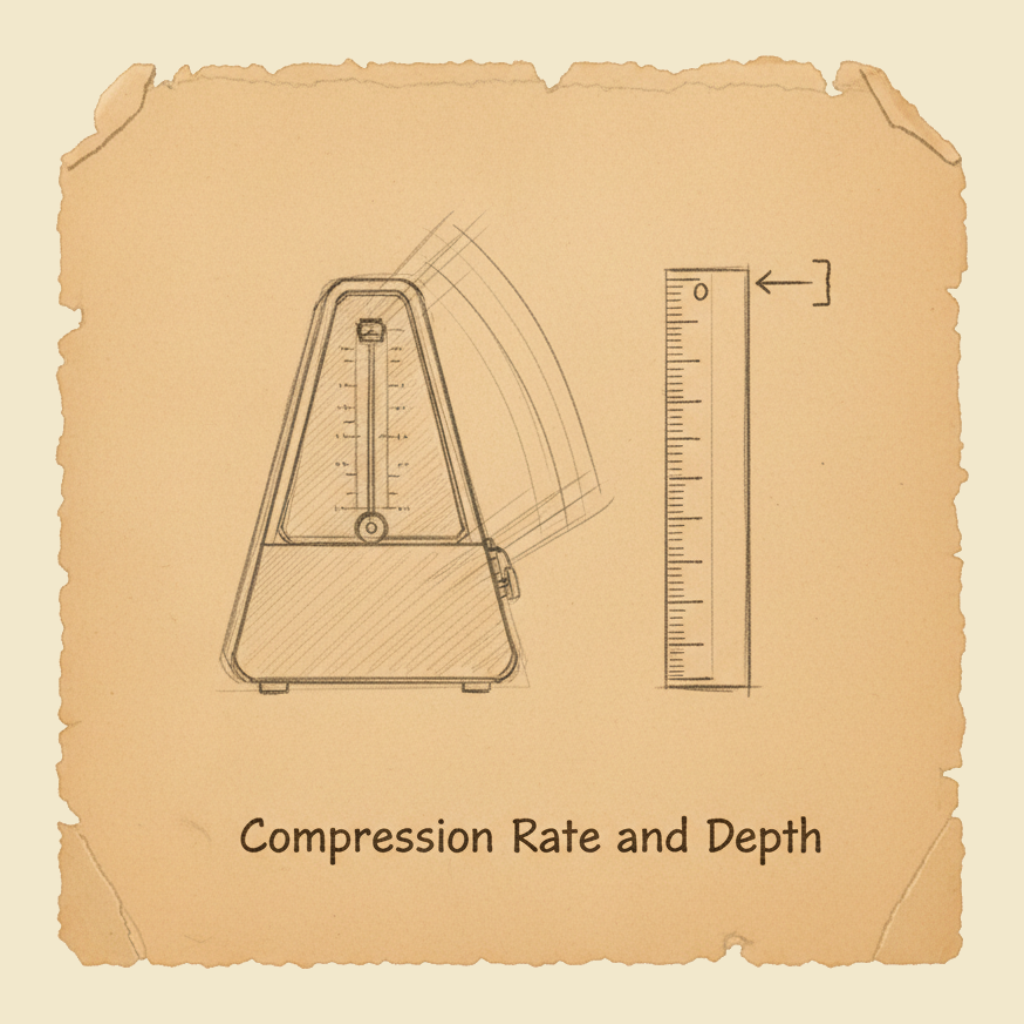
Why the numbers matter
CPR works by physically pumping blood. Chest compressions squeeze the heart between the breastbone and the spine, forcing blood out into the arteries; releasing the chest lets the heart fill again from the venous return. Done at the right rate, the right depth, with the right recoil, this generates about 25–30% of normal cardiac output — enough to keep the brain alive and the heart muscle perfusing for several minutes, until defibrillation or paramedics arrive. Done badly, it generates almost nothing. G6 G8
The difference between effective CPR and ineffective CPR is not whether you are doing "something". It is whether the four mechanical parameters — rate, depth, recoil, and ratio — are within the right ranges. The ANZCOR numbers are derived from the ILCOR international evidence review and are essentially identical across the major resuscitation councils worldwide. They are short, memorable, and worth burning into the brain.
§ Instructor's note
The teaching point of this chapter is that CPR is a mechanical intervention with measurable parameters, not a vague "do something with the chest" activity. The four numbers — 100–120, 5–6, full recoil, 30:2 — are the difference between life-saving and theatre. Drill the rule: you are not pumping; you are running a small heart. Run it at the right rate, the right depth, and let it fill between beats.
The four numbers, in one paragraph
For an adult:
- Rate: 100 to 120 compressions per minute.
- Depth: 5 to 6 cm (about one third of the chest depth).
- Recoil: full — let the chest come all the way back up between compressions.
- Ratio: 30 compressions to 2 rescue breaths.
For a child (1 year to puberty) and infant (under 1 year), the same rate and ratio apply, with proportionally smaller depth. The age-specific differences are covered in detail in the CPR anatomy chapter.
The rest of this chapter is the explanation of each number — what it is, why it is what it is, and how to actually achieve it.
Rate — 100 to 120 compressions per minute
The rate at which you compress determines how often the heart is squeezed and refilled. Too slow and you don't generate enough flow. Too fast and the heart doesn't have time to refill between compressions, so each squeeze pushes less blood. The sweet spot is 100–120 per minute, a range that has been validated by clinical research and is now the international standard.
100–120 per minute is faster than most people realise. It is roughly two compressions per second, or about the rhythm of:
- The Bee Gees' Stayin' Alive (103 bpm) — the unofficial international CPR rhythm, taught in resuscitation courses all over the world.
- Queen's Another One Bites the Dust (110 bpm) — same range, possibly less appropriate.
- The opening to Beyoncé's Crazy in Love, ABBA's Dancing Queen, or Justin Bieber's Baby — all in the 100–120 bpm range.
Pick a song you can sing in your head, and use it. Most rescuers, given a target without a rhythm reference, drift slow under stress — counting "one, two, three" tends to slip toward 60–80 per minute, which is too slow. Singing along internally to a 100 bpm song is the fastest way to lock in the right rate.
Modern AEDs and many manikins now have a metronome built in that beeps at 100–120 — turn it on if you have it. Some AEDs also give real-time feedback on compression rate ("press faster" / "press slower").
Depth — 5 to 6 cm in an adult
The depth of each compression determines how much the heart is actually being squeezed. Too shallow and you are bouncing on the chest without compressing the heart between the breastbone and the spine. Too deep and you risk fracturing ribs or injuring underlying structures. The sweet spot is 5 to 6 cm of depth in the adult chest — about one third of the front-to-back chest dimension.
5 to 6 cm is a lot more than most people instinctively press. It feels uncomfortably deep when you are doing it on a real chest, especially the first time. The most common error in untrained or under-trained CPR is shallow compressions — somewhere around 3 cm, which is enough to cause chest trauma but not enough to circulate blood effectively. Real CPR requires you to commit, lock your arms straight, use your body weight, and press with the heels of your hands — not your shoulders or your fingers — to drive the breastbone down by 5 to 6 cm.
How to get the depth right:
- Position your shoulders directly over your hands. This lets you use your body weight rather than your arm muscles — you will be doing this for a long time and the muscles will fail before the body weight does.
- Lock your elbows straight. A bent elbow absorbs force and shortens the compression.
- Press with the heel of your dominant hand, the other hand on top, fingers interlocked or lifted off the chest so you press with the heel only.
- Press from the hips, using a rocking motion that drives your body weight downward.
- Aim for the breastbone to descend 5 to 6 cm — you may hear or feel ribs cracking or the cartilage giving. This is normal and is not a reason to stop or to press more gently. A casualty whose ribs are cracked but who survives is in a much better position than a casualty whose ribs are intact and who is dead.
The cracked-rib problem is worth pausing on. Many first aiders, particularly first-time ones, instinctively reduce their compression depth when they feel rib cartilage giving way under their hands. This is the wrong instinct. Rib fractures during CPR are common (perhaps 30–40% of resuscitation cases) and are not associated with worse outcomes — they are associated with the force needed to do effective compressions. The casualty needs effective compressions; rib fractures are an acceptable cost. Do not back off on depth because the chest is giving way. Continue at full depth.
Recoil — let the chest come all the way back up
The release phase of the compression is just as important as the squeeze. When you release the chest, the negative pressure in the thorax draws blood back into the heart from the veins, refilling it for the next compression. If you don't let the chest come all the way back up — if you "lean" on the chest between compressions — the heart cannot refill, and each subsequent compression pushes less blood.
The technical term is complete chest recoil. The simple rule is: do not lean on the chest between compressions. Lift the heels of your hands just enough that the chest can return to its resting position, then drive down again for the next compression. The hands stay in contact with the chest (so you don't lose your position) but the weight comes off completely.
Most rescuers do not realise they are leaning. Compression-feedback devices used in research show that leaning rates are very high in trained rescuers under fatigue — by the second minute of compressions, many rescuers are unconsciously letting their body weight rest on the chest between compressions, halving the cardiac output. The countermeasures are:
- Conscious attention to the release phase — name it in your head, every compression: "down... up... down... up..."
- Two-minute rescuer rotation so fatigue doesn't accumulate to the leaning point.
- Real-time feedback from a manikin, AED, or compression-feedback device, if available.
Ratio — 30 compressions to 2 breaths
The standard ANZCOR ratio for adults, children, and infants is 30 compressions followed by 2 rescue breaths, repeated continuously. The reasoning:
- 30 compressions is enough to build up arterial pressure and circulate blood through the heart and brain. Shorter cycles lose pressure between cycles; longer cycles delay ventilation.
- 2 breaths is enough to deliver fresh oxygen to the lungs without taking too much time away from compressions. More breaths take longer and don't add proportional benefit.
- The 2-breath pause should be as short as possible — ideally less than 10 seconds — so that compression flow is restored quickly.
For an adult, the cycle is about 18 seconds: roughly 15 seconds of compressions plus 3 seconds for the breaths and the brief transition. Five cycles is about 90 seconds — close to the two-minute mark when rescuer rotation is recommended. (See the CPR duration and cessation chapter.)
If you cannot or will not give rescue breaths, the alternative is continuous compressions at 100–120 per minute, with no breath cycles at all. This is "compressions-only CPR" and is endorsed by ANZCOR for the rescuer who cannot do breaths. It is substantially better than no CPR at all and is the right choice when breaths are impossible.
For two-rescuer CPR with an advanced airway in place (a clinical setting, not a first-aid setting), the ratio changes — but for first-aid purposes, the 30:2 ratio is the standard, and you do not need to remember any other.
Rescue breaths — what "good enough" looks like
Rescue breaths are delivered by the head-tilt / chin-lift airway opening manoeuvre plus mouth-to-mouth (or mouth-to-mask, if you have a face shield or pocket mask in your kit).
The technique:
- Open the airway with head-tilt / chin-lift.
- Pinch the casualty's nose closed with the thumb and forefinger of the hand on the forehead.
- Take a normal breath (not a deep one — you do not need to force a large volume).
- Make a seal over the casualty's mouth with your lips, or apply your face shield / pocket mask.
- Blow gently until you see the casualty's chest rise — about 1 second.
- Lift your head, take another normal breath, and deliver the second breath.
- Return to compressions immediately.
Each breath should produce a visible chest rise equivalent to a normal breath. If the chest doesn't rise:
- Reposition the head — head-tilt and chin-lift again, more firmly.
- Check for a foreign body in the mouth and remove if visible.
- Try once more — but don't spend more than 10 seconds on the breath cycle. If it isn't working, return to compressions.
You don't need a big breath. You don't need to over-inflate. The goal is a normal breath into the casualty, not a hyperinflation. Over-ventilation is actually harmful — it raises intrathoracic pressure, reduces venous return, and reduces the effectiveness of subsequent compressions. Two normal breaths, taking less than 10 seconds total, then back to compressions.
The single biggest reason rescue breaths are not delivered is the rescuer's reluctance to put their mouth on a stranger's mouth. ANZCOR's position is unambiguous: if you cannot or will not deliver rescue breaths, do compressions-only CPR. Compressions without breaths is far better than no CPR at all, and the rescuer who would otherwise do nothing because of squeamishness about mouth-to-mouth is the rescuer who should do compressions-only.
A pocket mask or face shield in a first-aid kit removes the squeamishness almost entirely. The shield is a thin plastic sheet with a one-way valve in the middle — you place it over the casualty's face, deliver breaths through the valve, and the casualty's exhalation does not come back into your mouth. The kit is cheap, the technique is simple, and most workplace first-aid kits already include one (see the first aid kit contents chapter).
The instinct of a panicked rescuer is to deliver fast, large, frequent rescue breaths in an attempt to "give as much oxygen as possible". This is harmful. Over-ventilation increases intrathoracic pressure, decreases venous return to the heart, and reduces the effectiveness of the next round of compressions. Two normal breaths per cycle, each producing a visible chest rise over about one second, is the right amount. More is not better.
How long does each cycle take, and what does the rhythm feel like?
A 30:2 cycle for an adult, performed at 100–120 compressions per minute, takes about 18 seconds:
- 15 seconds for the 30 compressions (at 120/min that's 15 seconds; at 100/min that's 18 seconds).
- 1 second for each of 2 breaths, plus a couple of seconds for the transition.
- Brief pause (less than 10 seconds total) and then back to compressions.
Five cycles is roughly 90 seconds — close enough to the two-minute mark to use as a rule of thumb for rescuer rotation. ANZCOR's recommendation is to rotate the compressing rescuer every 2 minutes, or every 5 cycles, whichever you prefer to count. The change should take less than 5 seconds (see the CPR duration and cessation chapter).
The rhythm should feel like a clean, even, sustained pumping action with a brief breath break every cycle and a rescuer change every couple of minutes — not a series of frantic bursts and long pauses. CPR is a marathon, not a sprint, even though it is much harder than a marathon while you are doing it.
Children — 30:2 by one rescuer, 15:2 by two rescuers
For a child (1 year to puberty) or an infant (under 1 year):
- One-rescuer ratio: 30:2, the same as for an adult.
- Two-rescuer ratio: 15:2 — if there are two trained rescuers, the ratio increases the proportion of breaths because paediatric arrests are more likely to be respiratory in origin and the casualty's blood is more often oxygen-poor.
The rate (100–120 per minute) and the principle of full recoil are the same for children and infants as for adults. The depth changes — about one-third of the chest depth, which works out to roughly 5 cm in a child and 4 cm in an infant. The hand position changes — two hands (or one hand for a small child), and two fingers or two thumbs encircling for an infant. All of this is in the CPR anatomy chapter.
For first-aid purposes — where most first aiders work alone — the 30:2 ratio works for everyone. The 15:2 two-rescuer paediatric ratio is for trained two-rescuer teams.
Compressions-only CPR — when and how
The two situations where compressions-only is the right choice:
- The rescuer is unwilling or unable to give rescue breaths. Squeamishness, fear of disease transmission, no face shield, or the rescuer's own physical limitation. Compressions-only is the answer.
- A 000 dispatcher has instructed an untrained bystander to do compressions-only. The dispatcher's protocol is to coach compressions-only because it is simpler to do over the phone and because the great majority of adult cardiac arrests are cardiac in origin, where compressions matter more than breaths.
The technique is identical to the compressions half of the standard protocol — 100–120 per minute, 5–6 cm depth, full recoil — with no pause for breaths at all. You compress continuously until the casualty responds, the AED tells you to stop, paramedics take over, or you physically cannot continue.
For drowning, child arrests, infant arrests, choking, anaphylaxis, asthma, and anything else that is respiratory in origin, the standard 30:2 with breaths is preferred — but compressions-only is still better than no CPR if breaths are impossible.
Modern AEDs increasingly include real-time CPR feedback — a display or voice that tells the rescuer "press faster", "press slower", "press deeper", "release fully". If the AED you are using has this feature, listen to it. Many manikins used in training have similar feedback. The feedback is helpful precisely because human rescuers consistently misjudge their own compression quality under fatigue, and the device's measurements are more reliable than the rescuer's perception.
Chest compressions for an adult casualty in cardiac arrest should be delivered at a rate of 100 to 120 per minute, to a depth of 5 to 6 cm (approximately one-third of the chest depth), with complete chest recoil between compressions. The compression-to-ventilation ratio should be 30 compressions to 2 rescue breaths for one rescuer, regardless of the casualty's age. Where the rescuer is unwilling or unable to perform rescue breaths, compressions-only CPR should be performed continuously at the same rate and depth, as compressions alone are substantially better than no resuscitation at all.
What not to do
- Do not compress slower than 100 per minute. Use a song or a metronome to lock in the rate.
- Do not compress shallower than 5 cm. Commit to the depth even when you feel ribs giving.
- Do not lean on the chest between compressions. Full recoil is half the work.
- Do not over-ventilate. Two normal breaths, visible chest rise, return to compressions.
- Do not spend more than 10 seconds on the breath cycle. Compressions are the primary intervention.
- Do not stop CPR to "check" if it's working. The AED will tell you when to stop.
- Do not skip rescue breaths if you have a face shield and are willing — compressions-plus-breaths is better than compressions-only when both are available.
- Do not skip CPR entirely because you cannot do breaths. Compressions-only is the answer.
You will rehearse compressions on a manikin with rate and depth feedback until both numbers are inside the target range without you having to think about them. You will rehearse the 30:2 ratio with rescue breaths through a face shield. You will rehearse the rescuer rotation in under 5 seconds. The aim is for the four numbers — 100–120, 5–6, full recoil, 30:2 — to be embedded in your hands rather than your head, so that on the day of a real call your body knows the rhythm even when your brain is panicking.
CPR is a mechanical intervention with measurable parameters, not a vague theatrical gesture. The four numbers are the difference between life-saving and going through the motions. Compress fast enough, deep enough, with full recoil, and at the right ratio — and you are running a small mechanical heart that can keep a casualty alive long enough for the next link in the chain to take over.
— ANZCOR Guideline 6 (Compressions)