What's actually happening
Choking is sudden blockage of the upper airway by a foreign body — most often a piece of food in an adult, almost anything in a small child: a grape, a coin, a button, a piece of a toy. When the object lodges in the airway, air can no longer reach the lungs. The casualty has whatever oxygen is already in their bloodstream and not a breath more. Adults typically have three or four minutes before they lose consciousness, less if they were already short of breath. The first aider's job is to dislodge the object while the casualty is still awake and able to help — because once they collapse, the rescue gets much harder. G4
First aiders sort choking into two categories because the action is different for each:
- Mild (effective) airway obstruction — the casualty is still moving air. They can cough, sometimes forcefully, they may be able to gasp out a word or two, they look distressed but not collapsing.
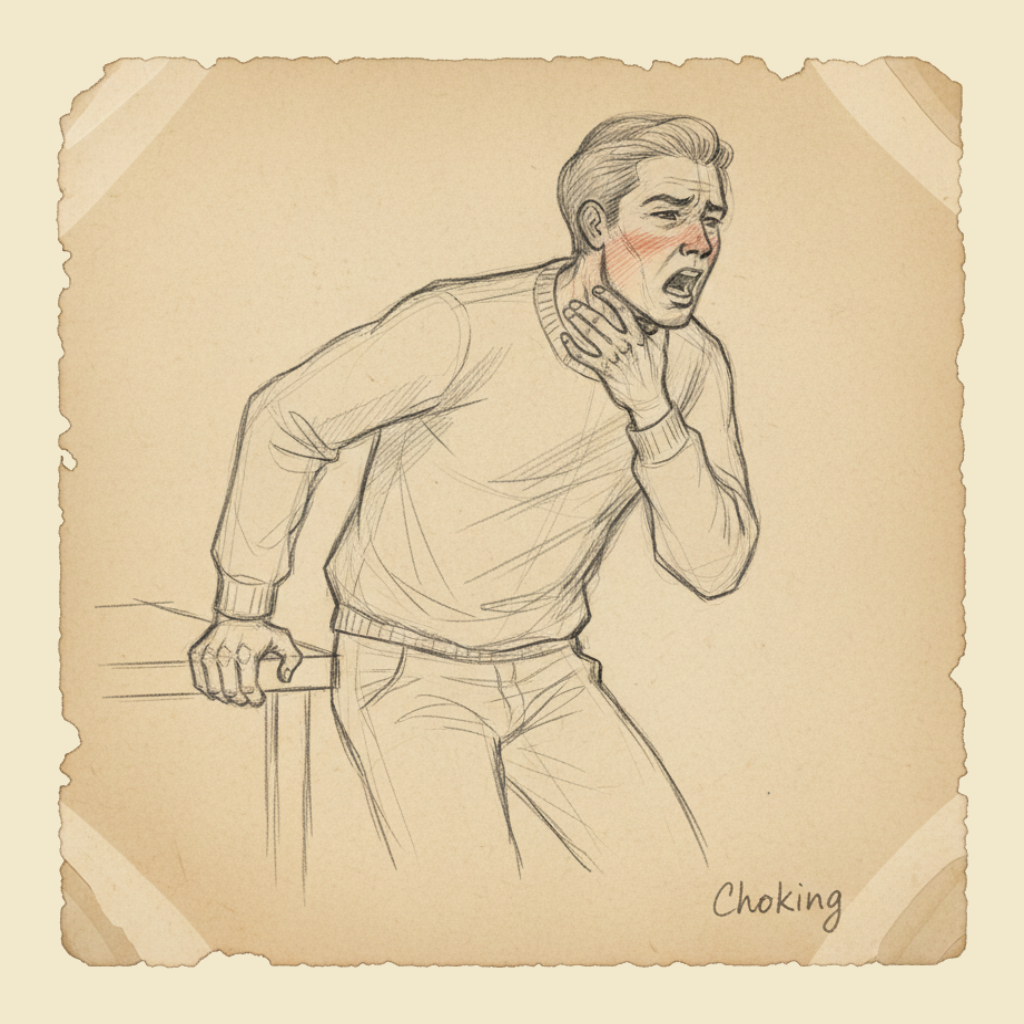
- Severe (ineffective) airway obstruction — air is barely moving or not moving at all. The casualty cannot speak, cannot cough effectively, may be completely silent, may grip their throat (the universal choking sign), and is going dusky, pale, or blue.
§ Instructor's note
The hardest skill in choking first aid is not intervening when the casualty has a mild obstruction. Learners want to start hitting people on the back as soon as someone coughs at the dinner table. A strong cough generates more pressure than any back blow you can deliver — interrupting it makes things worse. Drill the rule: if they can cough, let them cough.
Recognising it
The two categories above are the recognition step. The clue you are looking for is whether air is moving. The signs of severe obstruction, in roughly the order they appear:
- Sudden distress while eating (or, in a child, while playing with a small object).
- The hand at the throat — the universal choking sign. Teach learners to recognise it; it is the casualty asking for help without words.
- Silence. No coughing, no speaking, no wheezing — because no air is moving past the obstruction.
- Panic and frantic gestures.
- Dusky, blue, or grey colour around the lips and face.
- Collapse and unresponsiveness — the late stage. By now the airway must be cleared and CPR started.
A choking casualty who suddenly stops coughing has not "got it down" — they have stopped because they have no air left to cough with. Treat silence as escalation, not resolution.
First-line response — the ANZCOR sequence
The Australian sequence for choking is built around two manoeuvres alternated in sets of five. The clock starts the moment you decide the obstruction is severe. G4PC 1.3
For a casualty with a mild (effective) obstruction:
- Stay with them. Do not leave the room.
- Encourage them to cough. A strong cough is more effective than anything you can do.
- Watch for deterioration — if the cough weakens or they stop being able to speak, escalate to the severe sequence immediately.
For a casualty with a severe (ineffective) obstruction:
- Call 000. Send a bystander, or put your phone on speaker. Don't stop the rescue to make the call.
- Give up to 5 sharp back blows. Stand to one side, lean the casualty forward, and strike firmly between the shoulder blades with the heel of your hand. Check the mouth between each blow — if the object is now visible, fish it out with a finger sweep, but never do a blind finger sweep on a casualty whose mouth is empty.
- If 5 back blows haven't cleared it, give up to 5 chest thrusts. Same hand position as CPR compressions — heel of the hand on the lower half of the breastbone — but slower, sharper, and with the casualty either standing, sitting, or lying down. Each thrust is a deliberate, separate squeeze, not a rhythm.
- Alternate sets of 5 back blows and 5 chest thrusts until either the obstruction clears or the casualty becomes unresponsive.
- If the casualty becomes unresponsive, lower them carefully to the floor and start CPR immediately. Each compression cycle may itself dislodge the object — check the mouth before each rescue breath, and remove the object if you can see it.
For severe airway obstruction, give up to 5 back blows followed by up to 5 chest thrusts, alternating until the obstruction is relieved or the casualty becomes unresponsive. If the casualty becomes unresponsive, commence CPR. Australian first aid does not teach abdominal thrusts (the Heimlich manoeuvre) for routine choking — chest thrusts replaced them because they are safer and equally effective.
Infants and children
The principle is the same; the technique is scaled down.
Infant under one year:
- Lay the infant face down along your forearm, head slightly lower than the body, jaw supported between your fingers.
- Give up to 5 firm back blows between the shoulder blades with the heel of your other hand.
- Turn the infant face up along your other forearm and give up to 5 chest thrusts using two fingers on the lower half of the breastbone, sharper and slower than CPR compressions.
- Alternate. Never use abdominal thrusts on an infant.
Child over one year: treat as an adult, with proportionate force. Kneel beside or behind them.
When to call an ambulance
Call 000 immediately for any of:
- Any severe (ineffective) airway obstruction.
- Any choking casualty who has lost consciousness.
- Any choking event where back blows or chest thrusts were needed — even if the obstruction cleared. The manoeuvres themselves can cause internal injury, and the casualty needs hospital assessment.
- Any choking child or infant.
- Any time you are unsure.
What not to do
- Do not perform abdominal thrusts (the Heimlich) — Australian first aid uses chest thrusts.
- Do not do a blind finger sweep. You will push the object further down. Only remove an object you can see.
- Do not give the casualty water to drink to "wash it down" — it may go straight into the lungs.
- Do not leave the casualty alone, even to make the phone call — put it on speaker or send a bystander.
- Do not interrupt an effective cough with back blows. The cough is doing the job.
An adult who collapses unwitnessed and is found unresponsive may have choked. If your initial breaths during CPR don't go in despite a good head-tilt and chin-lift, suspect a foreign body, reposition, and continue compressions — each compression is itself a chest thrust.
You will rehearse back blows and chest thrusts on a manikin, practise the infant face-down hold, and run the full alternating sequence under time pressure. The technique is simple; the hardest part is committing to firm blows without flinching, and the only fix is reps.
A choking casualty has minutes, not hours. The sequence is short on purpose — five back blows, five chest thrusts, repeat — so that a frightened first aider can remember it under stress and just keep going until the airway is clear.
— ANZCOR Guideline 4