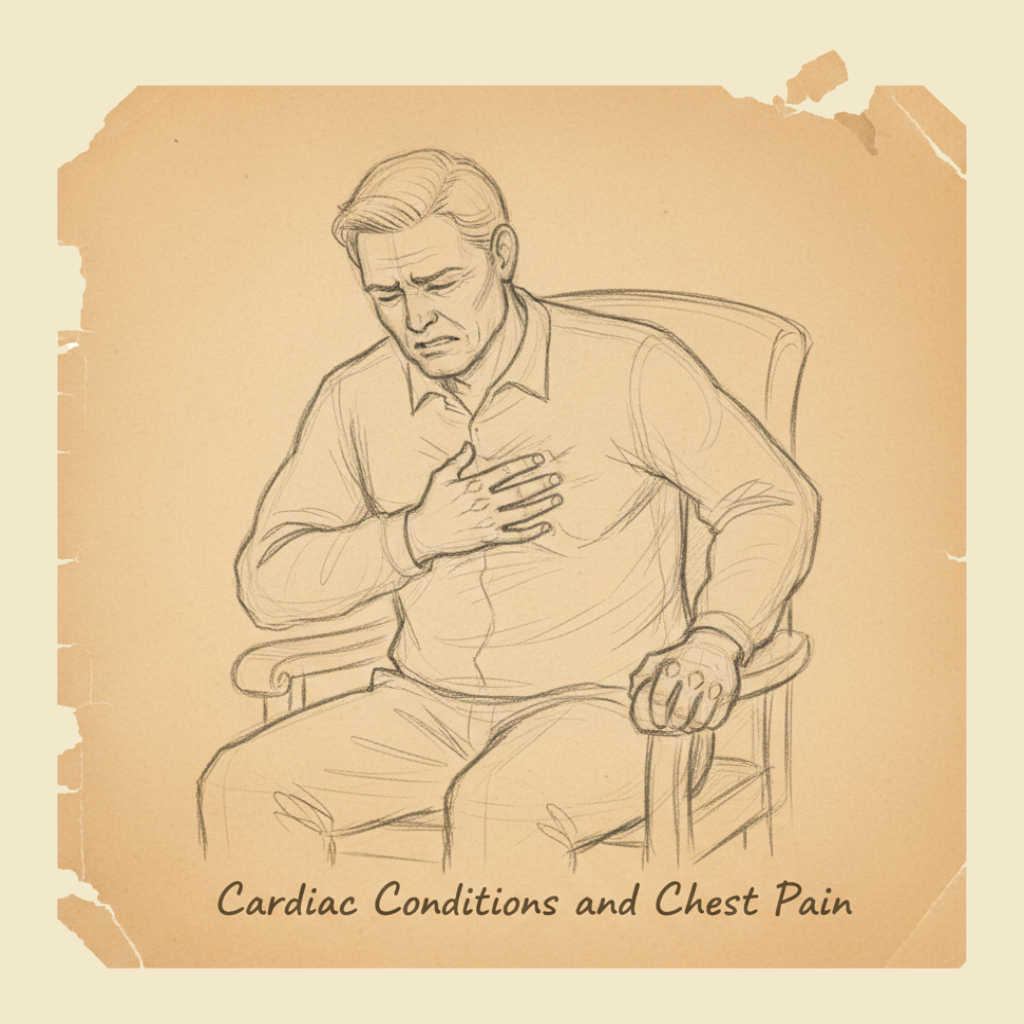
Why this chapter exists
Heart disease is the single largest cause of death in Australia, and the moment when a coronary artery occludes — the acute coronary syndrome, or in plain English the heart attack — is the moment when the casualty's chance of surviving and recovering depends almost entirely on how quickly the right treatment is delivered. The treatment is hospital-based: opening the blocked artery with a stent, or with clot-busting drugs. The first aider's job is not to provide the treatment but to recognise that it is needed, summon it, and keep the casualty alive and as comfortable as possible until it arrives. G9.2.1
The chapter is about the signs and symptoms of acute cardiac conditions, the actions a first aider takes, the medications a casualty may be carrying, and the threshold at which the situation tips over into cardiac arrest and CPR. The detail of CPR itself is in the cpr_techniques chapters; this chapter is about the conscious casualty with chest pain.
§ Instructor's note
The teaching point of this chapter is that chest pain in an adult is "cardiac until proven otherwise", and the proving is not the first aider's job. Learners often want diagnostic certainty before they act, and the actual standard is the opposite: if a casualty over about 35 has central chest pain or any of the cardiac equivalents, you call 000 and treat as cardiac. The risk-benefit is overwhelming. Drill the rule: chest pain → sit them down, call 000, aspirin if available and not contraindicated, monitor and be ready for CPR.
What is happening inside the casualty
The most common acute cardiac event is the heart attack (myocardial infarction), which happens when one of the coronary arteries — the small arteries that supply the heart muscle itself — becomes blocked. The blockage is usually a blood clot that has formed on top of a ruptured atherosclerotic plaque (a fatty deposit on the inside of the artery wall). When the artery blocks, the muscle downstream of the blockage stops receiving oxygen, and within minutes that muscle starts to die.
The casualty experiences this as central chest pain — a heavy, crushing, squeezing, or pressure-like sensation in the middle of the chest, often radiating to the left arm, the jaw, the neck, or the back. It is not usually a sharp stabbing pain (sharp pain is more likely to be musculoskeletal or pleuritic). It is not usually positional (it doesn't change much when the casualty moves or breathes). It does not usually settle quickly with rest.
The dying heart muscle has consequences:
- The pain itself, from the ischaemic muscle.
- A weakened pumping function, which can cause low blood pressure, breathlessness, and pulmonary oedema.
- Electrical instability — the dying muscle can trigger ventricular fibrillation, which is the rhythm that causes most cardiac arrests in the first hour after a heart attack. About half of all heart-attack deaths happen in the first hour, and most of those are from VF.
- Anxiety, sweating, nausea — driven by the body's stress response and the pain.
The treatment in hospital is to open the blocked artery as quickly as possible, either by inserting a balloon and stent into the artery (percutaneous coronary intervention, PCI) or by giving a clot-busting drug (thrombolysis). The faster this happens, the more heart muscle is saved. The phrase "time is muscle" is the cardiologist's mantra: every minute of delay is more dead heart muscle and a worse long-term outcome.
This is why the first aider's actions matter so much. Calling 000 early starts the clock running on the hospital's response. Giving aspirin (if available and appropriate) thins the blood and slows the clot's growth. Sitting the casualty down reduces the heart's oxygen demand. Being ready to start CPR if the casualty arrests means that the leading cause of death in the first hour can be intercepted.
Angina vs heart attack — the spectrum
Heart attack is the dramatic end of a spectrum of cardiac chest pain. The other end is angina, which is the same kind of pain — central, crushing, possibly radiating — but caused by a partial narrowing of a coronary artery rather than a complete blockage. Angina happens when the heart's oxygen demand exceeds the supply through a narrowed artery, typically during exertion or emotional stress, and resolves within a few minutes when the casualty rests. Many casualties with known angina carry glyceryl trinitrate (GTN) spray or tablets, which dilate the coronary arteries and relieve the pain.
The key distinction:
- Stable angina: predictable, brought on by exertion, relieved by rest or GTN within a few minutes. This is the casualty's known pattern.
- Unstable angina: pain at rest, or pain that is more severe / longer / more frequent than the casualty's usual pattern, or pain that does not respond to GTN. Unstable angina is treated as a heart attack until proven otherwise — the underlying mechanism is a partial-but-progressing clot that may complete its blockage at any moment.
- Heart attack: severe chest pain that does not settle with rest or GTN within 5–10 minutes. The artery is fully blocked and muscle is dying.
The practical rule for first aiders: any chest pain that lasts more than 10 minutes, or that is more severe than the casualty's usual angina, or that comes on at rest, is treated as a heart attack. Call 000.
Recognition — the signs and symptoms of a heart attack
The classical presentation:
- Central chest pain — heavy, crushing, squeezing, pressure-like, "elephant on the chest". Often described by the casualty as "discomfort" rather than pain — they may resist the word "pain" because it isn't sharp. Discomfort is the same as pain in this context.
- Radiation — to the left arm (most commonly), to both arms, to the jaw, the neck, the upper back, or the upper abdomen.
- Duration — more than a few minutes, often 20 minutes or more, persistent, not relieved by rest.
- Sweating — cold, clammy, sometimes profuse. Often a striking feature.
- Shortness of breath — the heart is not pumping efficiently and the lungs may be congested.
- Nausea or vomiting — particularly with inferior heart attacks (those affecting the lower part of the heart).
- Light-headedness or feeling faint — from low blood pressure.
- A sense of impending doom — a real and well-described feature, often verbalised by the casualty as "I think I'm dying".
- Pale, grey, or ashen skin — often the first thing a bystander notices.
- A casualty who looks unwell in a way that is hard to put into words — trust this instinct.
Not every casualty has every symptom. Atypical presentations are common, particularly in:
- Women, who are more likely to present with shortness of breath, nausea, fatigue, or upper-back pain rather than the classical crushing chest pain.
- People with diabetes, who may have less or no chest pain because of nerve damage from the diabetes — they may present with shortness of breath, sweating, or vague unwellness alone.
- Older adults, who may present with confusion, falls, or unexplained shortness of breath rather than chest pain.
The threshold for calling 000 should be low in any of these populations. The cost of an unnecessary ambulance is small; the cost of a missed heart attack is fatal.
What to do — the management
The management of a conscious casualty with suspected heart attack is short, structured, and should be done in roughly this order:
- Sit the casualty down in a comfortable position. The semi-upright "W" position — sitting up against a wall or pillow with knees bent — is often the most comfortable and reduces the work of the heart. Do not let them walk around or exert themselves.
- Call 000 immediately and clearly say "I think this is a heart attack" or "I have a casualty with chest pain". Those phrases trigger a cardiac dispatch protocol — different ambulance, faster response, possibly direct routing to a hospital with a coronary catheterisation lab. See the accessing emergency services chapter.
- Reassure the casualty. Cardiac chest pain is terrifying and the casualty's anxiety makes things worse — both physiologically (anxiety increases heart rate and oxygen demand) and psychologically. Calm presence helps. Tell them an ambulance is on the way.
- Loosen any tight clothing around the neck and chest.
- If the casualty has prescribed GTN spray or tablets for known angina, help them take a dose as per their prescription. GTN dilates coronary arteries and may relieve the pain. If the pain doesn't settle within 5 minutes, repeat — and recognise that this is no longer a stable-angina episode.
- Aspirin — if the casualty is conscious, able to swallow, and not allergic to aspirin, give them 300 mg of aspirin (one regular adult tablet) to chew and swallow. Chewing speeds absorption. Aspirin thins the blood and reduces the growth of the clot blocking the coronary artery, and giving it early is one of the few first-aid interventions that has been shown to improve heart-attack survival. The contraindications to aspirin are a known allergy, active stomach ulcer, or recent significant bleeding — if any of those apply, do not give it.
- Monitor the casualty closely. Stay with them, keep talking, watch for signs of deterioration: increasing pain, increasing breathlessness, loss of consciousness, cardiac arrest. Be ready to start CPR immediately if they collapse.
- Have an AED ready if one is available. The most likely cause of sudden deterioration is ventricular fibrillation, which the AED can fix.
- Do not leave the casualty alone at any point until paramedics arrive. The first hour of a heart attack is the most dangerous, and a casualty who looked stable five minutes ago can be in cardiac arrest now.
The whole sequence takes about a minute and is the entire first-aid response. There is nothing else useful that a first aider can do, and there is no benefit in waiting to "see if it gets better" before calling 000.
Roughly half of all heart-attack deaths happen in the first hour after symptom onset, and most of those are caused by ventricular fibrillation — a chaotic electrical rhythm that is treatable with a defibrillator if it is caught early. This is the reason an AED should be brought to any casualty with suspected heart attack as a precaution, even if the casualty is conscious and stable. If they arrest, you start CPR immediately and apply the AED as soon as it arrives. The transition from "chest pain" to "cardiac arrest" can take seconds.
Aspirin — when and how
Aspirin is one of the few medications a first aider may be in a position to administer, and the rules around it are worth being clear about:
- Dose: 300 mg, which is one regular adult aspirin tablet (or three 100 mg tablets if that is what is available). In Australia, the common pack sizes are 100 mg ("low-dose" aspirin) and 300 mg.
- Route: chewed and swallowed. Chewing speeds absorption and means the drug starts working within minutes. Do not give a coated or enteric-coated tablet whole if you can avoid it.
- Timing: as soon as practical after deciding the casualty is having a heart attack. The earlier the better.
- Contraindications:
- Known aspirin allergy — do not give. (Aspirin allergy is uncommon but not rare, and can cause severe asthma attacks or anaphylaxis.)
- Active bleeding — gastrointestinal bleed, significant trauma, recent surgery. Aspirin worsens bleeding.
- Children under 16 — aspirin is associated with Reye's syndrome in children with viral infections and is generally avoided. Heart attacks in children are vanishingly rare anyway, so this is mostly a non-issue.
- Recent stroke — if the casualty has had a stroke in the last few weeks, the type matters (haemorrhagic vs ischaemic) and you don't know which. Withhold aspirin and let the paramedics decide.
- Source: from the casualty's own supply, or from a first aid kit that contains aspirin (some workplace kits do; many don't). The first aid kit contents chapter covers the typical contents.
- Permission: if the casualty is conscious and competent, ask them. "I think you may be having a heart attack. Aspirin can help. Are you allergic to aspirin? May I give you a tablet to chew?" If they say no, respect that. If they are unconscious, do not attempt to give it — they cannot swallow safely.
Aspirin is the single first-aid intervention with the best evidence of improving heart-attack outcomes outside of CPR and defibrillation. Do not skip it without a reason.
GTN — the casualty's own medication
Many casualties with known angina or coronary artery disease carry a glyceryl trinitrate (GTN) spray or sublingual tablet. GTN works by dilating the coronary arteries (and the rest of the venous system), reducing the heart's workload and improving blood supply. It is given as a spray under the tongue or as a small tablet held under the tongue until it dissolves.
The first aider's role is to help the casualty take their own GTN as per their own prescription and habit. Don't administer GTN that isn't the casualty's. If they have it, help them use it; if the pain doesn't settle within 5 minutes, repeat once; if it still doesn't settle, this is no longer simple angina and is an unstable cardiac event — call 000 immediately if you haven't already.
GTN can cause a brief dizziness or headache as a side effect because of the vasodilation. This is normal and not a reason to stop using it. If the casualty's blood pressure was already low or they were already light-headed, GTN may worsen this — sit them down before giving it.
When chest pain is not cardiac
Not all chest pain is a heart attack. Other causes the first aider may encounter:
- Musculoskeletal pain — from a strained intercostal muscle, a rib injury, or unaccustomed exertion. Usually sharp, positional, reproducible by pressing on the affected area or by movement.
- Pleuritic pain — from inflammation of the lining of the lung (pleurisy), often caused by infection, pulmonary embolism, or pneumothorax. Sharp, made worse by deep breathing or coughing.
- Indigestion / reflux — heartburn, often described as a burning pain behind the breastbone. May be relieved by antacids. Can mimic cardiac pain quite closely, particularly in a stressed casualty.
- Anxiety / panic attack — chest tightness, breathlessness, sweating, feeling of impending doom. Often indistinguishable from a heart attack without medical investigation.
- Aortic dissection — a tear in the wall of the aorta. Sudden, severe, "tearing" pain that often radiates to the back. Rare but life-threatening; the casualty looks very unwell.
- Pulmonary embolism — a clot in the lung circulation. Sudden shortness of breath, chest pain on breathing, sometimes coughing up blood. Life-threatening.
The first aider does not need to make the diagnosis. The first aider's rule is simpler: if the chest pain is significant, call 000 and treat as cardiac. Let the paramedics and the hospital sort out the cause. The cost of treating an indigestion as a heart attack is a wasted ambulance trip and an embarrassed casualty; the cost of treating a heart attack as indigestion is a death.
Cardiac arrest — the transition
A casualty who is having a heart attack can deteriorate into cardiac arrest at any moment. The transition is:
- Sudden loss of consciousness — the casualty was talking to you and now they are not.
- Collapse — they slump or fall.
- No normal breathing — no rise and fall of the chest, possibly agonal gasps.
- No response to voice or shaking.
The instant any of this happens, the first aider switches from "chest pain management" to CPR. The protocol is the same as for any cardiac arrest — see the recognising unconscious not breathing chapter and the cpr_techniques chapters. Start compressions immediately, send for an AED, and continue until paramedics arrive or the casualty responds.
The reason an AED should be at the side of any chest-pain casualty is exactly this — when cardiac arrest happens, the window for defibrillation is short, and having the AED already there saves the minutes that would otherwise be spent fetching it.
Heart failure and acute pulmonary oedema
The other major acute cardiac presentation a first aider may encounter is acute heart failure with pulmonary oedema — fluid accumulating in the lungs because the heart is not pumping it forward effectively. The casualty:
- Is severely short of breath, often unable to speak in full sentences.
- Is sitting up, leaning forward, refusing to lie down because lying down makes the breathlessness much worse (orthopnoea).
- Is sweating, anxious, frightened.
- May cough up frothy, pink-tinged sputum.
- May have audible bubbling or crackling breath sounds even without a stethoscope.
- May have ankle swelling if the heart failure is chronic.
The first-aid response is:
- Sit the casualty up — high Fowler's position, leaning forward if that is what they want. Do not lay them flat. Lying flat makes pulmonary oedema dramatically worse and can be lethal.
- Call 000 immediately. This is a serious illness that needs paramedic intervention quickly.
- Loosen tight clothing and reassure.
- Help them with their own medications if they have them — many heart failure patients carry GTN, and some will know to take it.
- Monitor and be ready for CPR if they deteriorate.
Acute pulmonary oedema is the cardiac condition where positioning matters most. Sit them up.
One of the maddening features of cardiac chest pain is that casualties often deny it is happening. "It's just indigestion." "I'm fine, I just need to sit down." "Don't call an ambulance, I don't want a fuss." This is partly the casualty's anxiety expressing itself as denial, and partly the result of the pain not always feeling as dramatic as the textbook description. The first aider's job is to be persistent without being aggressive. Explain that you'd rather call an ambulance and be wrong than not call and be right. If the casualty is competent and refuses, you cannot force treatment — but you can keep them calm, keep them sitting, stay with them, and call 000 yourself if you become more concerned. Many casualties who initially refused help are quietly grateful when the ambulance arrives.
A casualty with suspected acute coronary syndrome should be encouraged to rest in a comfortable position, usually sitting, and an ambulance should be called immediately. If the casualty has prescribed glyceryl trinitrate, it should be administered as per their usual prescription. Aspirin (300 mg, chewed and swallowed) should be offered if the casualty is conscious, not allergic, and has no contraindication. The first aider should remain with the casualty, monitor for deterioration, and be prepared to commence CPR if the casualty becomes unresponsive and is not breathing normally.
What not to do
- Do not let the casualty walk around, climb stairs, or exert themselves.
- Do not delay calling 000 to "see if it settles". Call early.
- Do not dismiss atypical presentations — particularly in women, people with diabetes, and older adults.
- Do not give aspirin to a casualty with a known allergy, active bleeding, or under 16.
- Do not give the casualty food, drink, or anything other than the prescribed medications and aspirin. They may need surgery and should be kept fasted if possible.
- Do not lay a casualty with acute pulmonary oedema flat. Sit them up.
- Do not leave the casualty alone. Cardiac arrest can happen suddenly.
- Do not assume "they look fine, it's probably nothing" — looking fine and being in the early hours of a heart attack are not mutually exclusive.
You will rehearse the cardiac chest-pain scenario from "casualty grabs their chest" to "ambulance handover" — including the recognition, the call to 000 with the magic phrase, the aspirin question, the sit-them-down positioning, the GTN if available, and the transition to CPR if the casualty arrests. The instructor will sometimes deteriorate the casualty into arrest mid-scenario so you can practise the switch. By the end of the day, the response should be a single fluid sequence rather than a checklist you have to remember.
A heart attack is a clock and the casualty's life is the bet. The first aider's job is not to fix the heart — that is what the cardiologist's catheterisation lab is for — but to recognise the picture, summon the cavalry, give the one drug that helps (aspirin), keep the casualty calm and sitting, and be ready for the moment the heart stops altogether. Time is muscle. Call 000 early, give the aspirin if you can, sit them down, stay with them, and have an AED to hand.
— ANZCOR Guideline 9.2.1 (chest pain)