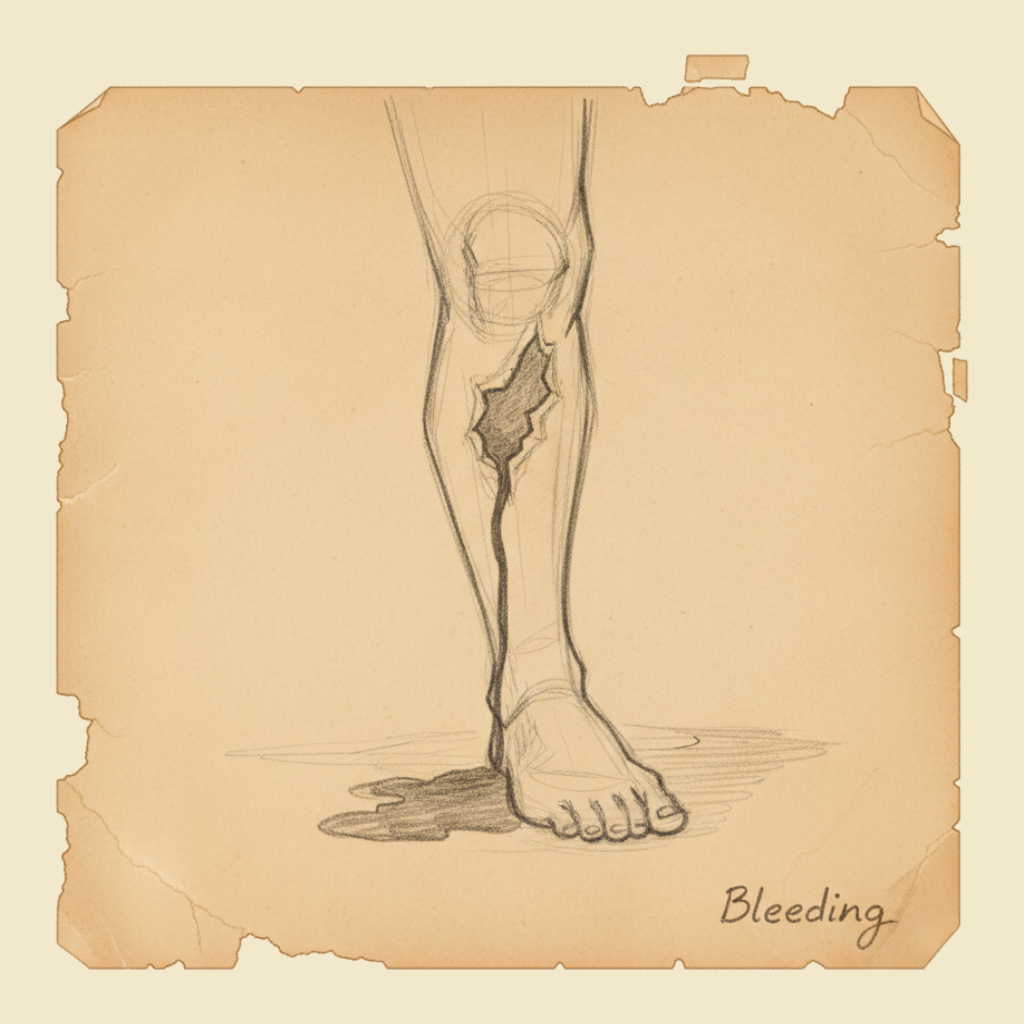
What's actually happening
Bleeding is what happens when a blood vessel is broken open and its contents escape. The body has roughly five litres of blood in an adult and about half that in a small child, and it tolerates losing some of it surprisingly well — until it doesn't. Once enough volume is gone, the circulation can't keep the brain and the heart supplied, and the casualty slides into shock and then cardiac arrest. The first aider's whole job is to keep that volume inside the casualty until the ambulance arrives. G9-1-1
First aiders sort visible bleeding into three patterns, because the pattern tells you how much time you have:
- Arterial — bright red, spurts in time with the pulse, empties a person in minutes. This is the one that kills.
- Venous — darker red, flows in a steady stream rather than spurts. Still serious; still needs pressure.
- Capillary — the slow ooze you see from a graze. Almost always stops on its own.
§ Instructor's note
Learners spend a lot of energy trying to identify which type of bleeding they're looking at. Don't let them. The action is the same regardless — firm direct pressure, hold it, don't peek. The reason we teach the three patterns at all is so a learner who sees a spurt understands the clock has started, not so they can stand there debating arterial vs venous while the casualty bleeds out.
Recognising it
External bleeding recognises itself — there is blood. The harder skill is recognising the casualty who has lost enough blood to be in trouble, even after the bleeding has been controlled, and recognising internal bleeding which has no outside sign at all.
The signs of significant blood loss, in roughly the order they appear:
- Pale, cool, clammy skin — the body is shunting blood away from the surface to protect the core.
- A fast, weak pulse and rapid shallow breathing.
- Thirst. A casualty asking repeatedly for water after an injury is a red flag, not a polite request.
- Restlessness, anxiety, then confusion — the brain is starting to feel the shortage.
- Drowsiness, collapse, unresponsiveness — late and dangerous.
Suspect internal bleeding after any significant blow to the chest, abdomen, pelvis, or back — a fall, a kick, a vehicle accident, a crush. There may be nothing to see on the outside. The signs are the same shock picture above: pale, sweaty, thirsty, fast pulse, confused. Treat for shock, lay the casualty down, and call an ambulance immediately. There is nothing else a first aider can do for internal bleeding except get them to hospital fast.
First-line response — direct pressure
For any significant external bleed, the response is one rhythm and you stay on it: G9-1-1PC 1.3
- Sit or lay the casualty down. A bleeding casualty who faints standing up will hit the ground hard.
- Expose the wound enough to see what you are dealing with. Cut clothing if you have to.
- Apply firm direct pressure over the wound with a sterile dressing, a clean cloth, a t-shirt, anything to hand. Press hard — harder than feels polite. If you have nothing clean, use your gloved hand.
- Elevate the injured part above the level of the heart if the injury allows it (don't move a suspected fracture).
- Hold the pressure for at least 10 minutes without lifting the dressing to peek. Peeking disrupts the clot that is forming and you start the clock again.
- If blood soaks through, do not remove the first dressing — add more padding on top and keep pressing.
- Once bleeding is controlled, bandage firmly to maintain the pressure, and check the fingers or toes past the bandage stay warm and pink. If they go cold, pale, or numb, the bandage is too tight — loosen and re-apply.
- Treat for shock — keep the casualty warm, lying down, reassured. Do not give them anything to drink no matter how thirsty they are.
Direct pressure applied firmly to the wound is the first-line treatment for external bleeding of any severity. Where direct pressure cannot control life-threatening bleeding from a limb — for example a partial amputation or a deep arterial wound — an arterial tourniquet applied high and tight above the wound is the next step, and should be left in place until removed by hospital staff.
Tourniquets — the escalation step
ANZCOR's guidance on tourniquets has shifted in the last decade. They are no longer the "last resort that costs you the limb" of older first-aid manuals; they are a recognised second-line tool when direct pressure has failed to control life-threatening limb bleeding.
If you have a commercial tourniquet (e.g. CAT) and direct pressure isn't holding:
- Place it high and tight on the limb, between the wound and the heart, never over a joint.
- Tighten it until the bleeding stops — a half-tightened tourniquet makes things worse by occluding the veins but not the arteries.
- Note the time it was applied. Write it on the casualty's forehead with a marker if you have one. Hospital staff need to know.
- Do not loosen it to check. Once on, it stays on until a doctor takes it off.
A makeshift tourniquet (belt, torn shirt, triangular bandage with a windlass) is worse than a commercial one but better than letting someone bleed to death.
When to call an ambulance
Call 000 immediately for any of:
- Bleeding that spurts or won't stop with steady direct pressure.
- Any wound deep enough to see fat, muscle or bone.
- Any bleed where you have applied a tourniquet.
- A casualty showing the shock picture above, even if the bleeding looks controlled.
- Suspected internal bleeding after a significant impact.
- Bleeding from the mouth, ears or coughed up from the lungs.
- Any wound from glass, a nail, a knife, a tooth, or an animal bite — infection risk is high regardless of how it looks.
What not to do
- Do not lift the dressing to check on the bleeding. Pile more on top.
- Do not remove an embedded object — a knife, glass, a stake. Pad around it and bandage it in place. Pulling it out releases whatever pressure it was providing and the bleed gets worse.
- Do not give the casualty anything to drink. They may need surgery.
- Do not use a tourniquet for anything other than life-threatening limb bleeding that direct pressure can't control. They are not for grazes, nosebleeds or scalp cuts.
- Do not put yourself at risk of blood-borne contact — wear gloves if you have them, wash thoroughly afterwards.
Nosebleeds are their own micro-topic. Sit the casualty upright, lean them slightly forward (not back — that sends blood down the throat), and pinch the soft part of the nose firmly for ten unbroken minutes. Most stop. See the nosebleed chapter for the full picture.
You will practise direct-pressure technique on a bleeding-arm trainer, apply a commercial tourniquet to a partner's limb under supervision, and rehearse the "bandage soaked through — add more on top" decision. The instinct to peek is very strong; the only fix is to drill it out under stress.
Bleeding is one of the very few things in first aid where you, with your bare hands and a t-shirt, can be the difference between life and death. Press hard. Don't let go.
— ANZCOR Guideline 9.1.1