What's actually happening
Asthma is a long-term condition in which the small airways in the lungs are over-reactive. When something triggers them — exercise, cold air, smoke, pollen, an animal, a virus, even strong emotion — three things happen at once: the muscle around the airways tightens, the lining swells, and extra mucus is produced. The result is the same picture every time: it gets harder to push air out than to pull it in, breathing turns wheezy and slow, and the casualty has to work visibly harder for every breath. G9-2-5
§ Instructor's note
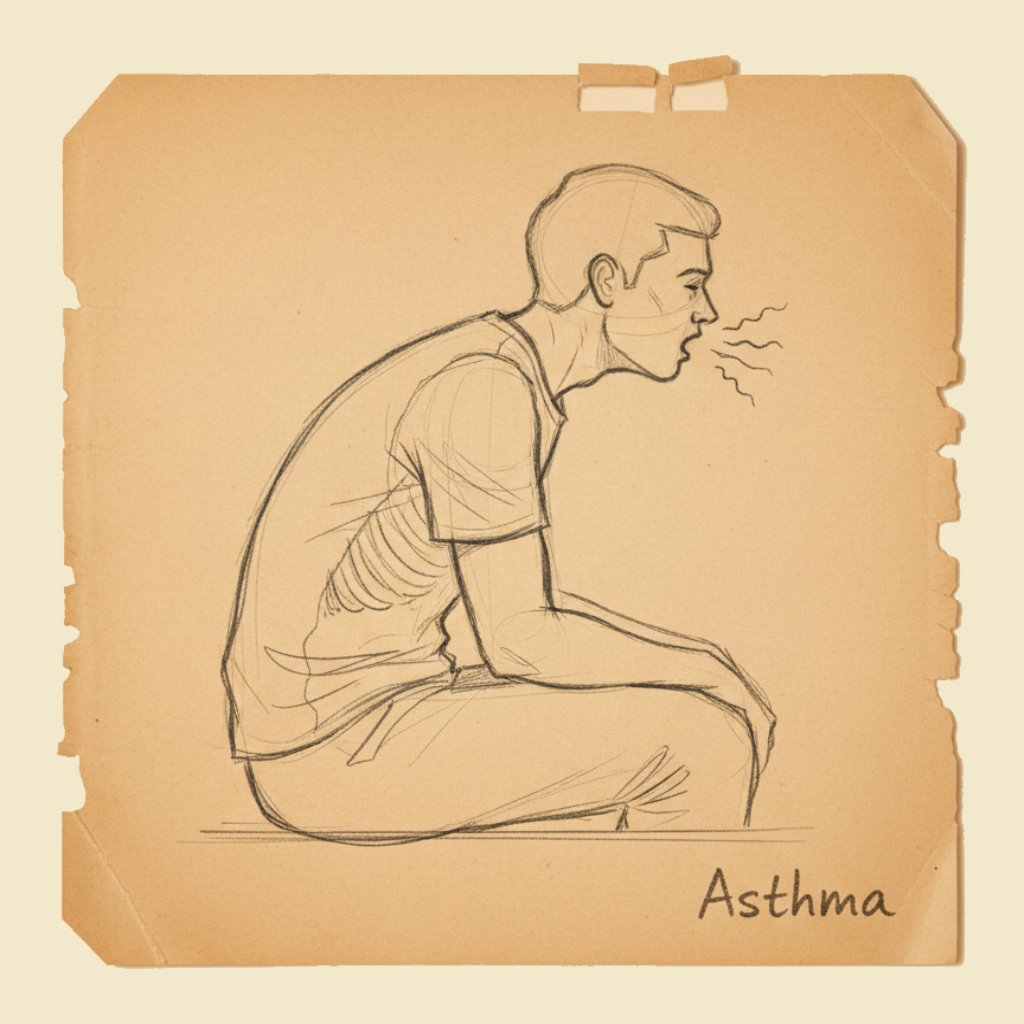
Most learners come in with the wrong mental model — they imagine asthma as "can't breathe in". The opposite is closer to the truth: it's hard to push air out, the airways collapse on the way out, stale air gets trapped behind them, and the next breath has nowhere to go. That's why a severe asthmatic ends up sitting forward, shoulders hunched, fighting to empty their chest.
Recognising it
The early picture of an asthma attack is quiet and easy to miss if you don't know what you're looking for. The casualty is usually awake, talking, often embarrassed. The signs to scan for, in roughly the order they appear:
- A wheeze, usually on breathing out — sometimes loud enough to hear across a room, sometimes only with an ear close to the chest.
- A persistent dry cough that won't clear.
- Difficulty speaking in full sentences. Watch for the casualty pausing for breath every few words.
- Visible effort. Shoulders rising with each breath, neck muscles working, chest sucking in between the ribs in a child.
- The tripod posture — sitting upright, leaning slightly forward, hands on knees or on a table, trying to give the chest room to work.
A severe asthma attack often gets quieter, not louder. So little air is moving that there isn't enough flow to make a wheeze at all. A casualty who has stopped wheezing, can't speak, is going pale or blue, is exhausted or drowsy, is in a life-threatening attack. Do not interpret silence as improvement.
First-line response — the 4 × 4 × 4 plan
ANZCOR teaches a single rhythm for any asthma attack a first aider sees, regardless of severity, and the rhythm is built in fours. G9-2-5PC 1.3
- Sit the casualty upright. Do not let them lie flat. Loosen tight clothing.
- Give 4 separate puffs of a blue/grey reliever inhaler (e.g. salbutamol — Ventolin, Asmol, Airomir).
- Use a spacer if one is available — it dramatically improves how much medication actually reaches the airways.
- One puff, four breaths through the spacer, repeat — not four puffs at once.
- Wait 4 minutes. Stay with them. Watch for improvement.
- If there is no improvement, give another 4 puffs.
Keep repeating sets of 4 puffs every 4 minutes until either the casualty is clearly improving or the ambulance arrives. There is no maximum dose in a first-aid emergency — keep going.
A reliever inhaler (salbutamol) given via a spacer is the first-line first-aid treatment for an asthma attack of any severity. A first aider may use someone else's reliever in an emergency — the medication is the same and the alternative is much worse than the breach of normal medication-sharing etiquette.
When to call an ambulance
Call 000 immediately for any of:
- A first-ever asthma attack (you have nothing to compare it against).
- A severe attack — silent chest, blue lips, exhaustion, can't speak, can't stay upright.
- No improvement after the first 4 puffs.
- An attack triggered by a known severe allergen (treat as anaphylaxis as well — give the EpiPen).
- Any time you are unsure.
Once you have called, keep giving 4 puffs every 4 minutes while you wait. Do not stop because help is on the way.
Children deteriorate fast and recover fast. Use the same 4 × 4 × 4 plan, the same reliever inhaler, the same spacer (with a face mask for the very young). Do not be reassured by a child who briefly perks up — call the ambulance anyway if the attack was severe enough to need first aid.
What not to do
- Do not give the casualty water to drink during a severe attack — they may not be able to swallow safely.
- Do not put them in the recovery position while they are still conscious and trying to breathe; let them sit upright in whatever position works.
- Do not wait to see if it gets better. Asthma can kill within 30 minutes of the first wheeze.
- Do not rely on a preventer inhaler (usually orange, brown or purple) in an emergency — preventers act over hours and days, not minutes. Only the blue/grey reliever fixes an active attack.
You will practise the spacer technique on a trainer device — including assembling it, shaking the inhaler, the four-breath count, and the timing of repeat sets. Spacer technique is the most common thing learners get wrong under stress, and the only fix is rehearsal.
If in doubt, treat as severe. Asthma deaths almost always happen because somebody — the casualty, a parent, a teacher, a first aider — decided to wait a few more minutes before acting.
— ANZCOR Guideline 9.2.5