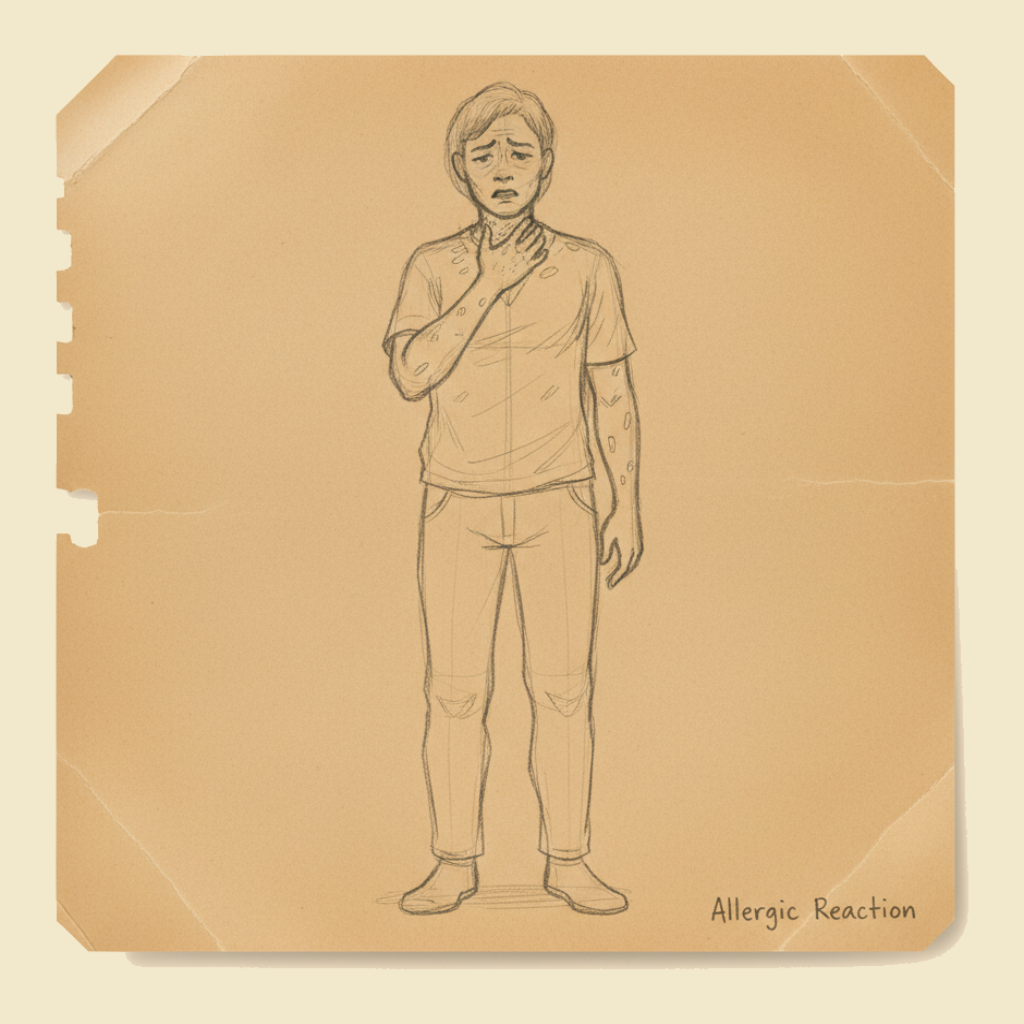
What an allergic reaction is
An allergic reaction is an immune-system response to a substance — an allergen — that the body has decided to treat as dangerous, even though it usually isn't. The substance might be a food (peanuts, shellfish, eggs, milk, tree nuts), an insect sting (bees, wasps, ants), a medication (penicillin, aspirin, anaesthetic agents), latex, pollen, animal dander, or any number of other things. The response is mediated by the release of histamine and other inflammatory chemicals from immune cells, and it produces a characteristic set of signs and symptoms — itching, swelling, redness, hives, and in severe cases breathing difficulty and circulatory collapse. G9.2.7
The defining feature of an allergic reaction, from a first aider's point of view, is that it is on a spectrum. At the mild end it is an annoying itch and a few hives that resolve on their own. At the severe end it is anaphylaxis — a multi-system, rapidly progressing emergency that kills people in minutes if it is not treated with adrenaline. The first aider's job is to recognise where on the spectrum a particular reaction sits, treat it appropriately, and escalate fast if it crosses the line into anaphylaxis. The detail of anaphylaxis itself — the criteria, the EpiPen, the call to 000 — is in the anaphylaxis chapter. This chapter is about the broader allergic-reaction picture and the mild-to-moderate end of the spectrum.
§ Instructor's note
The teaching point of this chapter is the spectrum and the threshold. Learners often want to know "is this anaphylaxis or not?" as if there were a clean binary, and the answer is that anaphylaxis is the top end of a continuous range. The real teaching is the recognition of when a reaction is becoming anaphylaxis — the moment swelling spreads, the voice changes, breathing tightens, dizziness sets in — because that is the moment the EpiPen comes out. Drill the rule: if any of A (airway), B (breathing) or C (circulation) is involved, it is anaphylaxis until proven otherwise, and the answer is adrenaline.
How an allergic reaction happens
The mechanism is worth understanding briefly because it explains why the timing and the treatment are what they are.
The first time the body encounters an allergen, nothing dramatic happens — but the immune system "learns" the allergen and produces antibodies (IgE) that are tuned to it. Those antibodies attach to mast cells (immune cells in the skin, gut, lungs and elsewhere) and sit there, waiting.
The next time the same allergen enters the body, it binds to the IgE on the mast cells, which degranulate — releasing histamine, tryptase, leukotrienes, and a cocktail of other inflammatory mediators all at once. The result is:
- Vasodilation — blood vessels widen, causing redness and warmth.
- Increased capillary permeability — fluid leaks out of blood vessels into tissues, causing swelling (oedema).
- Smooth muscle contraction — bronchioles in the lungs constrict (causing wheeze and breathing difficulty), and gut muscle cramps (causing abdominal pain, vomiting, diarrhoea).
- Itching and hives — from the effect of histamine on nerve endings and skin blood vessels.
In a mild reaction, the response is local and limited — confined to the area where the allergen entered or where the body decided to react. In a severe reaction, the response is systemic — happening throughout the body, affecting the airway, the breathing, and the circulation. The same chemical cascade is at work; the difference is the scale of the response and the systems it involves.
This matters because the treatment for the severe form (anaphylaxis) is adrenaline, which acts in the opposite direction to the chemical cascade — constricting blood vessels, relaxing bronchial smooth muscle, reducing capillary leak. Antihistamines and steroids, which are sometimes given for milder reactions, are slower and less directly effective; they cannot reverse a severe reaction in the time available.
Mild and moderate allergic reactions — recognition
A mild or moderate allergic reaction involves the skin and mucous membranes without affecting the airway, breathing, or circulation. The signs and symptoms:
- Itching — of the skin, the eyes, the mouth, the throat.
- Hives (urticaria) — raised, red, itchy welts on the skin, often appearing in patches and migrating from one area to another.
- Swelling of the face, lips, eyelids, hands, or feet. (Swelling around the lips and eyes is sometimes called angioedema.)
- Runny nose, watery eyes, sneezing — particularly with airborne or contact allergens.
- Tingling of the mouth or lips after eating a food allergen.
- Mild abdominal discomfort, nausea, or one episode of vomiting — particularly with food allergens.
- Redness or flushing of the skin without breathing difficulty.
The key feature of a mild-to-moderate reaction is that the airway, breathing, and circulation are not involved. The casualty is uncomfortable, possibly distressed, but not in immediate danger. They are talking normally, breathing normally, and not light-headed.
Mild reactions usually settle within a few hours, with or without treatment. Antihistamines (cetirizine, loratadine, fexofenadine, or older drugs like promethazine) speed up the resolution and reduce the symptoms but are not strictly necessary for survival. Cool compresses and removing the allergen also help.
Severe allergic reaction (anaphylaxis) — recognition
The reaction becomes anaphylaxis the moment any one of the following happens:
- Airway involvement — swelling of the tongue, throat, or upper airway; hoarse voice; difficulty swallowing; tightness in the throat.
- Breathing involvement — wheeze, persistent cough, shortness of breath, chest tightness, noisy breathing.
- Circulation involvement — pale and floppy (in young children), dizziness, light-headedness, collapse, loss of consciousness, weak rapid pulse.
- Persistent severe abdominal pain or repeated vomiting in someone with a known food allergy (these are taken as anaphylactic features in food-allergic casualties).
If any one of those is present, it is anaphylaxis and the first aider's response is the anaphylaxis protocol — adrenaline auto-injector immediately, lay the casualty flat, call 000, monitor and be ready to give a second dose. The detail of the protocol is in the anaphylaxis chapter.
The single most important thing to internalise is the threshold. The moment a casualty's allergic reaction shows airway, breathing, or circulation involvement, the first aider's hand should be reaching for the EpiPen. Hesitation kills people. There is no scenario in which giving adrenaline to someone who turns out not to need it causes serious harm; there are many scenarios in which not giving it to someone who does need it is fatal.
The single most consequential mistake in allergic-reaction first aid is hesitation about whether the situation has crossed into anaphylaxis. The answer is: if any of airway, breathing, or circulation is involved, give the adrenaline. The drug is safe in healthy people at the dose delivered by an auto-injector; the consequences of withholding it from a casualty in anaphylaxis are death within minutes. Err on the side of giving it.
Managing a mild or moderate allergic reaction
For a casualty with a mild or moderate allergic reaction — itching, hives, mild swelling, no airway/breathing/circulation involvement — the management is supportive:
- Remove the allergen if possible. Stop eating the suspect food, leave the area, remove the contact substance. If a bee stinger is still in the skin, remove it (a fingernail or the edge of a card scraped sideways is enough — see the envenomation chapter).
- Reassure the casualty and keep them calm. Anxiety alone can make symptoms feel worse.
- Cool the affected area with a cold compress if there is local swelling or itching — useful for stings and contact reactions.
- Antihistamines if available — most over-the-counter oral antihistamines help mild reactions resolve more quickly. The casualty can take their own usual dose if they have one. As a first aider, you do not administer medications that aren't the casualty's own (see the skills and limitations chapter) — you offer to fetch the casualty's own medication.
- Monitor the casualty closely for the next 30–60 minutes, watching for any signs that the reaction is progressing into anaphylaxis. Symptoms can escalate fast — particularly with food allergies, stings, or medication reactions — and a casualty who looked fine at the 5-minute mark can be in airway compromise by the 20-minute mark.
- Encourage the casualty to seek medical advice even if the reaction settles. A first reaction often predicts subsequent ones, and a doctor can advise on testing, allergen avoidance, and whether the casualty should carry an EpiPen.
- If symptoms worsen — escalate immediately. Treat as anaphylaxis, give adrenaline if available, call 000.
The hardest part of managing a mild reaction is not relaxing too soon. The first aider's instinct, once the casualty looks comfortable, is to walk away. The right behaviour is to stay with the casualty for at least 30 minutes and to be alert to escalation. Many anaphylactic deaths involve casualties who were initially mildly affected and then deteriorated while no one was watching.
Common allergens and how they present
The most common allergens that produce serious reactions:
- Peanuts and tree nuts — among the most common causes of severe food anaphylaxis worldwide. Reactions can be triggered by very small amounts and by skin contact in highly sensitive individuals.
- Shellfish — prawns, lobster, crab, oysters. Shellfish allergy is more common in adults than children and is often lifelong.
- Cow's milk and egg — common in children, often outgrown.
- Wheat, soy, sesame — less common but significant.
- Bee, wasp and ant stings — venom allergy is common and can be life-threatening. Casualties with known venom allergy should carry an EpiPen.
- Penicillin and other antibiotics — drug allergies are common; the reaction may be the first sign and may be severe.
- Anaesthetic agents and contrast media — typically encountered in healthcare settings.
- Latex — rubber gloves, balloons, condoms; an occupational hazard for some.
Reactions to ingested allergens (food, drugs taken orally) typically begin within minutes to half an hour of ingestion. Reactions to injected allergens (stings, IV drugs) can begin within seconds. Reactions to contact or airborne allergens are usually slower and milder, but can still escalate.
The biphasic reaction — why monitoring continues after treatment
In some cases — perhaps 5–20% of anaphylactic reactions — the casualty has an initial reaction, recovers (with or without treatment), and then has a second reaction hours later, even after the initial allergen is gone. This is the biphasic reaction. The second wave can be as severe as the first, and the casualty may no longer have the EpiPen they used the first time.
The implication for first aiders:
- Anyone who has had a significant allergic reaction needs to be observed in hospital for some hours after recovery. The ambulance and the emergency department will manage this; the first aider's job is to make sure the casualty gets to the hospital and does not refuse transport because "I feel fine now".
- Even if the casualty has fully recovered, the recommendation is to call 000 and have them assessed. The "I feel better, I don't need an ambulance" instinct can be fatal in the case of biphasic reaction.
This is part of why the anaphylaxis chapter is so insistent that calling 000 is part of the protocol, not optional.
The casualty with a known allergy — using their own equipment
Many casualties with known severe allergies carry their own equipment:
- An ASCIA Action Plan — a one-page colour-coded document from the Australasian Society of Clinical Immunology and Allergy that describes the casualty's allergens, their usual reaction, and the steps to take. If you find one (often kept with an EpiPen, in a school office, or in a wallet), follow it.
- An adrenaline auto-injector (EpiPen, Anapen, or generic). Two doses is the recommended carry, in case a second dose is needed before the ambulance arrives.
- An antihistamine for mild reactions.
- A medical-alert bracelet or necklace.
The first aider's role with a known allergic casualty is to help them use their own plan and their own equipment. You are not deciding whether to administer a drug from your own kit; you are assisting a casualty to take a medication that has been prescribed to them by their own doctor for exactly this situation. The legal and ethical question is the same as helping someone with asthma use their puffer (see the asthma chapter) or someone with diabetes take their glucose: it is supportive first aid, not medical practice.
If the casualty cannot self-administer (because they are too young, too distressed, or losing consciousness) and you have the EpiPen and the situation calls for it, administer it yourself. The act of pressing an auto-injector against an outer thigh is within the scope of a first aider, and the alternative — withholding adrenaline because you weren't sure if you "could" — is the wrong answer.
Many people use the word "allergy" to mean "this food makes me feel unwell". A true allergy is an IgE-mediated immune response with the histamine cascade described above; an intolerance (such as lactose intolerance) is a digestive or enzymatic problem that can produce unpleasant symptoms but is not an immune-mediated reaction and cannot cause anaphylaxis. The difference matters because intolerances do not need adrenaline and are not life-threatening, whereas allergies can be both. As a first aider, treat the casualty in front of you on the basis of their signs and symptoms, not on the basis of what they call their problem. If the symptoms include airway, breathing, or circulation involvement, the diagnostic label doesn't matter — give the adrenaline.
Children and infants
Allergic reactions in children deserve a brief mention because the recognition can be subtle:
- Younger children may not be able to describe symptoms — itching, throat tightness, abdominal pain. The first aider has to read the body language: scratching, irritability, refusal to eat, distress.
- The "pale and floppy" sign in a young child or infant is the equivalent of the adult "circulation involvement" criterion. A child who suddenly becomes pale, limp, and unresponsive after exposure to a possible allergen is in anaphylactic shock and needs adrenaline immediately.
- Persistent crying with no other obvious cause in a child after eating something new or being stung is worth taking seriously.
- Children with known allergies typically have an ASCIA Action Plan held by parents, schools, or carers. Find it and follow it.
The threshold for treating as anaphylaxis is the same as for adults: any airway, breathing, or circulation involvement → adrenaline.
Allergic reactions occur on a spectrum from mild localised symptoms to life-threatening anaphylaxis. Mild and moderate reactions may be managed with reassurance, removal of the allergen, and antihistamines if available, with close observation for signs of progression. Anaphylaxis — defined by the involvement of airway, breathing, or circulation — requires the immediate intramuscular administration of adrenaline by auto-injector, the casualty to be laid flat (or sat up if breathing is the predominant problem), and an emergency call to be made. A second dose of adrenaline may be required if symptoms do not respond within 5 minutes. All cases of anaphylaxis require transport to hospital for observation, regardless of apparent recovery, because of the risk of biphasic reaction.
What not to do
- Do not assume a mild reaction will stay mild. Watch the casualty for at least 30 minutes for any sign of progression.
- Do not delay adrenaline if the reaction crosses into airway, breathing, or circulation involvement. Give it immediately.
- Do not give adrenaline from someone else's EpiPen if there is a child-specific or adult-specific version available — but if only one EpiPen is available and the casualty is in anaphylaxis, use what you have.
- Do not allow a casualty who has had anaphylaxis to refuse hospital transport. The biphasic risk makes follow-up observation essential.
- Do not rely on antihistamines or steroids to reverse anaphylaxis. They are too slow.
- Do not make the casualty stand up or walk if there is any circulation involvement. Lay them flat.
- Do not wait to "see if it gets worse" before calling 000 in a serious reaction. Call early.
- Do not confuse intolerance with allergy. Treat the symptoms in front of you.
You will rehearse the recognition of mild, moderate, and severe allergic reactions on a manikin and on partner role-plays, with particular practice in identifying the threshold at which a reaction becomes anaphylaxis. You will also rehearse the use of an adrenaline auto-injector trainer device (a non-functional EpiPen) on a thigh manikin, so the technique is in your muscle memory before you ever need to do it for real. The auto-injector technique is simple — remove the cap, press the device firmly against the outer thigh, hold for a count of three — but the simplicity disappears under the panic of a real call if you have not done it at least once.
An allergic reaction is the immune system fighting a phantom — and most of the time the fight is irritating but harmless. The job of the first aider is to recognise the moment the fight becomes a real threat, treat it without hesitation, and get the casualty to the next link in the chain. Mild reactions get reassurance and antihistamines; severe reactions get adrenaline and an ambulance. The threshold is airway, breathing, circulation. Cross it, and the answer is adrenaline.
— ANZCOR Guideline 9.2.7 (anaphylaxis)