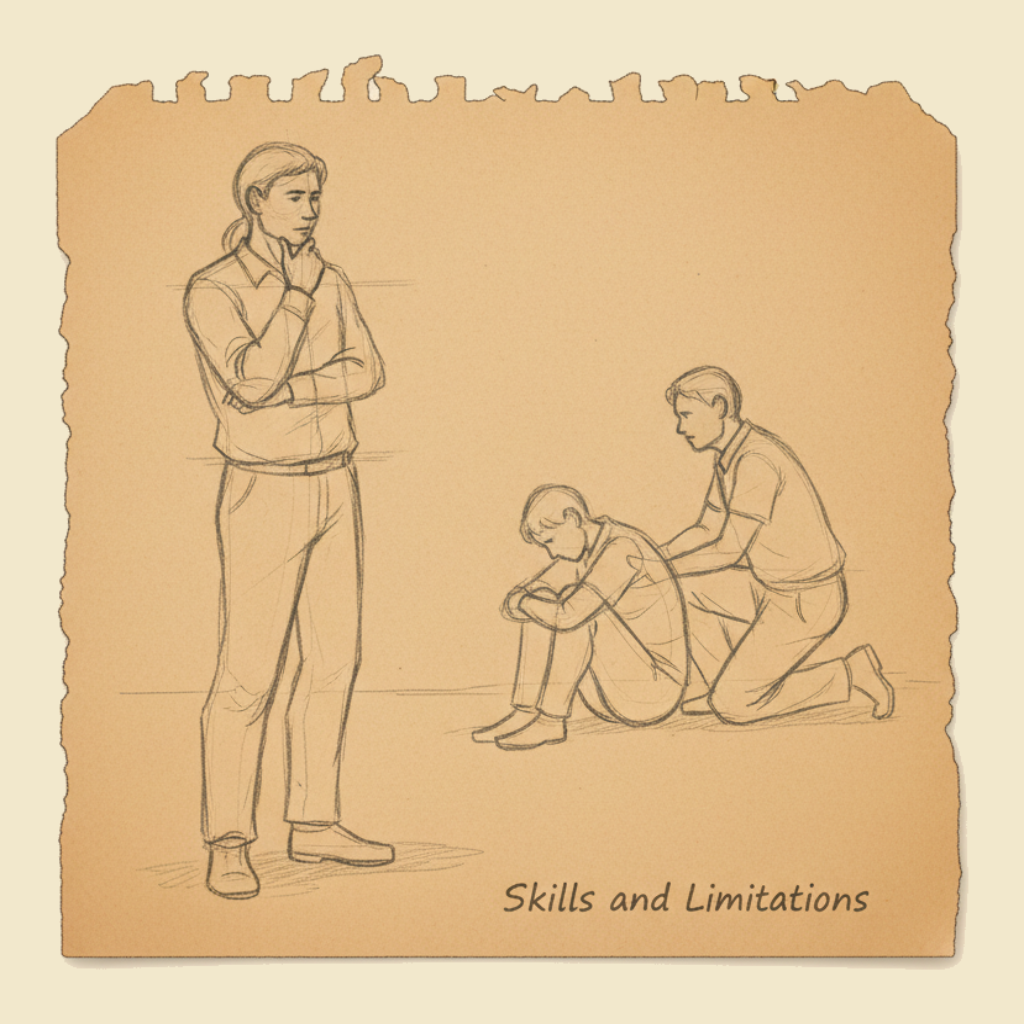
Why this is its own chapter
First aid sits in a peculiar place in the healthcare system. A first aider has more clinical responsibility than a member of the general public, but far less than a paramedic, a nurse, or a doctor. The temptation, in the heat of an incident, is to drift across the line — to make a diagnosis, to perform a procedure you've seen on TV, to give a casualty's medication based on your best guess, to "have a go" at something the situation seems to demand. Drifting across the line is how harm is done.
The framing this chapter teaches is the opposite: the first aider's job is to do the things that are in their training, and to recognise the boundary beyond which the right action is to call someone with more training. Recognising that boundary is not a failure of competence — it is the most competent thing a first aider does. Every ANZCOR guideline ends in some form of "call an ambulance" precisely because the protocol acknowledges where the first-aid layer stops and the next layer begins.
§ Instructor's note
The teaching point here is psychological as much as clinical. Learners often arrive worried they will "freeze" or "not know what to do". The honest answer is: most of the things you'll see, you will know what to do — because the protocols are short and they have been rehearsed. The dangerous failure mode is not freezing; it is the opposite — improvising past the edge of your training because nobody told you it was okay to stop. Drill the rule: doing the bit you know, well, and calling someone for the rest, is the goal. There is no extra credit for guessing.
The shape of "your training"
The HLTAID011 Provide first aid unit (and its smaller relatives 009 and 010) covers a specific set of conditions and a specific set of skills. The full list is in the YAML schema this site is built around — and roughly:
- Recognition and management of: cardiac arrest, anaphylaxis, asthma, choking, bleeding, burns, shock, fractures and sprains, head/neck/spinal injury, eye injury, nosebleed, drowning, envenomation (snake, spider, marine), hypothermia, hyperthermia, seizures, stroke, diabetes (hypo and hyper), poisoning, allergic reaction, cardiac conditions, minor wounds, sharps injuries.
- Skills: DRSABCD primary survey, CPR (compressions and rescue breaths) for adult/child/infant, AED use, recovery position, pressure-immobilisation bandaging, splinting, bandaging, glucose administration, EpiPen-assisted use, asthma reliever-assisted use, basic wound care, the procedural and legal wrap-around (consent, documentation, handover).
That is the complete scope of what an HLTAID011 first aider is trained to do. It is a substantial scope and it covers the great majority of incidents a workplace first aider will ever see. It does not include:
- Diagnosing conditions (you recognise patterns; you do not diagnose).
- Giving injections, except for the casualty's own pre-prescribed adrenaline autoinjector.
- Giving any oral medication that is not the casualty's own pre-prescribed drug, with their knowledge.
- Inserting airways (nasal or oropharyngeal), except where the workplace has separate higher training and authorisation.
- Administering oxygen, except where you have specific separate training and authorisation.
- Suturing, stapling, gluing wounds, or any other wound-closure technique beyond clean dressings and adhesive closure strips.
- Performing any procedure you have not been specifically trained on.
The line is bright on purpose. You are trained for the things on the first list; you are not trained for the things on the second; and the difference between the two is exactly the boundary you're meant to recognise.
How to know you're at the limit
You are at the limit when one or more of the following is true:
- The casualty has a condition you don't recognise. Not "this looks like X" — actual "I don't know what this is." Call the ambulance.
- The casualty needs a procedure you haven't been trained to do. Don't do it. Call.
- The casualty is deteriorating and your interventions aren't helping. That is a signal that the next layer of care is what they need. Call.
- The casualty needs a drug you don't have authority to give, and they don't have their own. Call.
- The scene has a hazard you can't safely manage. Stay back. Call. See the incident hazards chapter.
- You are exhausted, injured, frightened, or out of resources and continuing competently is not possible. Hand over to someone else, or to paramedics on arrival.
- The casualty's condition is one of those where ANZCOR's guideline says "call 000" — and the great majority of significant guidelines do.
In all of these, the right action is the same: do the parts of the protocol that you can do (positioning, airway, bleeding control, reassurance, monitoring), call the ambulance, and stay with the casualty until they arrive.
The single thing first aiders most commonly do wrong at the limit
It isn't the dramatic stuff. It's the small thing: giving a casualty an over-the-counter medication from the kit "to help". Painkillers for a headache. Antihistamines for an itchy rash. Aspirin for chest pain (this one is a partial exception — see below). Anti-diarrhoeals for an upset stomach. The first aider's instinct is "this is harmless, it might help, the casualty will appreciate it" — and the answer is no. A workplace first-aid kit does not contain oral medications for a reason (see the first aid kit contents chapter), and even if a tablet is somehow available, the correct action is to let the casualty take their own medication if they have it, or to wait for the paramedic / GP / emergency department.
The reason this matters: drug interactions, allergies, masking a more serious symptom, contraindications you don't know about, and the legal question of who authorised it. None of these are problems the first aider is positioned to evaluate, and the cost of getting it wrong far outweighs the (small) benefit of a tablet given on instinct.
The narrow, named exceptions where a first aider can assist with medication are spelled out in ANZCOR guidelines and this course:
- Adrenaline autoinjector for anaphylaxis — assist the casualty (or a child's parent, or the teacher with a school-stored autoinjector) to administer their pre-prescribed device. This is an authorised first-aid action under
G9-2-7. - Reliever inhaler (salbutamol) for asthma — assist the casualty to use their own inhaler, or use a workplace one according to the asthma first-aid protocol under
G9-2-5. - Glucose for hypoglycaemia — give oral glucose (gel, tablets, sugary drink, jelly beans) to a conscious hypoglycaemic casualty who can swallow safely, under the diabetes first-aid protocol. See the diabetes chapter.
- Aspirin for suspected heart attack — ANZCOR's
G9-2-1notes that for an adult casualty with suspected heart attack, who is not allergic to aspirin and not bleeding, a single 300 mg aspirin (chewed or dissolved) may be given. This is an authorised first-aid action and the only "give a tablet from the kit" action a first aider does — and even this is conditional. See the cardiac conditions chapter.
Outside of those four, the answer is "no medication from the first aider".
Skills decay and self-honesty
A second dimension of "your limits" is honest currency. A first-aid skill is only as sharp as the most recent time you practised it. A first aider whose CPR refresher was 11 months ago is much more current than one whose refresher was three years ago, and being honest about that gap is part of competence.
The structural answer to skills decay is the currency requirements chapter — annual CPR refresh, three-yearly full first-aid refresh — and the personal answer is to be honest with yourself between refreshes. If you can't remember the compression depth, look it up. If you've never used an AED, find one and practise on a training pad. If you've never seen an EpiPen used, watch a video. The protocols are public; the gear is widely available; the work of staying ready is on you.
The relationship between confidence and competence is not linear. New first aiders are often nervous and check the protocol before acting, which is exactly the right behaviour. Mid-career first aiders sometimes drift into over-confidence, skipping steps because "I know this one", and that is when errors creep in. Senior first aiders return to the protocol every time, because they have learned that the protocol is more reliable than their memory under stress. Aim for the third state from day one: checking the guideline is professionalism, not weakness.
When the casualty is "above your pay grade"
Sometimes the casualty in front of you obviously needs more than you can give. A multi-system trauma after a vehicle accident. A complex medical patient with multiple co-morbidities. A psychiatric crisis. A combative or intoxicated casualty. A mass-casualty incident. The right framing in all of these is the same:
- Make the scene safe for yourself and others.
- Call 000 with as much information as you can give the dispatcher.
- Do the parts of the protocol you can do — airway, breathing, bleeding control, positioning, reassurance, monitoring.
- Stay with the casualty until paramedics arrive (or until your own safety requires you to retreat).
- Hand over clearly and completely when they get there.
- Document and debrief afterwards.
You are not failing if you can't fix the casualty. You are succeeding by making sure the people who can fix them get there as fast as possible, with the casualty in the best possible state on arrival. Most first-aid wins look like that.
Mental, physical, and emotional limits
"Limitations" doesn't only mean clinical scope. It also means you, the first aider, have your own limits as a human being. A first aider can be:
- Physically limited — too small to roll a heavy casualty alone, too injured (a back problem, pregnancy, a fresh wound) to perform compressions safely.
- Emotionally limited — recently bereaved, in active mental health treatment, recovering from a traumatic incident, or simply deeply shaken by what they have just walked into.
- Cognitively limited — exhausted from a long shift, ill themselves, unfamiliar with the workplace, working with kit they have not used before.
In all of these, the right action is the same as for clinical limits: acknowledge the limit, do what you can within it, and call for help. A workplace first aider who is themselves unwell on the day should not be on the roster — that conversation with their manager is part of the role. A first aider who is too rattled by an incident to continue should hand over to a colleague or to paramedics and step back. The rescuer stress and support chapter covers the post-incident dimension of this in detail.
If you are alone with a serious casualty and your hands are full, the next thing you should do is recruit a bystander. Make eye contact with one specific person, point at them, and give them one specific job: "You — call 000 and tell them we have an unconscious adult at this address." A specific person with a specific instruction will almost always do what you ask. A general appeal to the crowd will almost always result in nobody acting. This is not a failure of bystanders — it is a well-documented psychological effect (the "diffusion of responsibility") and the answer is to direct the help you need.
The professional posture of "I don't know"
The most useful sentence in the first aider's vocabulary is "I don't know." Said honestly, to the right people, at the right moment, it is what triggers the next layer of care. Said to the casualty: "I don't know exactly what's happening, but I'm going to keep you safe and the ambulance is on its way." Said to the dispatcher: "I don't know what's wrong, but I have an unconscious adult who isn't breathing properly." Said to the paramedics: "I don't know the casualty's history; this is what I found and this is what I did." Said to yourself, after the event: "I don't know if I made the right call on X — let me check the guideline now."
None of these are admissions of weakness. They are the verbal markers of a person operating responsibly inside the limits of their training, and they are exactly what the system is designed to hear.
First aiders should provide care within the limits of their training and only attempt skills they have been taught. Where the situation exceeds the first aider's competence, immediate steps should be taken to obtain additional assistance from emergency medical services, while continuing to provide whatever care is within the first aider's scope. Recognising the boundary of one's own competence is a core element of safe first-aid practice.
What not to do
- Do not improvise procedures you have not been trained to do.
- Do not give medications from the kit (or anywhere) outside the four narrow exceptions in your training.
- Do not treat "I don't know what this is" as a failure — treat it as the trigger to call 000.
- Do not continue when you are physically, emotionally, or cognitively unable to continue safely. Hand over.
- Do not assume your training is current because you "remember it from last time". Refresh on schedule.
- Do not appeal vaguely to "someone" in a crowd. Direct a specific person to do a specific job.
- Do not confuse confidence with competence. Check the protocol every time.
You will work through scenarios designed to put you at the edge of your scope deliberately — a casualty whose presentation isn't in the textbook, a workplace where the kit is incomplete, a bystander who insists you "do something", a casualty who asks for a tablet you don't have authority to give. The aim of the exercises is not to make you feel inadequate; it is to make you comfortable saying "this is the bit I can do; the ambulance is on its way for the rest" without flinching. That sentence, said calmly, is the most professional thing a first aider does.
The first aider's job is not to be the doctor. It is to be the first link in the chain of care — competent within their training, honest about their limits, fast to call the next link, and steady until the next link arrives. Knowing where your scope ends is what makes the chain work.
— ANZCOR Guideline 2 (introduction to first aid)