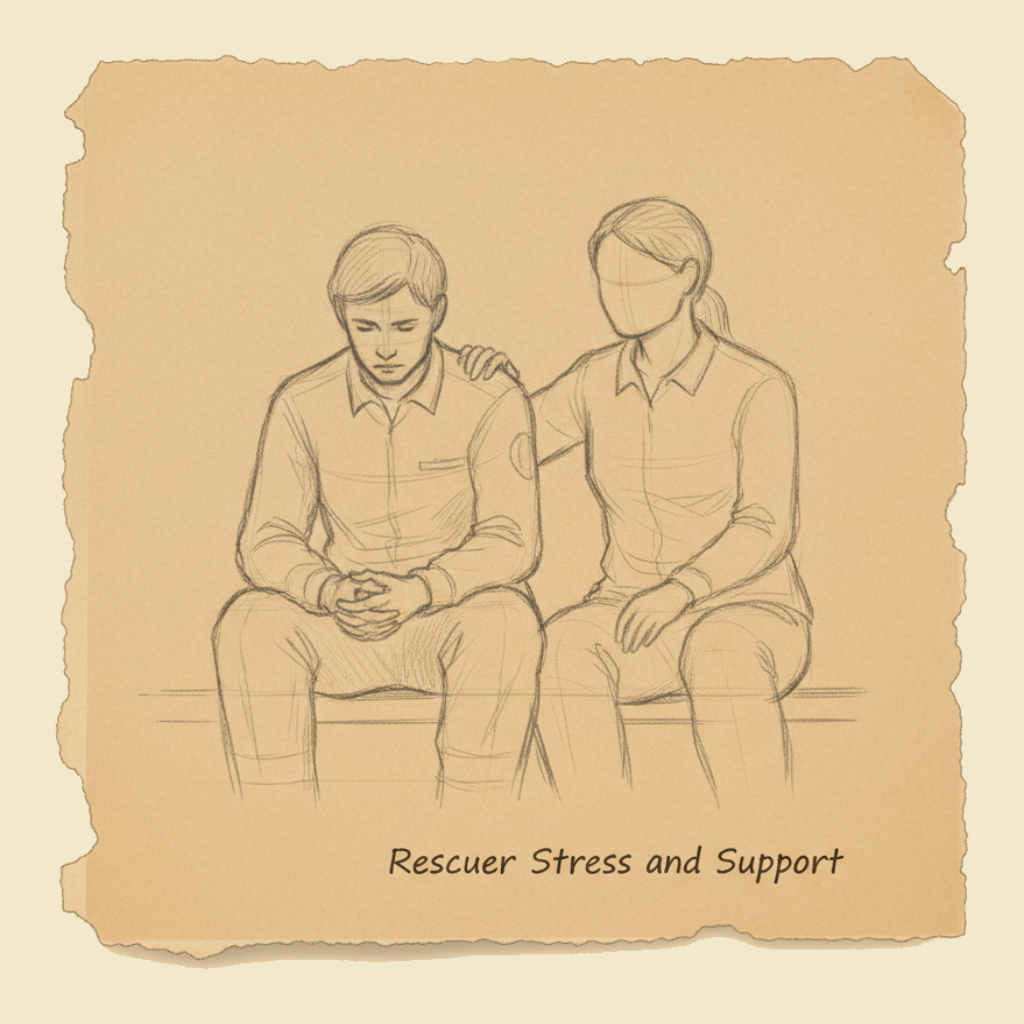
Why this is its own chapter
The previous chapters in this unit have been about what happens to the casualty. This one is about what happens to you. Responding to a serious incident — a cardiac arrest, a major bleed, a child casualty, a workplace death — is a significant psychological event, and it can have effects in the hours, days, weeks and sometimes months that follow. Not noticing those effects, or not having anywhere to take them, is how good first aiders quietly burn out and stop volunteering.
The purpose of this chapter is short: to make sure you arrive at your first serious incident already knowing that the stress reactions you may have are normal, and already knowing what to do about them. None of it should come as a surprise, and none of it should be carried alone.
§ Instructor's note
This chapter is unusual because it is the only one in the unit where the first aider is the casualty. Learners often expect "first aid" to be about toughness, and the cultural framing in some workplaces still treats stress reactions as weakness. The teaching point is the opposite: stress reactions to serious incidents are a normal physiological and psychological response to abnormal events, and the people most at risk of long-term harm are the ones who suppress, ignore, or are shamed out of acknowledging them. Drill the rule: looking after yourself is part of the job, not separate from it.
What "stress" actually means in this context
The body's response to a serious incident is biological. When you arrive at a scene and recognise that something significant is happening, your sympathetic nervous system fires — adrenaline and cortisol release, heart rate climbs, blood is redirected to the muscles, pupils dilate, peripheral vision narrows, fine motor control degrades, time perception distorts. This is the "fight, flight or freeze" response, and it is the same response your ancestors had to a charging predator. It is not pathological; it is what evolution gave you to deal with high-stakes events, and it is part of the reason you are able to act at all.
The catch is that the response was designed for short, physical episodes with a clear end point — and a serious workplace incident isn't always either. Adrenaline keeps you running through the response, but the cortisol takes hours to clear, the memory of what you saw takes longer, and the cognitive review of "did I do the right thing?" can take weeks. What you experience in the hours and days afterwards is the long tail of a perfectly normal acute response, working its way through your system at its own pace.
This matters because it tells you two things:
- What you feel afterwards is not a sign of weakness. It is your body and brain doing exactly what they are built to do.
- It will, in almost all cases, resolve on its own if you give it the conditions to do so — sleep, food, time, rest, and the chance to talk about it with someone safe. Most people return to baseline within a few days.
Common reactions, in three time frames
Immediately during and after the incident — minutes to hours:
- Tunnel vision and narrow focus.
- Time distortion (the response felt like five minutes; it was twenty, or vice versa).
- Tunnel hearing — sounds outside the immediate task fade out.
- Trembling, shaking, weakness in the legs once the adrenaline starts to drop.
- Nausea, dry mouth, urgency to use the toilet.
- Difficulty making small decisions immediately afterwards.
- A sudden need to sit down, eat something, or be quiet.
- Tearfulness, sometimes catching you by surprise.
- A surreal, "did that just happen?" feeling.
- The opposite — a strange calm, sometimes followed later by a delayed reaction.
Hours to days afterwards:
- Difficulty getting to sleep, or waking in the night.
- Dreams about the incident, or unrelated unsettling dreams.
- Replaying the incident in your head — what you saw, what you did, what you might have done differently.
- Intrusive images or sounds from the scene that pop up unexpectedly.
- Feeling jumpy or irritable.
- Changes in appetite — not hungry, or eating for comfort.
- Wanting to be alone, or wanting to be around people more than usual.
- A general flat, drained feeling.
- A sense of numbness or distance from normal life.
Days to weeks afterwards, in most cases, all of the above gradually fading. In a minority of cases, persisting:
- Continued intrusive memories or flashbacks.
- Continued sleep disturbance.
- Avoidance — not wanting to be in the place where the incident happened, not wanting to talk about it, not wanting to respond to the next call.
- Persistent low mood, anxiety, or anger.
- Physical symptoms — headaches, muscle pain, gut symptoms — without an obvious cause.
- Increased use of alcohol, food, or other substances to cope.
- Difficulty returning to normal work and family life.
The first two time frames are normal and need acknowledgement, rest, and time. The third is the territory where professional support is the right step, and is covered below.
What helps in the first 24 to 72 hours
The single most evidence-based thing a first aider can do for themselves in the hours after a serious incident is to give the body and mind the basic conditions for recovery:
- Eat something. Adrenaline and cortisol burn through your reserves; refuel. Even if you don't feel hungry.
- Drink water. Mild dehydration makes everything worse.
- Sit down somewhere quiet for ten minutes after the immediate response is over. Resist the urge to plough straight back into the day.
- Do the documentation, if you can do it without distress — it gives the experience a structured, factual frame.
- Tell someone you trust what happened, in broad strokes — a colleague who was there, a supervisor, a manager. The act of putting it into words helps the brain process it.
- Sleep, as soon as it is reasonable. Sleep is when most of the consolidation happens.
- Move, gently — a walk, a gentle exercise — to let the residual adrenaline work its way out.
- Avoid heavy alcohol or substance use to "shut it off". It interferes with sleep and pushes the processing further down the line, where it tends to come back harder.
- Don't isolate yourself. Be around the people you trust, even if you don't want to talk much.
- Be patient with yourself. Your sleep, appetite, mood and concentration will probably be off for a few days. That is the system working, not breaking.
Defusing and debriefing — what works and what doesn't
There is now reasonably good evidence about what kinds of post-incident conversation help and which don't.
Helpful, particularly in the first 24–72 hours:
- Operational defusing — a brief, focused conversation between the people who were on the response, going through what happened, what they did, what worked, what didn't. The point is clinical learning and acknowledgement of the event. It does not require deep emotional disclosure and works well immediately after the incident.
- Peer support — informal contact with another trained first aider who has been through similar incidents, focused on "how are you doing?" rather than reliving every detail.
- Manager check-in — a brief, non-intrusive "how are you?" from a supervisor, with the message that support is available if needed and that the first aider's wellbeing is taken seriously.
- Time off if needed. Some workplaces formalise this as a "post-incident rest day" for first aiders after a serious response. Others handle it case by case. Either way, the message that you don't have to be back at your desk immediately is valuable.
Not helpful, despite a long tradition of being recommended:
- Mandatory single-session psychological debriefings held in the first hours after the incident, where everyone is required to disclose their emotional reactions. The evidence on these (often called Critical Incident Stress Debriefing in older programmes) is that they do not prevent post-traumatic stress disorder and may, for some people, make it slightly more likely. Modern best practice avoids forcing emotional disclosure on a fixed schedule and instead offers support that the first aider can take up when ready.
- Lecturing or moralising — "well, you should be glad you saved them" or "that was nothing, you should have seen what I saw" — is not helpful and shuts down the very processing the first aider needs to do.
- Pretending it didn't happen. The single most common workplace failure mode after a serious incident is for the workplace to carry on as normal and never mention it again. The first aider feels invisible and the next response is harder.
The Australian standard is to offer support that is immediate, available, but not forced — and to follow up with a check-in a few days later to see how the first aider is doing.
When professional support is the right next step
For most first aiders, most of the time, a serious incident will be processed within a few days with rest, food, sleep, and the right kind of low-key conversation. For some — and the difference is largely about the cumulative load, the nature of the incident, and the individual's history — the processing doesn't complete on its own, and professional support is the right next step.
The signs that this is the case:
- Symptoms persisting beyond about two weeks — sleep disturbance, intrusive memories, avoidance, low mood, anxiety — without clear improvement.
- Symptoms worsening rather than fading.
- Functional impairment — difficulty doing your job, looking after your family, sleeping, eating, leaving the house, going to the place where the incident happened.
- Increased use of alcohol, sedatives, or other substances to cope.
- A sense of dread about the next response, or active avoidance of first-aid duties you used to do without trouble.
- Thoughts of self-harm or suicide — at any intensity, this is a signal to get help today, not next week.
The places to go:
- Your workplace's Employee Assistance Programme (EAP) if it has one. EAP is confidential, free to the employee, and designed for exactly this kind of situation. Most medium-to-large Australian workplaces have one; if you don't know your workplace's EAP, ask HR.
- Your GP. General practitioners are the front door of mental health care in Australia, and a Mental Health Treatment Plan unlocks subsidised psychology sessions under Medicare.
- A psychologist, ideally one with experience in trauma or first-responder work. Your GP can refer you.
- Lifeline (
13 11 14) for free 24/7 phone counselling. - Beyond Blue (
1300 22 4636) for support around depression and anxiety. - Black Dog Institute for online resources and self-help tools.
- Suicide Call Back Service (
1300 659 467) if thoughts of self-harm or suicide are present.
None of these are gated. None of them require a referral or a diagnosis. The act of picking up the phone is the entire decision. Workplace first aiders in particular sometimes feel they "shouldn't" need help because they are the helpers — the framing to reject explicitly is exactly that one.
The first aider whose health is most at risk is rarely the one who has just been through a single dramatic incident. It is the one who has been through a series of moderately serious incidents over months or years, each handled in isolation, each adding a small load that never quite gets cleared. The cumulative effect is real, and it is the leading reason workplace first aiders quietly stop volunteering. The countermeasure is regular, low-key check-ins between incidents — not just after the dramatic ones — and treating each significant incident as something that gets a debrief and a follow-up, rather than something that gets brushed off because "it wasn't that bad".
Workplace-level support
A workplace that takes first-aider wellbeing seriously will have, at a minimum, the following in place:
- A nominated point of contact (usually a manager or HR) for first aiders to raise concerns with.
- Access to an EAP, with the contact details posted where first aiders can find them.
- A simple post-incident process — debrief, check-in, follow-up — that is offered after every significant incident and not gated on the first aider asking.
- Recognition that the first-aid role is a real role, with real psychological exposure, and that recovery time after a serious incident is part of the job.
- A culture that doesn't shame first aiders for stepping back from the roster temporarily if they need to.
- A health and safety committee that includes psychological hazards in the workplace risk assessment, not just physical ones.
If your workplace doesn't have these in place, raising it with the health and safety committee (under the framework in the workplace procedures chapter) is reasonable and is not a complaint about anyone — it is the workplace meeting its WHS obligations to its workers.
Looking after the casualty's witnesses, too
A serious incident often has more witnesses than just the first aider — colleagues who saw what happened, bystanders who tried to help, the casualty's family if they were on site. All of them may have stress reactions, and all of them are part of the workplace's duty of care if the incident happened at work. A first aider in a workplace context can usefully:
- Suggest to the manager that EAP is offered to anyone who was present.
- Make sure witnesses know that what they're feeling is normal.
- Avoid spreading details of the incident to people who weren't involved (see the privacy and confidentiality chapter) — but acknowledge with witnesses that something difficult happened.
- Notice if a colleague seems unusually affected and quietly suggest they take the EAP up.
The first aider isn't a counsellor for the witnesses any more than for themselves; the role is to make sure support is offered and accessible.
One of the hardest moments in a workplace first-aid response is when the casualty's family arrives — sometimes during the response, sometimes just after. They are not your patient, but they need support, information, and someone to be with them. If you can, ask a colleague to look after them while you focus on the casualty, take them somewhere quiet, give them factual information without speculation, and make sure they are not left alone. The compassion you show them in that moment is part of the response, and it matters.
Rescuers may experience significant emotional and physical reactions following involvement in a serious incident. These reactions are a normal response to an abnormal event and usually resolve over time with rest and informal support. Where reactions persist or interfere with normal functioning, professional support should be sought. Workplaces and training organisations should ensure that rescuers have access to appropriate post-incident support, including peer support, employee assistance programmes, and referral pathways to mental health services.
What not to do
- Do not treat your stress reactions as weakness. They are a normal response to an abnormal event.
- Do not "tough it out" by suppressing what you feel. Suppression delays processing, it doesn't prevent it.
- Do not drink, sedate, or substance your way through the days after a serious incident.
- Do not isolate yourself. Be around people, even if you're quiet.
- Do not wait for someone to ask if you're okay. Take EAP, take time off, talk to your GP if you need to.
- Do not assume small incidents have no effect — accumulation is real.
- Do not force yourself back onto the roster before you're ready.
- Do not force a colleague to talk if they aren't ready — but make sure they know support is there when they are.
You will not be asked to share emotional material in the classroom. What you will get is the language for what to expect after an incident, the contact details for the main support pathways, and a worked example of a post-incident debrief done well. The point of the classroom session is not therapy; it is to make sure that on the day of your first serious incident you already have a map of what's coming and where to go for help.
Looking after the casualty is the visible part of first aid. Looking after the first aider is the invisible part — the one that decides whether the same person is still on the roster a year from now, still willing to step forward when the next call comes. Both are part of the role, and neither is optional.
— ANZCOR Guideline 10.5 (legal and ethical issues)