What a first-aid kit is for
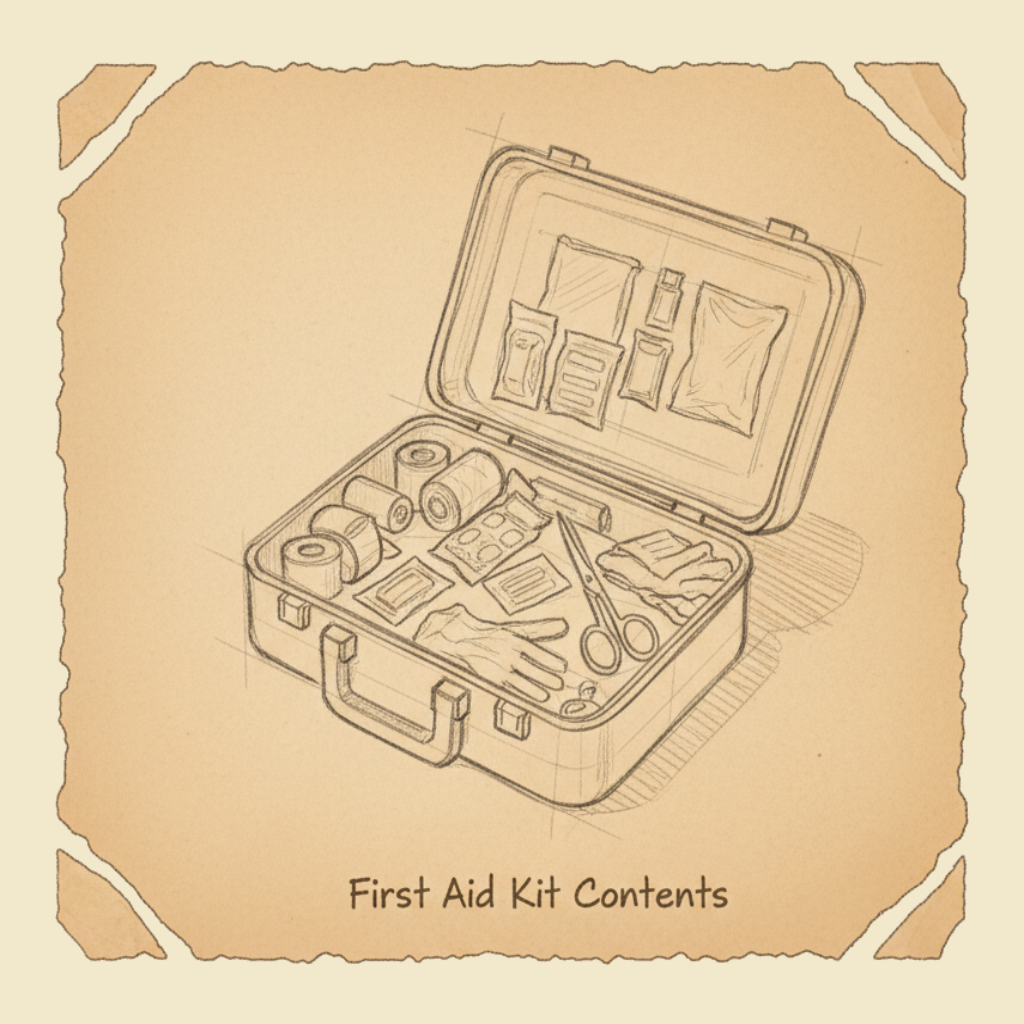
A first-aid kit is the physical implementation of a workplace's first-aid risk assessment. It exists to give the trained first aider the materials needed to manage the categories of injury and illness that the workplace is most likely to see, until either the casualty has recovered or paramedics have taken over. It is not a hospital in a box, it is not a replacement for an ambulance, and it is not the place for items the average first aider isn't trained to use.
The contents are guided by Safe Work Australia's Model Code of Practice: First Aid in the Workplace (see the codes of practice chapter) and by Australian Standard AS 2675 — First Aid Kits. The Code lists the minimum contents for a "low-risk" workplace and a "high-risk" workplace, and tells the PCBU to scale the kit up from there based on the number of workers, the location, the type of work, and the distance from medical help. G9-1-1
§ Instructor's note
The point of this chapter is not to make learners memorise a parts list. The point is to make them comfortable opening the kit they actually have, recognising every item, and knowing what each one is for. A first aider who can name every item in a generic Australian standard kit but has never opened the kit on the wall behind them is the wrong shape; one who has unpacked their own workplace kit and understands every item is the right shape. Encourage the unpack-and-name exercise on day one of any new workplace.
The Australian standard "first aid kit" — typical contents
A typical Australian-standard workplace first-aid kit contains the following categories. Quantities scale with the size of the workplace; the categories themselves are stable.
Personal protective equipment
- Disposable nitrile gloves — at least 4 pairs, often 6 or 8. The single most important item in the kit. See the infection control chapter.
- CPR face shield or pocket mask with one-way valve — for rescue breaths during CPR.
- Safety pins — for slings and securing dressings.
- Plastic biohazard waste bags — for contaminated dressings, gloves and wipes.
Wound care and dressings
- Adhesive plastic strips ("Band-Aids") — assorted sizes, for minor cuts and grazes. The most-used item in any kit by a wide margin.
- Sterile gauze swabs — typically 7.5 × 7.5 cm, individually wrapped, for cleaning and packing wounds.
- Non-adherent sterile dressings — small, medium, large, for covering wounds without sticking to the wound surface.
- Combine pads — large absorbent dressings (typically 9 × 20 cm or 20 × 20 cm) for heavier bleeding.
- Pressure bandages — heavy-weight crepe bandages for direct-pressure haemorrhage control and for snake-bite pressure-immobilisation. Two of these are non-negotiable in any Australian kit because of the snake-bite use case. See the envenomation chapter.
- Crepe bandages (light) — for general bandaging, sprains, holding dressings in place.
- Triangular bandages — calico, for slings and broad immobilisation. A first-aid kit staple that handles a surprising number of jobs.
- Wound closure strips ("Steri-strips") — for closing small wounds whose edges meet cleanly.
- Eye pads — sterile, individually wrapped, for eye injuries. See the eye injuries chapter.
Burns
- Hydrogel burns dressings — sterile gel-impregnated pads for cooling and covering burns after the initial 20 minutes of running cool water (not as a substitute for the water — see the burns chapter).
- Cling film — yes, plain food-grade plastic wrap. ANZCOR endorses it as a temporary burns covering because it is sterile inside the roll, doesn't stick to the burn, and lets the receiving clinician inspect the burn through it without disturbance.
Tools
- Tweezers — for removing splinters and bee stings (the bee sting is scraped off, not pulled).
- Sharp scissors — for cutting bandages, tape, and casualty's clothing if needed. Stainless steel.
- Splinter probes / forceps — fine, pointed, for the minor procedures the kit is intended for.
- Disposable resuscitation face shield or pocket mask — listed under PPE above; sometimes shelved with tools.
- Penlight torch — for assessing pupils, illuminating mouths and ears, and inspecting wounds in poor light.
- Notepad and pencil/pen — for the casualty's history, baseline observations, time of symptom onset, and the handover to paramedics.
Tapes
- Hypoallergenic adhesive tape — for securing dressings without irritating sensitive skin.
- Cloth/sports tape — heavier, for strapping and immobilising.
Miscellaneous but essential
- Saline ampoules / sachets — sterile, for flushing wounds and irrigating eyes. Single-use containers; do not refill from a bottle.
- Antiseptic wipes — for cleaning intact skin around a wound (not the wound itself, which should be flushed with saline or running water).
- Instant cold pack — chemical, single-use, for soft-tissue injuries. Shake to activate.
- Thermal blanket / space blanket — silver foil, for retaining body heat in shocked or hypothermic casualties.
- Resuscitation chart / DRSABCD card — laminated, with the basic CPR sequence printed on it. For the next person, not for you — you should know the sequence.
- First-aid manual — a current ANZCOR-aligned reference, for the protocols you don't use often.
- Emergency contact list — Poisons Information (
13 11 26), local hospital, on-site nurse if any, named first aiders, manager, ambulance dispatch instructions. - First-aid record book / incident register forms — for documenting what was done, in line with the workplace procedures chapter.
Items often added in higher-risk or specific workplaces
- Tourniquet — modern windlass tourniquet (e.g. CAT, SOFTT-W). ANZCOR's guidance on tourniquets shifted in the early 2020s as evidence from military trauma research became conclusive: a tourniquet, applied properly, is a life-saving intervention for catastrophic limb haemorrhage. Workplaces with traumatic-injury risk (construction, machinery, cutting tools, remote work) should have one and the first aiders trained in its use. See the bleeding chapter.
- Haemostatic gauze — gauze impregnated with a clotting agent, for catastrophic bleeding that can't be controlled by direct pressure alone.
- Asthma reliever inhaler (salbutamol) and spacer — for use with a known asthmatic casualty under ANZCOR's
G9-2-5protocol. Often kept in workplace kits where children are present (schools, childcare). - Adrenaline autoinjector (EpiPen) — for use in known anaphylaxis under ANZCOR's
G9-2-7. Schools and childcare settings are required to have a "general use" autoinjector available. - Glucose gel or glucose tablets — for hypoglycaemic casualties who can swallow safely. See the diabetes chapter.
- Eyewash bottle or eyewash station — workplaces with chemical or dust hazards should have a dedicated eyewash facility, separate from the kit.
- AED (Automated External Defibrillator) — increasingly common in workplaces, public buildings, sporting clubs. Not technically a kit item — it's a separate cabinet — but it's part of the overall first-aid provisioning.
- Burn shield / large burn dressing — for workplaces with significant burn risk (kitchens, foundries, welding).
What is not in a standard workplace first-aid kit, and why
The Code is as deliberate about exclusions as inclusions. A workplace first-aid kit should not typically contain:
- Oral medications — paracetamol, ibuprofen, antihistamines, anti-diarrhoeals, cold and flu tablets. These are not first-aid items. The reasons are partly clinical (drug interactions, allergies, masking serious symptoms) and partly liability (giving a casualty a tablet that turns out to interact with their existing medication is not what your training authorises). The casualty's own GP-prescribed medication is a different question — see below.
- Sutures, scalpels, syringes, IV equipment — hospital-grade procedural equipment that a first aider is not trained to use.
- Sharps you have no use for — unused needles, blades, lancets. The kit should not be the place needles enter the workplace.
- Out-of-date items — anything past its expiry date is removed and replaced. Hydrogel dressings, saline, eye pads, autoinjectors and inhalers all have meaningful expiry dates.
- "Folk remedies" — butter for burns, raw onion for bee stings, vinegar for non-jellyfish bites, urine for jellyfish stings. None of these are in the kit because none of them are in the guidelines.
The casualty's own medication — their EpiPen, their salbutamol, their insulin, their nitrolingual spray — is not a kit item and is not the first aider's medication to give independently. The casualty (or, if unconscious, their action plan) authorises its use, and the first aider is assisting the casualty to take their own prescribed medication, not administering it from stores. This distinction matters legally and is covered in the consent and skills and limitations chapters.
Maintaining the kit
A first-aid kit is a perishable, living object. It needs:
- Regular inspection — typically monthly — by a named person who is responsible for the kit. The inspection includes a check of every item against the contents list, every expiry date, and the integrity of seals and packaging.
- Restocking after every use — opened sterile dressings are not put back, even if "they look fine"; gloves used and discarded are replaced; saline ampoules used are restocked. The first aider who opens the kit has a responsibility to leave it ready for the next opening.
- Replacement of expired items — hydrogel dressings, saline, eye pads, autoinjectors and inhalers all expire and need to be rotated.
- A logbook — most workplaces keep a check sheet on or in the kit, with dates and initials, so the inspection history is documented.
- Visible location — the kit should be where a stranger could find it in 30 seconds. Posters or signage indicating the kit's location are part of the workplace's first-aid signage requirement.
If you ever open a kit and find it empty, expired, or missing items, that is a workplace control failure and should be raised through the health and safety channels described in the workplace procedures chapter.
The Code of Practice does not say "every workplace must have a Type B kit". It says the workplace must do a risk assessment and provision kits appropriate to the size, type and hazards of the workplace. In practice, that means: a small low-risk office may have a single kit; a building site of 80 workers needs multiple kits at strategic locations; a remote mine site needs heavy kits, vehicle kits, eyewash, AEDs, and a first-aid room. The risk assessment, not a fixed rule, drives the answer. AS 2675 provides standardised kit configurations (Type A, Type B, Type C) that workplaces typically buy off the shelf to satisfy the Code.
The personal first-aid kit — for travellers, drivers, and households
A first aider trained at the workplace level often gets asked about the kit they should keep in their car, their backpack, or at home. The same principles apply, scaled smaller:
- The same PPE basics — gloves, face shield, biohazard bag.
- The same dressing basics — adhesive strips, sterile dressings, two pressure bandages, triangular bandage, hypoallergenic tape.
- The same tools — tweezers, scissors, penlight, pencil and notepad.
- The same hydrogel and cling film.
- The same saline and antiseptic wipes.
- The same emergency contact list.
Two pressure bandages are non-negotiable for a remote-area or bushwalking kit because of snakes — Australia is the only continent where this is true at the level it is true here. A car kit that contains nothing for a snake bite is not an Australian car kit.
First aid kits should be provided in accordance with the workplace risk assessment. They should be clearly identified, easily accessible, and contain the items necessary to treat the range of injuries and illnesses likely to occur in that workplace. Kits should be checked regularly to ensure that they are fully stocked, that all items are in good condition, and that no items are out of date. The contents of the kit should reflect the relevant Australian Standard (AS 2675) and the recommendations of the Australian Resuscitation Council.
What not to do
- Do not add oral medications to a workplace kit unless your workplace has a documented medication-administration policy and a clinically-trained authoriser.
- Do not put expired items back in the kit. Replace them.
- Do not treat the kit as a personal toolkit — it belongs to the workplace and the next casualty.
- Do not open sterile packaging "to look at" — once opened, it is no longer sterile.
- Do not improvise items that the kit doesn't have if a casualty needs hospital-level care. Call the ambulance.
- Do not assume the kit is fully stocked because it looks full. Inspect on a schedule.
- Do not forget the snake-bite bandages. Anywhere in Australia.
You will unpack a standard Australian first-aid kit, identify every item, and explain what each is for. You will also do a worked exercise of restocking the kit after a simulated incident and recording the maintenance check. The point is not to memorise quantities — the point is for you to be able to walk up to your own workplace's kit and know exactly what you have to work with before you ever need it.
A first-aid kit is not magic. It is a small, deliberate, current set of materials chosen by people who thought hard about what a trained first aider can actually do at the side of a casualty. Open yours, learn it, restock it, and the kit will be ready when you are.
— Safe Work Australia, Model Code of Practice: First Aid in the Workplace