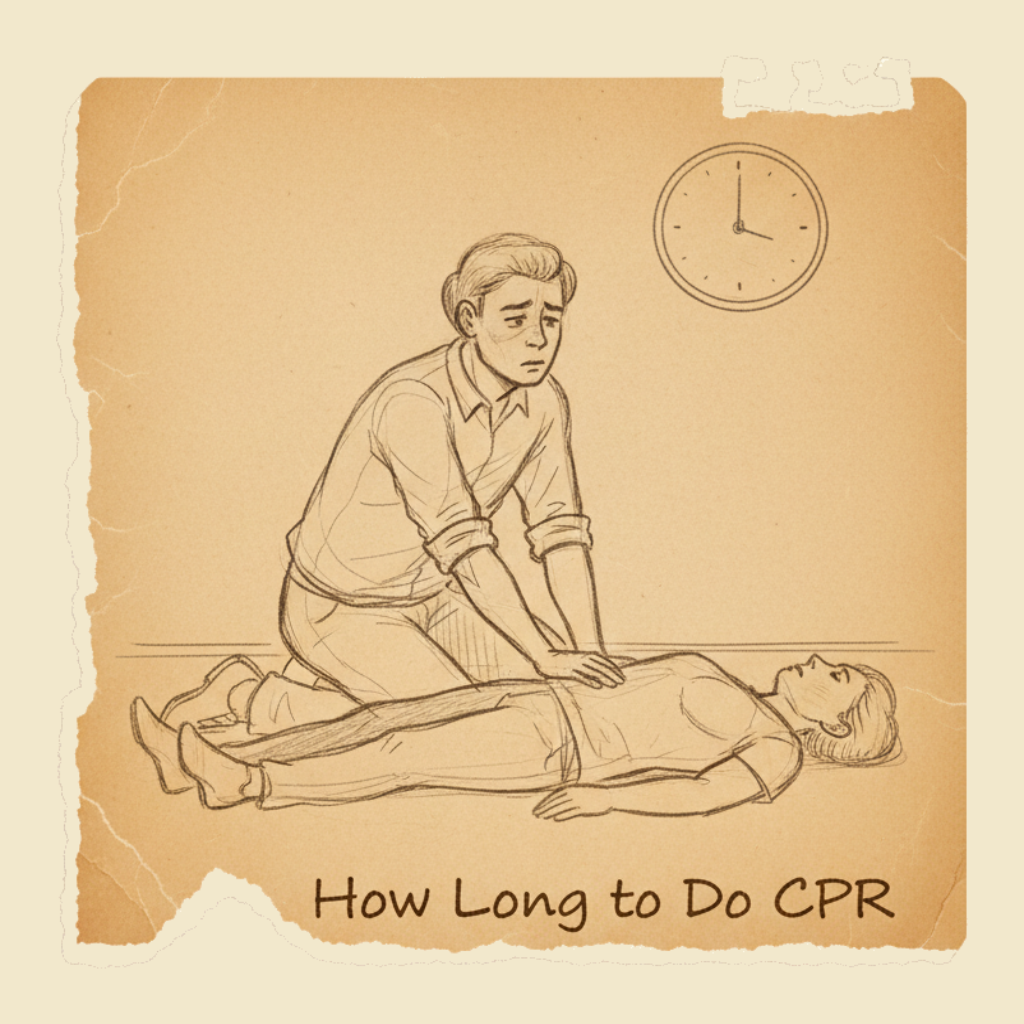
Why this is its own chapter
Most chapters in this course are about how to start a piece of first aid. This one is about how to continue it, and when — and only when — to stop. CPR is unique in two ways: it is physically demanding to the point of exhaustion, and it is the one intervention where the casualty's life is literally being kept going by the rescuer's hands. Knowing how long to keep going, when to swap rescuers, and what counts as a legitimate reason to stop is part of being a competent CPR provider. G8
The starting position, and the one most learners need to internalise, is this: once you start CPR, you keep going until one of a small number of specific things happens. Stopping because you are tired, frustrated, or unsure is not on the list. The list of legitimate reasons to stop is short, defined by ANZCOR, and worth knowing by heart.
§ Instructor's note
Learners often arrive thinking CPR is something you do for a few minutes "just in case", and that you stop when it "doesn't work". This is the wrong frame and is the reason many bystander CPR attempts in the community are abandoned too early. The teaching point is that CPR is the bridge — sometimes a long bridge — between cardiac arrest and the arrival of advanced care. The bridge has to be held until the advanced care reaches the casualty. Drill the rule: start CPR, keep going, swap rescuers every 2 minutes, stop only for the specific reasons on the list.
What CPR is actually doing
CPR — chest compressions, with or without rescue breaths — does not restart a stopped heart. What it does is take over the heart's pumping function manually, keeping a small but critical amount of oxygenated blood circulating to the brain and the heart muscle itself, until something definitive (defibrillation, advanced life support, paramedic intervention) can restore a spontaneous rhythm. The key word is bridge. CPR buys time. It does not, by itself, fix the underlying problem.
Two consequences follow from this:
- CPR works when it is started early and continued without long interruptions. Each time you stop compressions, the blood flow to the brain stops within seconds. Each time you restart, it takes several compressions to build the pressure back up. The protocol is built around minimising these interruptions.
- CPR has the highest chance of success when it is combined with early defibrillation (an AED) and early paramedic arrival. The longer the casualty is in arrest before CPR starts, and the longer they are in arrest before defibrillation, the worse the odds become. See the chain of survival chapter.
The first aider's job is to provide the highest-quality CPR possible from the moment the arrest is recognised, and to continue it without significant interruption until one of the legitimate stopping conditions occurs.
When you can — and should — stop
ANZCOR's guidance on when a first aider can stop CPR is short and specific. You stop CPR if and only if:
- Signs of life return. The casualty starts breathing normally (not agonal gasping), moves purposefully, opens their eyes, or coughs. Keep them in the recovery position, monitor closely, and be ready to restart CPR immediately if they deteriorate again.
- A more qualified rescuer takes over — paramedics, a doctor, a nurse — and explicitly assumes care of the casualty. Do not just step back when they arrive; hand over verbally, then step back when they have the casualty.
- You are physically unable to continue. You have exhausted yourself completely, there is no-one to swap with, and you cannot do effective compressions any longer. The protocol does not require you to compress yourself into the ground.
- The scene becomes unsafe and continuing would put you in danger. Fire, structural collapse, hostile attacker, rising water — anything that would make the scene unsurvivable for you.
- An authorised person directs you to stop. A doctor on scene, a paramedic, or (in some jurisdictions) a police officer or coroner who has determined that the casualty is deceased and that continued resuscitation is not appropriate.
- An AED, after a shock or no-shock advice, indicates the casualty has signs of life and you can confirm normal breathing. This is functionally a special case of (1) above.
That is the entire list. Tiredness alone is not a stopping condition — the answer to tiredness is to swap with another rescuer. Frustration is not a stopping condition. "It's been a long time" is not a stopping condition. The decision to call time of death is a medical one, not a first-aid one, and the first aider's job is to keep going until somebody with that authority arrives.
Swapping rescuers — every two minutes
CPR is harder than it looks. After about two minutes of compressions, the quality starts to drop measurably even in fit, trained rescuers — compressions become shallower, the rate drifts, and the rescuer doesn't always notice. ANZCOR's recommendation is therefore:
Where two or more rescuers are available, swap the compressing rescuer every two minutes (about every five cycles of 30 compressions and 2 breaths).
The swap should be done in less than five seconds — the second rescuer is in position before the first one steps out, and the change happens during the breath cycle so the next compression starts immediately. The worst thing you can do during a swap is to pause compressions for thirty seconds while the rescuers reorganise themselves; the goal is for the casualty to feel almost no break in the rhythm.
Two-minute swaps achieve two things:
- Quality stays high. A fresh rescuer compresses at the right depth and rate; a tired one starts to compromise without realising.
- No rescuer collapses. Rotating rescuers prevents the lead rescuer from hitting the wall and being unable to continue at all.
If you are alone, you cannot swap, and you do the best you can. If there are bystanders who can be recruited, recruit them — even an untrained bystander can be talked through chest compressions in 30 seconds if the only alternative is for the lead rescuer to collapse.
Compressions-only CPR — when it's appropriate
ANZCOR's protocol is 30 compressions to 2 breaths for adults, children and infants, with rescue breaths integrated into the cycle. This is the gold standard.
However: compressions-only CPR is also recommended in two situations:
- The rescuer is unwilling or unable to give rescue breaths. Some rescuers cannot bring themselves to perform mouth-to-mouth on a stranger. The evidence is unambiguous: compressions without breaths is far better than no CPR at all. If you cannot or will not do breaths, do compressions only and do not stop.
- The dispatcher on the 000 call is coaching a bystander through CPR. The dispatcher may direct the bystander to do compressions only, especially for adult arrests where the cause is most often cardiac.
For drowning, child arrests, infant arrests, and arrests of respiratory origin (asthma, choking, anaphylaxis, hanging), rescue breaths matter more — the casualty's blood is already low in oxygen, and compressions alone won't restore it. The protocol still allows compressions-only if breaths are impossible, but breaths-and-compressions is preferred for these.
The take-home: any CPR is better than no CPR, and the rescuer who cannot do everything should still do something.
How long is "long enough"?
There is no fixed number. The published ANZCOR guidance is to continue CPR until one of the stopping conditions occurs — which means, in practice, until paramedics arrive or until the casualty either responds or becomes obviously beyond resuscitation.
In the community, that usually means somewhere between 5 and 15 minutes before paramedics take over, depending on the local response time. In a remote setting it can be longer — 30 minutes, an hour, or more. ANZCOR has never set a maximum duration for first aiders because there isn't one: there are recorded survivors of cardiac arrests where CPR was provided for over an hour before advanced care reached the casualty. The bridge has to be held as long as it takes.
What you should not do is decide, mid-CPR, that "it has been too long" and stop. That is a medical decision and is not within the first aider's scope. The decision tree for the first aider is the six-item list above, and "I think it's been long enough" is not on it.
It is common for a casualty in cardiac arrest to start producing agonal breaths during CPR — slow, irregular gasps. This is not a sign of recovery and is not a reason to stop. Agonal breaths during CPR are simply the body's brainstem reflex responding to the circulation you are providing, and they do not represent restored spontaneous breathing. Only if the casualty starts breathing normally and regularly, opens their eyes, or moves purposefully, should you consider stopping. If in any doubt, keep going.
What "signs of life" actually look like
The signs of life that justify stopping CPR are:
- Normal regular breathing — not gasping, not snoring, not occasional. You should see a rhythmic chest rise and fall, hear normal breath sounds, and feel air at the mouth. This usually accompanies the next two.
- Purposeful movement — the casualty raises a hand, turns their head, pushes you away, opens their eyes deliberately.
- Coughing or speaking.
- A return of colour to the face and lips (this lags behind the others and is a confirmatory sign rather than a triggering one).
When you see these, stop CPR, position the casualty in the recovery position, monitor breathing, and stay alert. A casualty who has just had a cardiac arrest has a meaningful chance of arresting again in the next few minutes, and you should be ready to restart CPR immediately if they deteriorate. Do not pack up and leave; stay until paramedics arrive.
The handover to paramedics
Paramedics arriving on scene do not magically take over CPR. The handover is a deliberate transition that you should make explicit:
- Continue CPR while paramedics are setting up — they need a few seconds to ready their equipment.
- Verbal handover at the first opportunity: name (if known), age (if known), what happened, when the arrest was witnessed, when CPR started, how many shocks the AED has delivered, any relevant medical information from bystanders.
- Continue compressions until the paramedics tell you to stop. They will say "we have it" or "stop compressions" — that is your cue.
- Step back to a position where you can be useful without being in the way. Paramedics may ask you to fetch equipment, reassure family, or take over compressions again briefly.
The handover is your duty-of-care transfer point, as covered in the duty of care chapter. Make it explicit.
Compression quality drops with time — even when you don't notice
A well-documented finding from CPR research is that rescuers, even experienced ones, believe they are maintaining good compressions long after the actual quality has dropped. Compression depth tends to drift shallower after about a minute of work, the rate can drift either way, and the rescuer's perception lags behind the reality. The ANZCOR recommendation to swap every two minutes exists precisely because of this — it isn't only about exhaustion, it's about the quality drift you don't notice.
If you are alone and cannot swap, do your best to consciously check your own compressions every cycle: am I going deep enough (5–6 cm in an adult)? Am I going at 100–120 per minute? Am I letting the chest fully recoil between compressions? Am I keeping interruptions minimal? Naming the parameters out loud, even just in your head, helps maintain them.
Bystander CPR roughly doubles the chance of survival from out-of-hospital cardiac arrest, and the effect is even larger when CPR is started within the first minute or two. The casualty in front of you cannot tell you whether your compressions are working — but the population data is clear: rescuers who keep going make the difference between a recoverable arrest and a fatal one. If you are doubting yourself mid-CPR, the answer is "keep going; you are helping".
CPR should be continued without interruption until the casualty shows signs of life (responsiveness, normal breathing, purposeful movement), more qualified help takes over the resuscitation, the rescuer is physically unable to continue, the scene becomes unsafe, or an authorised person directs cessation. Where multiple rescuers are available, the rescuer providing chest compressions should be changed every two minutes (or every five cycles of 30:2) to maintain compression quality. The change of rescuer should take less than five seconds.
What not to do
- Do not stop CPR because "it's been a long time".
- Do not stop CPR because the casualty has agonal breaths during the response — agonal breaths are not normal breathing.
- Do not stop because you are tired — swap with another rescuer if at all possible.
- Do not pause compressions for more than a few seconds at a time. Interruptions kill outcomes.
- Do not let a swap take more than five seconds.
- Do not assume the AED has "fixed it" after a shock — continue CPR immediately as the AED instructs you to.
- Do not pack up after the casualty regains a pulse — they may arrest again. Stay with them until paramedics arrive.
- Do not declare a casualty dead. That is not a first-aid decision and is not within your authority.
You will run a CPR scenario long enough to feel the fatigue set in, practise the two-minute rescuer swap, and rehearse the verbal handover to a simulated paramedic arrival. The aim is not to push you to exhaustion — it is to give you a felt sense of what two minutes of compressions actually costs, so the swap-every-two-minutes rule isn't an abstract number when you need it.
CPR is a bridge. You are holding the casualty between cardiac arrest and the arrival of advanced care, and the bridge has to be held until the next link in the chain takes over. The legitimate reasons to stop are few and named; the illegitimate ones — tiredness, doubt, "long enough" — are the reasons community CPR fails most often. Once you start, you keep going until something changes.
— ANZCOR Guideline 8 (CPR)