What an AED actually does
A cardiac arrest in an adult is, in the great majority of cases, caused by an electrical malfunction of the heart — most commonly a chaotic disorganised rhythm called ventricular fibrillation (VF), in which the muscle fibres of the ventricles are quivering instead of contracting. The heart is electrically alive but mechanically useless: no blood is being pumped, and the casualty has the same minutes-to-brain-death problem as if the heart had stopped completely. An Automated External Defibrillator (AED) delivers a controlled electrical shock through the chest that depolarises every cardiac cell at once, briefly stopping the chaotic activity, and giving the heart's normal pacemaker (the sinus node) the opportunity to restart a coordinated rhythm. G7
CPR keeps the casualty alive in the meantime — it provides the small amount of oxygenated blood the brain needs while the rescuer waits for the AED. Defibrillation is what actually fixes the underlying problem, when the underlying problem is a shockable rhythm. The two interventions are complementary, not alternatives, and the highest survival rates from out-of-hospital cardiac arrest are achieved when both are started early.
The numbers are stark: with no CPR and no defibrillation, survival from out-of-hospital VF arrest is around 5%. With early bystander CPR, survival roughly doubles. With early CPR and early defibrillation (within 3–5 minutes of collapse), survival can exceed 50% — better odds than for many cancers. The window is short: every minute of delay reduces survival by about 10%, and after 8–10 minutes without defibrillation, the chances are extremely poor. Time is the most important variable, and the AED is the single tool that compresses it.
§ Instructor's note
The teaching point of this chapter is to remove the fear of the device. Learners often expect an AED to be a complicated piece of medical equipment requiring technical knowledge to operate. The truth is the opposite: it is a deliberately idiot-proof box designed so that anyone — a frightened bystander, a school child, a person who has never seen one before in their life — can switch it on, follow the spoken instructions, and shock a casualty back to life. The whole skill is: open the lid, follow the voice. Drill the rule: the AED is on your side, listen to it, do what it says.
What an AED looks like, and where to find one
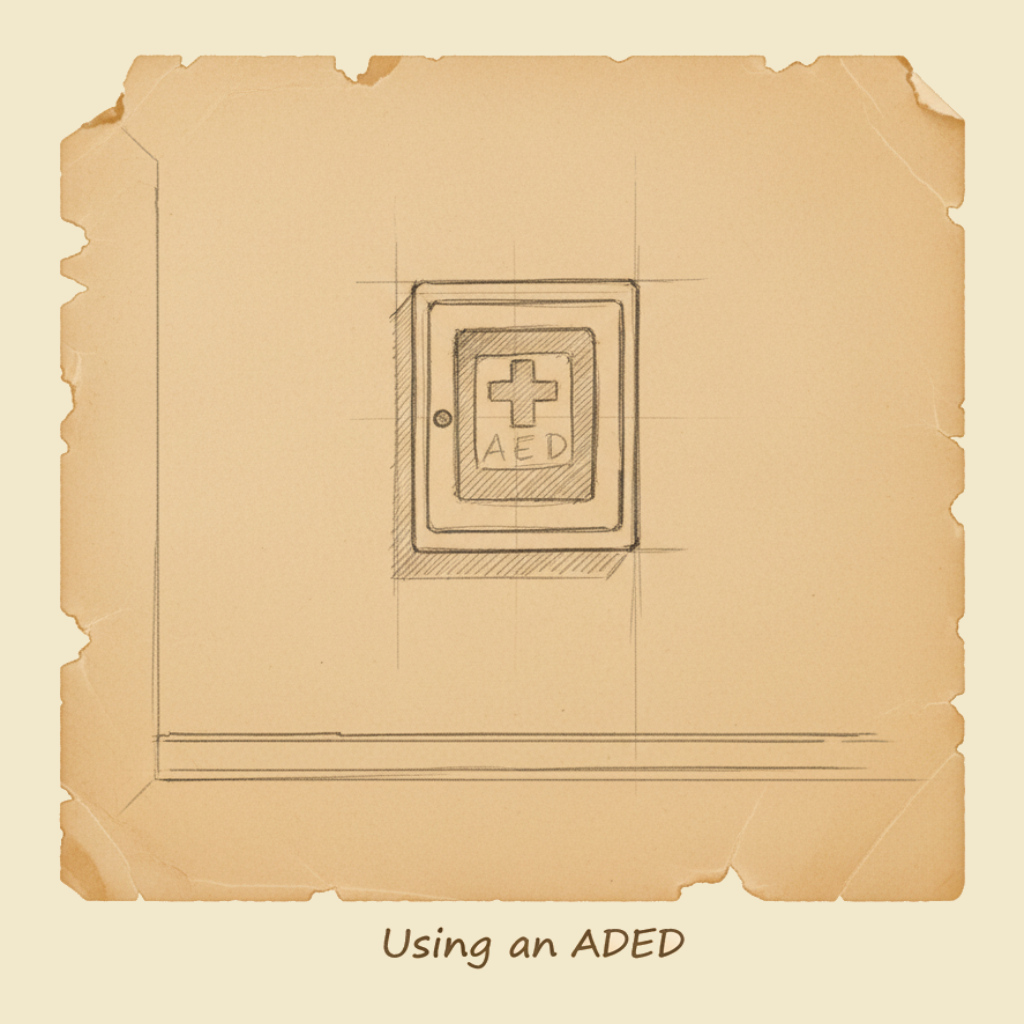
An AED is a portable, battery-powered, plastic-cased device, typically about the size of a small lunchbox. It is usually housed in a wall-mounted cabinet (often green or yellow), labelled with a heart-and-lightning-bolt symbol. The cabinet may be alarmed — opening it triggers a loud noise, which is intended to alert nearby people that an emergency is unfolding and to summon help. Do not let the alarm stop you from taking the AED. The alarm is designed to bring people to you.
AEDs are increasingly common in Australian public spaces:
- Shopping centres, airports, train stations, sporting venues, gyms, swimming pools.
- Schools, universities, council buildings.
- Many medium-to-large workplaces (in line with the workplace's first-aid risk assessment under the first aid kit contents chapter).
- Some street corners in central business districts and residential precincts.
- The AED Locator maps maintained by the Heart Foundation and the state ambulance services list publicly accessible AEDs near you.
If you are first on scene at a cardiac arrest in a public place and someone else is available to fetch the AED, send them. Don't go yourself — your job is to start CPR. Direct a specific person — point at them — and say "you, go and get the AED, I think it's by the front desk, come straight back."
The universal AED operating sequence
Every AED on the Australian market — Philips, Lifepak, Zoll, Heartsine, CardiAct, Defibtech, and the others — follows the same basic operating sequence and the same voice-prompt model. The brand-specific differences are minor and the device tells you what to do. The sequence:
- Switch the AED on. Some AEDs power on automatically when you open the lid; others have a button. Either way, the device starts speaking to you.
- Expose the casualty's chest. Cut or remove clothing as needed. The pads need to attach directly to bare skin.
- Open the pads packaging. Two adhesive electrode pads, with a wire each, connecting to the AED.
- Apply the pads. The pads have a picture on them showing where they go. The standard adult position is one pad on the upper right chest (just below the collarbone, to the right of the breastbone) and one pad on the lower left side (over the lower ribs, in the mid-axillary line — basically just below and to the left of the heart). Press them firmly so they stick to the skin with no air gaps.
- Stop CPR briefly while the AED analyses. The AED says "stand clear, analysing the heart rhythm". Do not touch the casualty during analysis — movement interferes with the rhythm reading.
- If a shock is advised: the AED says "shock advised, charging" and then "stand clear, push the shock button now". Make sure no-one is touching the casualty. Look around and call "everyone clear". Press the shock button.
- Resume CPR immediately. As soon as the shock is delivered, restart compressions without checking for a pulse. The AED will tell you to do this.
- Continue the cycle. The AED re-analyses every two minutes. Follow its prompts.
- Continue until the casualty shows signs of life, paramedics take over, or one of the other CPR-stopping conditions in the duration chapter is met.
That is the entire procedure. You do not need to know what rhythm the casualty is in. You do not need to interpret the device's beeping. You do not need to second-guess the shock decision. The AED has its own ECG analysis software, and it has been designed never to advise a shock on a non-shockable rhythm. Follow the voice. Trust the box.
Pad placement — children, infants, and special situations
The standard pad placement above is for an adult. For children and infants the picture changes slightly:
- Children aged 8 and over, or weighing 25 kg and over: use adult pads in the standard adult position.
- Children aged 1 to 8, or under 25 kg: use paediatric pads if available. Paediatric pads are smaller and deliver a lower-energy shock. They come in their own packet, often with a switch or key on the AED that selects the paediatric mode. If paediatric pads are not available, use adult pads — the alternative is no defibrillation, which is worse. Place the pads so they don't touch each other: one on the front of the chest and one on the back (anterior-posterior position) is the recommended way to do this on a small child.
- Infants under 1 year old: paediatric pads in the anterior-posterior position. Most AEDs can be used on infants if paediatric pads are available; if not, use adult pads in the anterior-posterior position. Do not delay defibrillation looking for the "perfect" pads — use what you have.
A few special situations:
- Casualty wet from rain, sweat, or pool: dry the chest with a towel or piece of clothing before applying the pads. The pads need to stick to dry skin.
- Casualty with very hairy chest: the pads may not stick properly. Most AED kits include a small disposable razor for this purpose. Shave a quick patch where each pad will go — it doesn't need to be perfect.
- Casualty with a pacemaker or implantable defibrillator (visible as a small lump under the skin, usually on the upper left chest): place the AED pad at least 8 cm away from the device — usually a couple of fingers' width below or to the side of the visible lump. The AED will still work; you just don't want to discharge directly onto the pacemaker.
- Casualty with a medication patch on the chest (nitroglycerine, hormone replacement, nicotine): peel the patch off and wipe the area before applying the pad. The patch can deflect the current.
- Casualty in water (e.g. just pulled from a pool or the surf): drag them clear of standing water, dry the chest, and proceed as normal. A casualty on a wet but not pooling surface (wet grass, wet floor) can be defibrillated where they lie.
- Casualty on metal: ideally move them to a non-conductive surface, but the priority is starting defibrillation.
- Pregnant casualty: defibrillate as for any adult. The risk to the foetus from no defibrillation is far higher than the risk from defibrillation. The shock is safe for the foetus.
In all of these, the principle is the same: defibrillation is the casualty's best chance, and the special situation is rarely a reason not to do it. Adapt slightly, then proceed.
Before pressing the shock button (or before the device delivers an automatic shock on a fully-automatic model), look at the casualty and the people around them. Check that no-one is touching the casualty, that no-one is touching anything in contact with the casualty (a stretcher, a metal floor in a vehicle), and that no-one is leaning over the casualty. Call "everyone clear, shocking now". Then deliver the shock. The current is not lethal to a properly-isolated bystander, but it is uncomfortable and can cause involuntary movement that hurts someone. The two-second visual check is a rescuer-safety habit that should never be skipped.
Manual versus semi-automatic versus fully automatic
There are three "kinds" of AED you might encounter, distinguished only by how the shock is delivered:
- Semi-automatic AED: the most common. The AED analyses the rhythm, decides whether a shock is advised, charges itself, and then prompts the rescuer to press a button to deliver the shock. The rescuer is the trigger.
- Fully automatic AED: less common. The AED analyses the rhythm, decides on a shock, charges, and delivers the shock itself after a verbal countdown. There is no shock button to press. The rescuer's job is to stand clear and let it work.
- Manual defibrillator: used by paramedics and clinicians. Requires the operator to interpret the rhythm themselves and make the shock decision. Not for first-aid use, and not what is in any public-access cabinet.
For first-aid purposes, the only thing that matters is reading the device label or listening to the voice prompts to know whether you are about to press a button or stand clear for the device to deliver. Either way, the AED tells you what to do.
What if the AED says "no shock advised"?
The AED is doing its job. "No shock advised" does not mean the casualty is dead or that you have done something wrong; it means the casualty is in a rhythm that defibrillation cannot fix — usually asystole (a flat line) or pulseless electrical activity (electrical signal without mechanical pumping). For these rhythms, the only intervention available to a first aider is continued CPR, and that is exactly what the AED will tell you to do.
The protocol after "no shock advised":
- Resume CPR immediately. The AED will say "no shock advised, resume CPR".
- Continue 30:2 compressions and breaths for two minutes.
- The AED will re-analyse at the end of the cycle. The rhythm may have changed — sometimes a casualty in asystole goes into a shockable rhythm after a couple of minutes of CPR, and the next analysis catches it.
- Keep going until one of the cessation conditions in the duration chapter is met.
Never remove the pads after a "no shock advised" message. Leave the AED running — it is still monitoring, and it will tell you the moment a shock becomes advisable.
After a shock — and after several shocks
Immediately after the AED delivers a shock, the protocol is to resume CPR immediately for two minutes before the next analysis. Do not stop to check for a pulse, do not stop to check breathing — the AED knows what it is doing, and the two-minute CPR cycle gives the heart the best chance of regaining a perfusing rhythm even after a successful shock.
After the next two minutes, the AED will re-analyse. It may say "shock advised" again, and you deliver another shock. Some casualties need multiple shocks before the rhythm converts. The protocol does not put a limit on the number of shocks — keep following the AED's prompts until paramedics arrive or the casualty recovers.
When the casualty does start to show signs of life — normal breathing, movement, eye opening — stop CPR, leave the AED pads in place, position the casualty in the recovery position, and stay alert for re-arrest. The AED stays on and stays connected so it can detect re-arrest immediately.
Children and the AED — common worries and the actual answers
The most common reasons people hesitate to use an AED on a child are:
- "What if the shock is too strong?" Paediatric pads deliver a reduced-energy shock. Adult pads, used on a child without paediatric pads available, are still safer than no defibrillation. The risk-benefit is firmly in favour of using whatever pads you have.
- "What if I get the placement wrong?" The pictures on the pads tell you. For children small enough that adult pads would touch each other, use the front-and-back position.
- "What if the AED doesn't work on a child?" Modern AEDs are designed to be used on children of all ages. Some have a paediatric switch or key; others detect paediatric pads automatically; some always deliver an adult-strength shock. The instruction is the same: turn it on, follow the voice.
- "What if I'm wrong about the cardiac arrest?" The AED will tell you. If the child has a normal rhythm, the AED will say "no shock advised" and you continue CPR if it's still indicated. The device cannot shock a child (or anyone) who doesn't need it.
The bottom line is the same as for adults: use the AED, follow its instructions, do not delay. A child in cardiac arrest who receives early CPR and early defibrillation has the best chance of survival.
You do not legally need any specific training to use an AED in Australia. The devices are designed and marketed as public-access equipment, and the expectation is that any bystander, with or without training, can open one and follow the prompts. First-aid training (this chapter included) makes you faster and more confident, but it is not a legal prerequisite. If you ever encounter a cardiac arrest in a public place with an AED nearby and someone there has never used one, hand it to them and tell them "open it, do what it says, you can do this." They can.
An Automated External Defibrillator (AED) should be applied to any unresponsive casualty who is not breathing normally, as soon as one becomes available. CPR should be commenced and continued until the AED is ready to analyse the rhythm. If a shock is advised, it should be delivered without delay; if no shock is advised, CPR should be continued and the AED will re-analyse. AEDs are designed to be used safely and effectively by trained and untrained rescuers, and their use should not be delayed by lack of formal training. The AED should remain connected to the casualty until paramedics take over or the casualty fully recovers.
What not to do
- Do not delay CPR while you wait for an AED. CPR starts immediately; the AED is added when it arrives.
- Do not assume the AED is "for paramedics". It is for you.
- Do not worry about getting the pad placement perfect — the pictures on the pads are good enough.
- Do not touch the casualty during analysis or shock delivery.
- Do not stop to check a pulse after a shock. Resume CPR immediately.
- Do not remove the pads after a "no shock advised" message — leave them on, the AED is still monitoring.
- Do not be afraid to use an AED on a child, a pregnant woman, or a casualty with a pacemaker. Adapt the pad placement and proceed.
- Do not wait for "permission" — if there is a casualty in cardiac arrest and an AED nearby, use it.
You will rehearse the AED operating sequence on a training device until opening the lid and following the voice is automatic. The training AED is functionally identical to the real ones in the cabinet — same voice prompts, same pad placement, same shock buttons — and the entire skill is about ten minutes to learn. By the end of the day you should feel ready to walk up to the wall cabinet at your workplace, take down the AED, and use it on a real casualty without hesitation.
An AED is the most powerful tool in first aid, and the easiest to use. It exists in a public cabinet so that any bystander can fetch it and any rescuer can run it. Open the lid, follow the voice, deliver the shock when it tells you to — and a casualty whose heart had given up has, suddenly, a real chance of walking out of the hospital. Trust the box.
— ANZCOR Guideline 7 (Automated External Defibrillation)