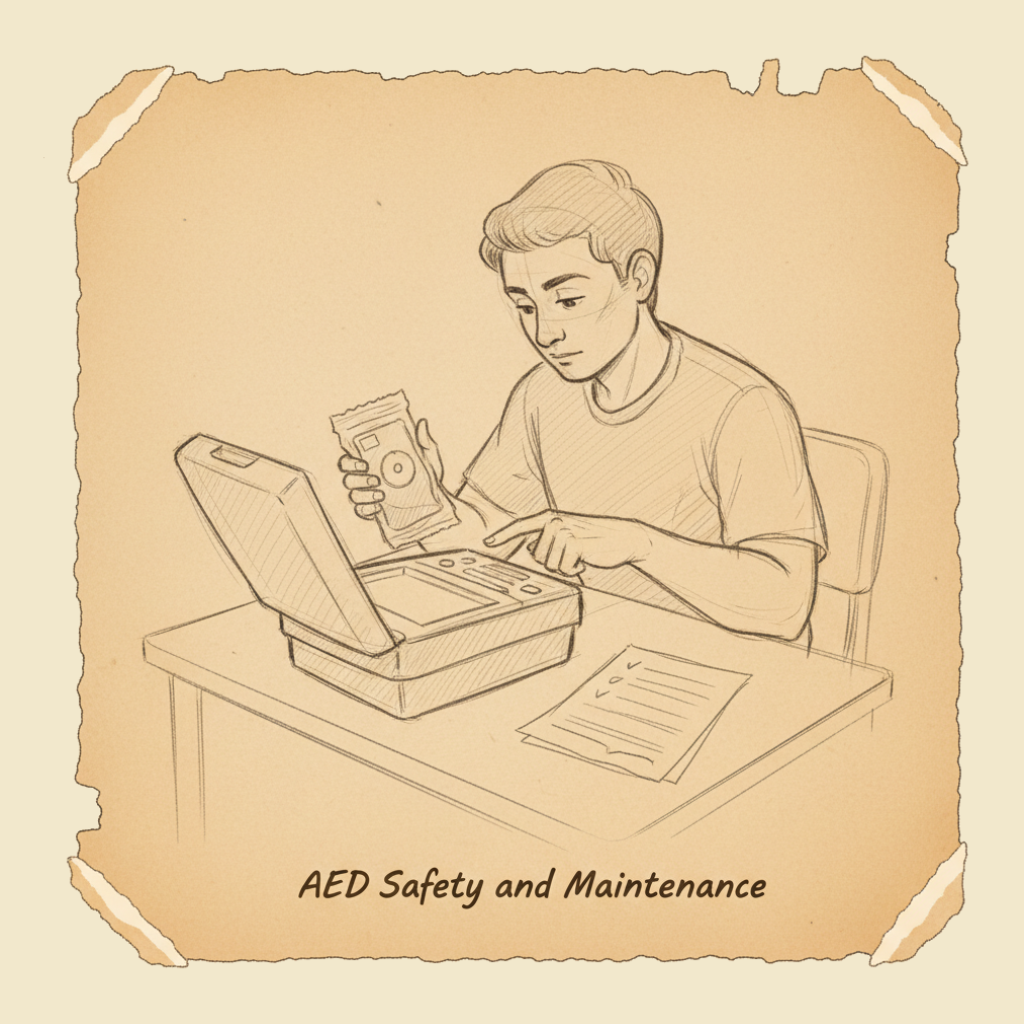
Why this is its own chapter
The previous chapter covered how to use an AED in the moment of an incident — open the lid, follow the voice, deliver the shock. This chapter covers the much less dramatic but equally important other side of the AED's life: keeping it in a state where it will actually work when somebody runs in panicking and grabs it off the wall. An AED that isn't checked, isn't maintained, has a flat battery, has expired pads, or has been moved without anyone updating the location register is no use to a casualty in cardiac arrest. The maintenance is the whole point. G7
There are also a small number of specific safety considerations around using the device safely in the presence of bystanders, particular casualties, and particular environments — the on-the-day side of "safety". Both topics belong together because both are about making the AED a tool you can trust without thinking.
§ Instructor's note
The teaching point here is to reframe maintenance as part of the rescue, not as a separate "facilities" task. The cardiac arrest survivor whose life was saved by an AED in their gym five years from now will owe their life partly to the rescuer who pressed the button — and partly to whoever was on the maintenance roster the month before and noticed the indicator light had turned red. The maintenance log is not paperwork; it is the slow-motion first half of the rescue.
Safety considerations during use
The AED is a deliberately safe device. It is designed so that a frightened bystander with no training can use it without harming themselves or anyone around them. Most of the safety considerations are common sense and most are explicitly covered by the device's voice prompts — but they are worth knowing in advance so they don't have to be re-learned in the panic of a real call.
Stand clear during analysis and shock
The AED needs to read the casualty's heart rhythm without interference. Touching the casualty during the analysis phase introduces electrical noise into the ECG signal and can prevent the device from making the correct shock decision. The voice prompt is "stand clear, analysing"; the right behaviour is to stop compressions, lift your hands off the casualty, and wait for the device to finish.
When the AED says "shock advised, stand clear", look around before pressing the button. Make sure:
- No-one is touching the casualty.
- No-one is touching anything in conductive contact with the casualty (a metal stretcher, a pool of standing water, a metal floor in a vehicle).
- You yourself are not touching the casualty.
Call out clearly: "Everyone clear, shocking now." Two seconds of visual confirmation is the entire rescuer-safety habit, and it is the one habit that prevents the small risk of a bystander getting an unintended shock.
Wet, sweaty, or soiled chest
The AED pads need to make full skin contact to deliver a clean shock. A wet chest can cause the current to track across the surface of the skin instead of into the heart. A sweaty chest is the most common version of this problem; a chest still wet from rain or pool water is the more dramatic one. The fix is the same: dry the chest with a towel, a piece of clothing, or even a corner of the casualty's shirt, then apply the pads.
Drag the casualty out of any standing water before starting — a casualty lying in a puddle of pool water provides an electrical path you do not want to create. Wet grass, wet floor, wet tarmac are all fine; it is standing water that matters.
Hairy chest
If the casualty has a thick layer of chest hair, the AED pads may not stick properly, the pads may lose contact during compressions, or the AED may complain about poor pad contact ("check pads"). Most public-access AED kits include a small disposable razor for exactly this. The fix:
- Apply the first pad. If it sticks well, apply the second.
- If it doesn't stick or the AED complains, peel the pad off (which incidentally takes a clump of hair with it — fast hair removal).
- Use the razor to quickly shave a patch where each pad will go. This does not need to be cosmetically perfect — just clear enough for the pad to stick to skin.
- Apply a fresh pair of pads.
The whole shave-and-reapply takes about thirty seconds and is faster than trying to make hairy pads work.
Implanted devices, patches, jewellery
- Pacemakers and implantable defibrillators: visible as a small lump under the skin, usually on the upper left chest. Do not place an AED pad directly over it. Move the pad about 8 cm (a couple of fingers' width) away. The AED will still defibrillate the casualty effectively from the slightly shifted position.
- Medication patches: peel them off and wipe the area before placing the AED pad. The patch can deflect the current and may also cause a small skin burn under the pad.
- Jewellery in the way: necklaces, body piercings, nipple rings. Move them out of the way of the pads if you can do so quickly; otherwise just place the pad clear of the metal. Do not delay defibrillation to remove jewellery.
- Underwire bra: cut and remove if it is in the way of the lower-left pad position. The wire is too small to cause a problem in itself, but the bra fabric over the chest interferes with pad placement.
Children and infants
Covered in detail in the AED use chapter. The safety summary: paediatric pads if available, paediatric mode if the AED has a switch, anterior-posterior placement on small chests so the pads don't touch each other, and adult pads as the fallback if no paediatric pads are available — the alternative is no defibrillation, which is worse.
Pregnant casualties
Defibrillate as for any adult. The risk to the foetus from an unrecovered cardiac arrest is far higher than the risk from defibrillation. Modern obstetric resuscitation guidelines treat AED use in pregnancy as both safe and indicated.
Oxygen flow nearby
In a clinical environment, a flowing oxygen source at the casualty's face during defibrillation can theoretically increase the (already very small) risk of an arc fire. In a first-aid context this is almost never relevant — first aiders do not administer oxygen, and the oxygen kit is rarely the issue. If oxygen is being administered (e.g. by a nurse, paramedic, or workplace medic), they should remove the mask or move the source 1 m away from the casualty's chest before the shock is delivered. The first aider's job is to deliver the shock; the oxygen-handling is the clinical user's responsibility.
The casualty in or near a vehicle
If the casualty is inside a metal vehicle, the metal chassis is conductive but is not normally connected to the casualty closely enough to matter for AED use. The practical answer is: get the casualty out of the vehicle if you safely can (it makes CPR much easier as well as making AED use safer), and use the AED on the ground beside the vehicle. If you cannot move the casualty (entrapment, suspected spinal injury, paramedics very close), use the AED in place — the device is designed to be safe in the field.
The casualty on a metal surface
The same logic. Moving them to a non-conductive surface is preferable; using the AED in place is acceptable when moving isn't practical.
Almost every "special situation" in this chapter has the same answer: adapt slightly, then proceed. Cardiac arrest is the casualty's most time-sensitive emergency; every minute of delay in defibrillation reduces their survival chance by about 10%. The right framing is "the AED is safe to use, the special situation needs a small adaptation, the rest of the protocol runs as normal." The wrong framing is "I'd better wait for paramedics because this casualty is too complicated to defibrillate."
Maintenance — keeping the box ready
A modern AED is a low-maintenance device, but it is not a no-maintenance device. The two consumables that wear out are the battery and the pads, and both have limited shelf life regardless of whether the AED is ever used.
The self-test
Every modern AED runs an automatic self-test at intervals — typically once a day or once a week — and reports the result via a status indicator. The status indicator is usually:
- A green light or green tick symbol on the front of the device, visible through the cabinet window without opening it: the AED is ready.
- A red light or red cross symbol, or sometimes a flashing or audible alert: the AED has detected a fault and needs attention.
The self-test checks the battery, the internal electronics, and the connection to the pads. It does not check whether the pads themselves are within their expiry date — that is a separate manual check.
The monthly check
The Australian recommendation, and the manufacturer guidance for almost every device on the market, is a monthly visual inspection. The inspection takes about three minutes and consists of:
- Check the cabinet is intact, locked, accessible, signed, and at the correct location.
- Check the status indicator through the cabinet window. It should be showing the "ready" state. If it is not, take action.
- Check the pads expiry date printed on the pads packaging. Pads typically expire 2–3 years after manufacture, regardless of whether the seal has been broken. Replace them before the expiry date.
- Check the battery expiry date printed on the battery or on the device. Batteries typically last 3–5 years for a sealed primary battery, less for a rechargeable. Replace before expiry.
- Check the spare pads, razor, gloves, scissors, and other accessories are present in the cabinet or attached to the AED.
- Sign the inspection log with the date and your initials, indicating the device is ready.
- If anything is not as it should be, raise it immediately with whoever is responsible for the AED at your workplace, and take the device out of service or organise repair until it can be returned to ready state.
The inspection log is normally kept on or in the AED cabinet. If your workplace doesn't have one, you should establish one — it is the documentary record that the AED has been kept ready, and is the kind of thing an inspector or coroner would ask about after a workplace cardiac arrest.
After every use
If the AED is used on a real casualty, the maintenance after the use is more involved:
- Replace the pads. Used pads cannot be cleaned and reused; they are single-use. Open a fresh pair from the spares in the cabinet.
- Check the battery. AEDs typically use a small fraction of the battery capacity per use, but the device itself will tell you if the battery is now below ready state. Replace if necessary.
- Wipe down the device with a clean damp cloth. Disinfect any blood or body fluid contact with the workplace's standard disinfection procedure. See the infection control chapter.
- Download or print the event record, if your AED model supports it. Most modern AEDs record the entire event — ECG rhythm, shocks delivered, voice from the scene — and the recording is valuable to the receiving hospital, the paramedic service, and any subsequent review. Many AEDs use a USB or wireless connection; some require a dedicated reader. Your AED's manual will tell you how.
- Restore the device to the cabinet in ready state.
- Document the use in the workplace incident register and in the AED log.
- Notify the workplace's first-aid coordinator so the use can be tracked and reviewed.
The whole post-use service typically takes 15–30 minutes. The device should be back in the cabinet, ready for the next call, by the end of the same day or the next morning at the latest.
Battery and pads — replacement schedule
Manufacturers vary, but a typical Australian AED has:
- Primary (non-rechargeable) battery: 3–5 year shelf life. Replace before the printed expiry date. The device may also alert you when the battery is below a usable threshold.
- Adult pads: 2–3 year shelf life. Replace before expiry.
- Paediatric pads: 2–3 year shelf life. Replace before expiry.
- Rechargeable batteries: shorter cycle life (1–2 years), and need to be cycled or replaced according to manufacturer instructions. Less common in public-access AEDs.
The device should be set up so that someone is responsible for the battery and pads — usually the workplace's first-aid coordinator, a designated AED owner, or (for community AEDs) the organisation that purchased the device. Replacements should be ordered well before the expiry date — pads especially can have lead times of several weeks for some brands.
The cabinet itself
If the AED is in a wall-mounted cabinet, the cabinet too has things to check:
- Lock or alarm working: the cabinet should be openable in an emergency without a key — usually a break-glass or simple latch — and any alarm should sound when opened.
- Signage visible: a clear AED symbol on or near the cabinet, ideally with directional signs from common approaches.
- Cabinet temperature: AEDs have an operating temperature range (typically 0–50°C) and a storage temperature range. Outdoor cabinets in hot climates should be insulated or shaded; outdoor cabinets in cold climates should be heated. A cooked or frozen AED is a non-functional one.
- Cabinet not blocked: a kit cupboard with cleaning supplies stacked in front of it is a kit cupboard nobody can use.
- Cabinet unlocked or accessible 24/7: a workplace AED that is locked in the manager's office at night is no use to the night-shift cleaner who collapses at 3 am.
The location register
Workplaces with multiple AEDs, or organisations that provide community AEDs, should keep a register of where each device is located, the model and serial number, the date of installation, the responsible person, and the last inspection date. The register is the documentary record that the AED programme is being managed; it is also what allows a new staff member to find every device on site without having to ask around.
Many state ambulance services maintain a public AED register that members of the community can search to find the nearest publicly-accessible AED. If your workplace has a publicly-accessible AED, registering it with the local service is good practice — it makes the device findable in the moments when it matters.
The AED is the third link in the chain of survival (see the chain of survival chapter) and the link with the highest leverage on outcome. A community that maintains its AEDs well — every cabinet checked, every battery in date, every pad ready — is a community where cardiac arrests are survivable. A community where AEDs sit in cabinets with red lights nobody has noticed is a community where the bystander who runs to fetch one will arrive with a paperweight. The maintenance discipline is what makes the chain real.
Documentation and accountability
The minimum documentation for a workplace AED programme is:
- An installation record: model, serial number, location, date installed, responsible person.
- An inspection log: monthly inspection record with date, initials, status (ready / not ready / action taken).
- A use log: every use of the AED on a real casualty, with date, time, casualty (if known), event summary, action taken to restore the device to service.
- A consumables log: dates of pad and battery replacements, with serial numbers if applicable.
- A maintenance contact list: who is responsible for the device, who orders consumables, who handles faults.
None of this is hard to set up; all of it is documentary evidence that the device is being managed. After a workplace cardiac arrest — whether the casualty survives or not — the documentation is the first thing an investigator will ask for.
Automated External Defibrillators should be maintained according to the manufacturer's instructions, with regular checks of the device status, the battery and the pads. A documented inspection and replacement schedule should be in place, and consumables (pads and batteries) should be replaced before their expiry dates. After every use of the AED, the device should be restored to a ready state as soon as practicable, including replacement of pads and download of the event record where supported. AED programmes should be supported by training, ongoing maintenance, and an accessible record of where each device is located.
What not to do
- Do not assume the AED on the wall is ready because it was ready last year. Check monthly.
- Do not ignore a red status indicator. It means the device has failed its self-test and needs attention immediately.
- Do not use expired pads if a fresh pair is available. If only expired pads are available, use them anyway — expired pads are far better than no defibrillation.
- Do not delay defibrillation to deal with hair, jewellery, or a wet chest "perfectly". Adapt and proceed.
- Do not forget to restore the AED after a real use. The next casualty needs it as much as this one did.
- Do not lock the AED in an inaccessible place. The whole point is rapid access.
- Do not leave the AED unsupervised in extreme outdoor temperatures. Get a properly insulated/heated cabinet.
- Do not treat the maintenance log as paperwork. It is the documentary record that the device works.
You will inspect a real AED in its training cabinet, walk through the monthly check, identify the battery and pads expiry dates, and practise the post-use restoration sequence. The classroom AED is identical to the one you will encounter in the wild; the maintenance discipline you practise here is the discipline that keeps real-world devices ready when they are needed.
An AED is only ever as ready as its last inspection. The dramatic ten minutes of using one on a casualty is the easy part; the quiet five minutes of checking it once a month, signing the log, and replacing the pads on schedule is the part that makes the dramatic ten minutes possible. The two halves of the AED's life are inseparable, and both belong to the first aider.
— ANZCOR Guideline 7 (Automated External Defibrillation)