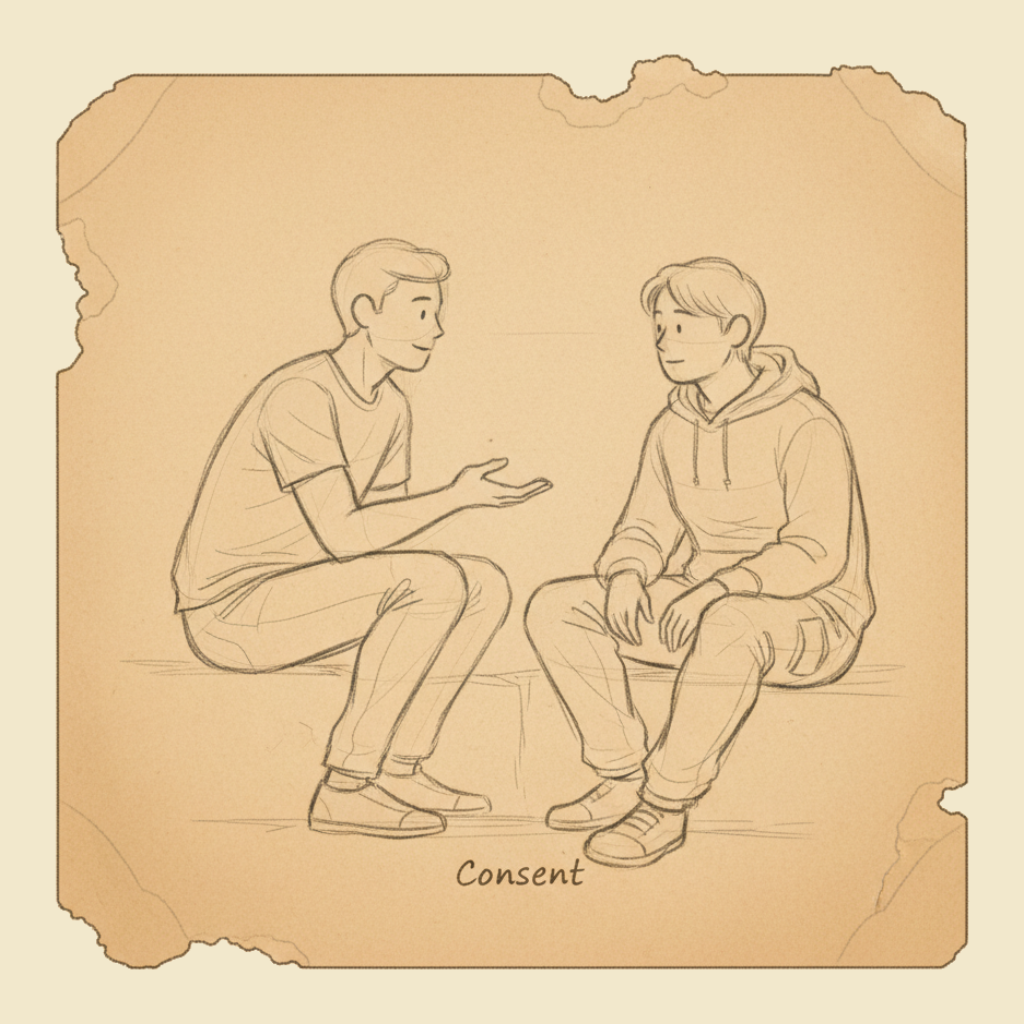
Why consent is the very first thing you ask for
The Australian common law is unambiguous: any unconsented touching of another person's body is a battery in the legal sense, no matter how well-meaning. The law makes a sensible exception for emergencies — implied consent, covered below — but the general rule still applies, and the first aider needs to know it. Consent is not paperwork. It is a thirty-second conversation that you have at the start of every encounter with a conscious casualty, and it is the legal foundation on which everything else you do rests.
There are three reasons consent matters in practice:
- Legal. It is the difference between assistance and battery. A first aider who lays hands on a competent adult who has explicitly refused care is not protected by Good Samaritan legislation — the protection requires you to be acting reasonably, and overriding a competent refusal is not reasonable.
- Clinical. A casualty who has agreed to be helped is a casualty who will cooperate with the care. A casualty who feels their bodily autonomy is being ignored will resist, panic, or shut down. Consent is what makes the whole encounter work.
- Human. The casualty is a person, often frightened, often in pain, often surrounded by strangers. Asking permission is the act that returns some of their agency to them. It is not a bureaucratic step — it is a piece of dignity.
§ Instructor's note
Learners often expect "consent" to be a long, formal exchange. The teaching point is that it is the opposite — it is short, plain, and built into the opening words of every encounter. "Hi, my name's Sam, I'm a first aider. Can I help you?" is the whole consent transaction. The casualty's "yes" or nod is the consent. Drill the rule: name, role, ask permission, every time, even when it feels obvious.
Express consent — the conscious adult
Express consent is consent that the casualty actively gives, in words or by an unmistakable gesture (a nod, a hand on yours, taking the dressing from you). The conditions for express consent to be valid are simple but important:
- The casualty is conscious and able to understand the situation. They are oriented to where they are and what is being offered.
- They are an adult (or a child accompanied by a parent or guardian who can consent on their behalf — see below).
- They are not so impaired by pain, alcohol, drugs, intoxication, head injury, or fear that their decision-making is genuinely compromised. A drunk casualty who is still oriented and conversational can consent; a casualty who is incoherent or has a head injury cannot.
- They have been given enough information to know what you are proposing — "I'd like to look at the cut on your arm and put a dressing on it. Is that okay?" is enough; you do not need to lecture them.
The form of words isn't legally important. What matters is that the casualty understood what was being offered and agreed to it. The opening line of any first-aid encounter should establish this:
"Hi, I'm a first aider. My name's Sam. Can I help you?"
If the answer is yes — verbal, nodded, or a hand reaching out — you have consent and you can proceed. As you go, narrate what you're about to do: "I'm going to check your pulse now." "I'm going to roll you onto your side." Each is an opportunity for the casualty to refuse if they want to, and each is a small act of respect that reinforces the consenting relationship.
Implied consent — the unconscious or incapacitated casualty
Implied consent is the legal doctrine that says: when a casualty cannot give express consent (because they are unconscious, severely confused, or otherwise unable to communicate), the law presumes that a reasonable person in their situation would consent to life-saving or pain-relieving care, and therefore the first aider is authorised to act.
This is the legal foundation for CPR, for rolling an unconscious casualty into the recovery position, for controlling severe bleeding on a casualty who has fainted, for using an AED, and for everything else you do for someone who cannot answer you. The reasoning is simple: if they could speak, they would say "yes please". The law fills the gap.
The conditions for implied consent are:
- The casualty is genuinely unable to consent — unconscious, severely confused, post-ictal, deeply intoxicated, in shock, or a young child without an accompanying guardian.
- The action you are taking is reasonable for someone in their condition — CPR for a casualty in arrest, bleeding control for haemorrhage, recovery position for an unresponsive but breathing casualty, AED for arrest, and so on.
- You are acting within your training.
- There is no clear evidence the casualty would refuse — for instance, no advance care directive on their person, no medic-alert refusing CPR.
In practice, almost every unconscious-casualty first-aid encounter runs on implied consent, and almost every one is unproblematic. The two edge cases worth knowing are:
- A casualty wearing a "Do Not Resuscitate" or "No CPR" medic-alert bracelet, or carrying a written advance care directive. If the document is clearly visible and clearly applies, it is evidence that this casualty has expressly refused the very intervention you were about to make. The legal answer is: you respect it. The practical first-aid answer is: stop and call 000, explain what you have found, and let the dispatcher and paramedics adjudicate. Never go looking through pockets or wallets to find such a document — it has to be visible — but if you can see one, do not ignore it.
- A casualty who was conscious and competently refused care, then deteriorates and becomes unconscious. The question of whether the earlier refusal still applies is genuinely difficult. The pragmatic first-aid answer is: their condition has changed, the previous refusal was for the previous condition, you act on implied consent for the new emergency, and you let the paramedics sort it out on arrival. You will not be in trouble for treating an unconscious casualty whose condition was changing.
Refusal of care by a conscious adult
A conscious, competent adult can refuse first aid, even when refusal will obviously harm them. The right to refuse medical treatment is one of the strongest in Australian common law, and a first aider does not have the authority to override it.
If a competent casualty says "no, leave me alone":
- Stop, step back, and don't touch them. Pressing on would be a battery.
- Stay with them at a respectful distance if they will allow it. The duty of care doesn't end just because consent has been refused; you can still observe, monitor, and be ready to act if they change their mind or lose consciousness.
- Explain calmly what you'd like to do and why. Sometimes the refusal is from fear or misunderstanding, and a clear explanation changes the answer. "I'd like to put a dressing on that cut to stop it bleeding — is that okay?" is more likely to get a yes than just reaching for them.
- Ask if you can call an ambulance — even if they refuse hands-on care, they may still consent to professional help being summoned. If they refuse that too, you can still call 000 yourself if you genuinely believe they need an ambulance, and the dispatcher will handle it.
- Document the refusal in the workplace incident register: time, what you offered, what they said, who witnessed it. The contemporaneous record protects everyone if there is a later question.
- If they later become unconscious or incapacitated, implied consent kicks in and you can treat (see above).
The key word is competent. If the casualty is severely intoxicated, post-ictal, head-injured, in shock, hypoglycaemic, or otherwise unable to make a clear decision, their refusal is not a competent refusal and you can proceed under implied consent. Use your judgement, document carefully, and call paramedics for any difficult case.
A casualty mid-stroke or with a significant head injury may say "I'm fine, leave me alone" — and the words may sound competent. They are not. A casualty whose brain has just been damaged is not in a position to consent to or refuse care reliably. The right action is to call 000, stay with them, and do what you can without forcing physical contact. Tell the dispatcher what's happening; paramedics arriving on scene have legal authority to act that you do not. See the stroke chapter.
Children, minors, and parental consent
Children cannot legally consent to medical treatment until they are old enough and mature enough to understand what they are agreeing to (the Gillick competence test, applied case by case in Australia). For first-aid purposes the practical rules are:
- A child accompanied by a parent or guardian: ask the parent. They consent on the child's behalf.
- A child alone, not in immediate danger: contact the parent if practical (school nurse, childcare worker, manager), and otherwise act on the basis that a reasonable parent would consent to first aid for their child. Get the parent involved as soon as you can.
- A child alone, in immediate danger: act on implied consent. Save the child's life first, sort out parental notification afterwards. This is uncontroversial in law and in practice.
- A teenager who appears mature and refuses care: consider whether they meet the Gillick test (do they understand what they're refusing, and the consequences?). If in doubt, contact a parent/guardian and call paramedics.
In education and care settings specifically (the world of HLTAID012), the workplace's enrolment paperwork normally includes a parental authorisation for first aid, which simplifies the consent question for foreseeable incidents. Get familiar with your service's policy; the principal, director, or nominated supervisor will be able to point you at it.
For a young child, the parent is your second casualty in every interaction. A frightened parent will often want you to do something specific, or want you to not do something. Stay calm, explain what you're doing and why, ask their permission for each step, and let them be physically close to the child if it can be done safely. A parent who feels involved in the care is a parent who supports it; a parent who feels excluded becomes a different problem.
Casualties who can't communicate but aren't unconscious
A small number of casualties are conscious but cannot communicate consent in the usual way: deaf casualties, casualties whose first language isn't English, casualties with severe cognitive disability, casualties who are aphasic from a stroke. The principles are:
- Try every channel you have — speech, gesture, writing, drawing, an interpreter on the phone, a bystander who can translate. The casualty's right to consent is not diminished by their channel of communication.
- Lean toward implied consent for life-saving action when no channel is available and the casualty needs urgent help.
- Lean toward asking for consent for non-urgent action even when it takes longer than you would like.
- Document the communication challenge in the incident record, so anyone reviewing later understands the context.
The same principles apply to casualties who are intoxicated, frightened, or simply too distressed to engage with the question in the moment — meet them where they are, explain what you're doing, ask, and document.
A first aider should obtain consent from a casualty before providing care. Consent may be express (verbal, written, or by clear gesture) or implied (where the casualty is unable to communicate but a reasonable person in their situation would consent to the care being offered). A competent adult casualty has the right to refuse first aid; the rescuer should respect this refusal, document it, and continue to monitor the casualty so that further care can be offered if their condition changes. Children and casualties unable to consent may be treated under implied consent for actions that are reasonable and necessary in the circumstances.
A short script you can actually use
Most first-aid encounters with a conscious casualty fit into a brief opening exchange:
"Hi, I'm Sam, I'm a first aider. Are you okay? Can I help you?"
If "yes":
"Tell me what happened. Where does it hurt?"
Then, before each step:
"I'm going to check your pulse / lift this off / put a dressing on this — is that okay?"
If they say no at any point, you stop. If they say yes, you continue. The whole protocol is built into the way you talk to them, and after two or three encounters it becomes automatic.
For an unconscious casualty, the script is shorter:
"Hello? Can you hear me? Open your eyes. Squeeze my hand."
(That's the Response check from DRSABCD.)
If there is no response, you proceed under implied consent. You can say it out loud if it helps the bystanders understand what you're doing: "They're not responding. I'm going to check their breathing."
What not to do
- Do not start touching a conscious adult before asking permission.
- Do not override a competent adult's refusal of care, even if you think they are wrong.
- Do not treat a casualty's lack of objection as the same as consent — ask, don't assume.
- Do not rummage through a casualty's wallet, pockets, or bag looking for ID or advance directives. If a medic-alert is visible on a wrist or neck, that's different.
- Do not ignore a clear "Do Not Resuscitate" or advance care directive on the casualty's person. Stop, call 000, and let the dispatcher and paramedics adjudicate.
- Do not withhold life-saving care from an unconscious casualty just because nobody told you out loud that you could. Implied consent covers you.
- Do not forget to document a refusal or a difficult consent encounter. Contemporaneous notes protect everyone.
You will rehearse the consent script as part of every scenario you run, so that "name, role, ask permission" becomes the automatic opening of any encounter. You will also work through a small number of harder scenarios — the casualty who refuses, the head-injured casualty whose words sound competent but aren't, the unconscious casualty wearing a medic-alert. The goal is for the consent question to feel like a reflex by the end of the day, not a step you have to remember.
Consent is the small, polite act that turns "touching a stranger" into "first aid". It costs ten seconds, it protects you legally, and it gives the casualty their dignity back at the moment they need it most. Ask first, every time.
— ANZCOR Guideline 10.5 (legal and ethical issues)