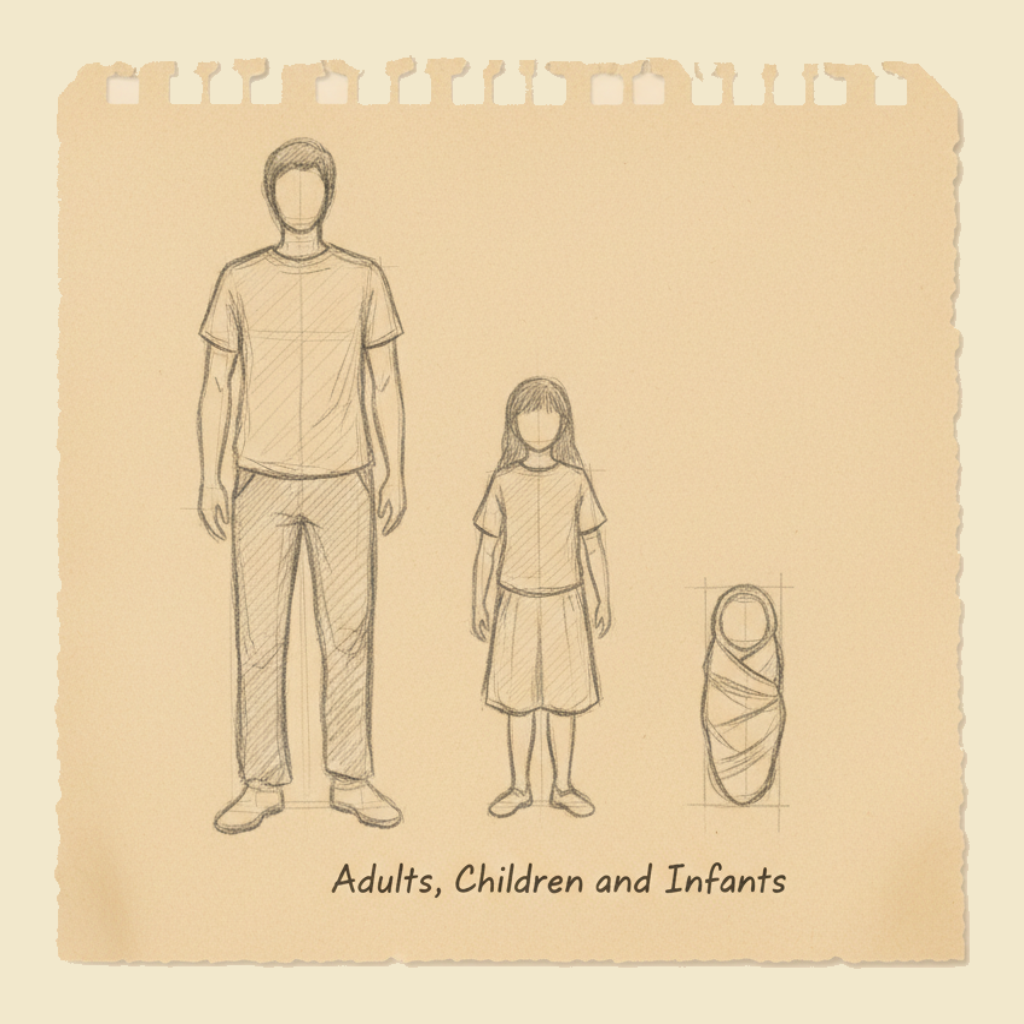
One principle, three techniques
ANZCOR teaches three age categories for CPR: adult (puberty and above), child (1 year to puberty), and infant (under 1 year). The boundaries are not precise — there is no birthday at which a child suddenly becomes an adult casualty — and the practical rule is use the technique that fits the body in front of you, with the age categories as a starting point. A small twelve-year-old may need the child technique; a large eight-year-old may need the adult one. The categories are guides, not laws. G6 G8
What changes between the age groups is size, proportion, and physiology. What stays the same is the principle: chest compressions and rescue breaths in a 30:2 ratio (or 15:2 for two-rescuer paediatric), at 100–120 compressions per minute, with full chest recoil between compressions. The hand-position chapter covered the technique changes; this chapter is about the anatomy and physiology that drive them, so that the technique makes sense rather than being a list of arbitrary numbers.
§ Instructor's note
Learners often arrive with a vague worry that paediatric CPR is "different" from adult CPR in ways they cannot quite name, and that worry can paralyse them on the day. The teaching point of this chapter is that the principle is identical and the differences are mechanical adaptations to a smaller body. Drill the rule: same chain, same rhythm, smaller hands and softer force. The casualty in front of you is the casualty you treat, regardless of whether they fit neatly into a category.
What stays the same at every age
Before listing the differences, it is worth being clear about what does not change:
- The recognition criterion. Unresponsive and not breathing normally → start CPR. (See the recognising unconscious not breathing chapter.)
- The compression rate. 100 to 120 compressions per minute, at every age.
- The hand position landmark. Lower half of the sternum, centre of the chest.
- Full chest recoil. Let the chest come all the way back up between compressions.
- The 30:2 ratio for a single rescuer. Adult, child, and infant.
- The need for an AED. The same AED can be used at every age, with paediatric pads or paediatric mode for casualties under 8 years old where available.
- The chain of survival. Recognition → call → CPR → defibrillation → handover. (See the chain of survival chapter.)
What changes is the size of the hands you use, the depth you compress, the force you apply, the head position for the airway, and the way you deliver rescue breaths. The principle is preserved; the implementation is scaled.
Adult anatomy (puberty and above)
The reference body for CPR is the adult. The technique chapters are written for adults, and the paediatric techniques are described as adaptations of the adult technique. Adult-specific anatomy that matters:
- Chest depth: roughly 18–22 cm front-to-back in an average adult. One-third of that is 6–7 cm — which is why the depth target is 5–6 cm (slightly less than one-third, to leave a margin against injury).
- Sternum length: roughly 17 cm. The "lower half" is the bottom 8–9 cm, which is where the heart sits behind it.
- Rib cage rigidity: the adult rib cage is reinforced by costal cartilage that is partially calcified, which makes it stiffer than a child's. This is why effective adult compressions sometimes fracture ribs — the force needed to displace the breastbone by 5–6 cm is enough to crack the brittle cartilage.
- Heart position: the adult heart sits behind the lower half of the sternum, slightly to the left, with the apex pointing down and to the left. Compressions on the lower sternum squeeze the right ventricle and the lower portion of the left ventricle directly.
- Lung volume: adult tidal volume is about 500 mL. Rescue breaths should produce a visible chest rise — a normal breath, not a forced one. Over-inflation is harmful.
- Airway: the adult airway is largely rigid (cartilaginous trachea, bony jaw and skull) and tolerates the head-tilt / chin-lift well. Full extension of the neck opens the airway maximally.
- Cardiac arrest cause: most adult arrests are cardiac in origin — a sudden ventricular fibrillation triggered by coronary artery disease. The casualty is well-oxygenated at the moment of arrest; what they need is defibrillation and circulation. This is why compressions-only CPR works so well for adult arrests: the blood is already oxygenated.
The adult is the casualty for whom the AED was designed and for whom the technique is most directly mechanical. Squeeze the chest hard, often, with full recoil; deliver two breaths every 30 compressions; defibrillate.
Child anatomy (1 year to puberty)
A child is bigger than an infant and smaller than an adult, and the transition is gradual. The most useful definition of "child" is "1 year to the onset of puberty", which is roughly age 12–14, but the practical rule is "if they look like a child, use the child technique".
What changes from adult to child:
- Chest depth: smaller — perhaps 12–15 cm in an average primary-school child. One-third is 4–5 cm, which is the compression depth target.
- Chest pliability: the child's rib cage is more flexible than an adult's. The cartilage is more elastic, and the chest can compress further with less force without fracturing. This means you can press deeply enough to be effective without needing the full force of an adult compression.
- Sternum: shorter and more flexible. The same landmark (lower half of the sternum, centre of the chest) applies.
- Hand technique: one or two hands, depending on the size of the child and the size of the rescuer. A small child may need only one hand; a larger child or a smaller rescuer may need two. Use whichever combination achieves about one-third of the chest depth without disproportionate force. Either is acceptable, and ANZCOR explicitly endorses both.
- Heart position: similar to the adult — behind the lower half of the sternum, slightly to the left.
- Lung volume: smaller. Rescue breaths should still produce a visible chest rise, but the volume needed is less than for an adult. Watch the chest, not the pressure of your breath.
- Airway: the child's head is proportionally larger than the adult's, and the back of the head naturally tilts the head forward when the child is supine. A small folded towel or a hand under the shoulders may be needed to bring the head into a neutral or slightly extended position. The head-tilt / chin-lift is still the airway opener but is gentler than for an adult.
- Cardiac arrest cause: most child arrests are respiratory in origin — drowning, choking, asthma, anaphylaxis, severe pneumonia, sepsis. The heart fails because the child has been hypoxic for some time, not the other way around. This is why rescue breaths matter more in paediatric arrest than they do in adult arrest, and why the two-rescuer paediatric ratio is 15:2 rather than 30:2 — to deliver more breaths per minute.
The take-home for children: same landmark, less force, more attention to the breaths, neutral-to-slightly-extended head position, one or two hands depending on size.
When to use one hand vs two
The deciding factor is whether one hand can reliably achieve about one-third of the chest depth without the rescuer having to throw their weight in a way that risks over-compression. Practical guidance:
- Small children, small rescuer: one hand is usually enough.
- Larger children, smaller rescuer: two hands, with the technique identical to adult CPR but with proportionally less force.
- Larger children, larger rescuer: one hand is often enough; switch to two if depth is not adequate.
The rescuer should make the call based on what is happening on the chest, not on a fixed rule. The goal is one-third of chest depth, not "always one hand for a child".
Infant anatomy (under 1 year)
The infant — under one year old, excluding newborns at the moment of birth (whose resuscitation is a different protocol) — is anatomically different enough from an older child that the technique changes meaningfully.
What changes from child to infant:
- Chest depth: very small — perhaps 8–10 cm. One-third is about 4 cm, which is the compression depth target.
- Chest size: the infant chest is small enough that an adult hand cannot compress it accurately. The technique changes to use fingers or thumbs rather than the heel of the hand.
- Hand technique (one rescuer): two-finger technique. Place the index and middle fingers on the lower half of the sternum, just below an imaginary line drawn between the nipples, and compress by 4 cm or about one-third of the chest depth. The other hand can stabilise the head or be free.
- Hand technique (two rescuers): two-thumbs encircling-hands technique. Place both thumbs side by side on the lower half of the sternum and wrap your hands around the infant's chest from underneath, with the fingers supporting the back. Compress with the thumbs while the encircling hands provide back support. This generates more consistent depth and better blood flow than the two-finger method but requires a second rescuer to manage the airway and breaths.
- Head position: neutral, not extended. The infant's head is large relative to the body, the neck is short, and the airway is soft and easily collapsed. Tilting the head back the way you would for an adult can close the airway by kinking the soft trachea. A small folded cloth under the shoulders may be needed to maintain the neutral position. See the upper airway chapter.
- Rescue breaths: mouth-to-mouth-and-nose. The infant's face is small enough that the rescuer's mouth can cover both the mouth and the nose simultaneously, sealing them at the same time. The breath volume is very small — a "puff" rather than a breath, just enough to see the chest rise. Over-inflation is even more dangerous in an infant than in an older casualty.
- Heart position: behind the lower half of the sternum, the same as in older casualties.
- Cardiac arrest cause: almost always respiratory — sudden infant death syndrome, choking, drowning, severe respiratory infection, anaphylaxis. As with children, rescue breaths matter more, and the two-rescuer ratio of 15:2 reflects this.
- Force: very small. The infant's chest compresses with the force of two fingers of an average adult — the temptation is to under-compress because the casualty looks fragile, but the depth target is real and must be met.
The two-finger vs two-thumbs choice
If you are alone, use the two-finger technique — it allows you to manage the airway with the other hand and to switch to rescue breaths without losing position. If there are two rescuers, the two-thumbs encircling-hands technique is more effective and is preferred. The switch happens naturally when the second rescuer arrives.
The biggest mistake in infant CPR is under-compressing. The casualty looks small and fragile, the rescuer is afraid to hurt them, and the compressions become superficial — bouncing on the chest without compressing the heart. The infant needs the same proportional depth as anyone else: about one-third of the chest, which is roughly 4 cm. That feels like a lot when you are pressing with two fingers on a baby's sternum, but it is what is needed for the compressions to circulate blood. Commit to the depth. A four-centimetre compression on a soft infant chest is what saves the casualty; a one-centimetre compression is what doesn't.
Why paediatric arrests favour breaths
The single biggest physiological difference between adult and paediatric cardiac arrest is the cause, and the cause changes how much rescue breaths matter:
-
Adult arrest is usually a primary cardiac event — VF triggered by coronary disease — at a moment when the casualty is otherwise well-oxygenated. The blood in the casualty's circulation is already loaded with oxygen at the instant the heart fails. What that blood needs is to be circulated, urgently, until defibrillation can restart the rhythm. Compressions are the dominant intervention; breaths are useful but secondary; compressions-only CPR is endorsed when breaths are impossible.
-
Paediatric arrest is usually a respiratory event that has progressed to cardiac arrest because of prolonged hypoxia. The casualty's blood is already deoxygenated by the time the heart fails — they have been struggling to breathe (or not breathing) for minutes before the cardiac arrest. What that blood needs is oxygen first, then circulation. Compressions alone do not help much because there is no oxygen in the blood to circulate. Rescue breaths matter more in children and infants than they do in adults, which is why:
- The two-rescuer ratio is 15:2 (more breaths per minute).
- The "2 minutes of CPR before calling 000 if alone" rule applies to paediatric respiratory arrests — to give the rescuer a chance to oxygenate the casualty before the call.
- Rescue breaths are not optional in the same way they sometimes are for adults.
The compressions-only option is still better than no CPR if breaths are impossible — but the first preference for paediatric arrest is compressions plus breaths.
Comparison table — the four numbers, by age
| Parameter | Adult | Child (1 yr to puberty) | Infant (under 1 yr) |
|---|---|---|---|
| Hand technique | Two hands, heel of one | One or two hands, heel of one | Two fingers (1 rescuer) or two thumbs (2 rescuers) |
| Landmark | Lower half of sternum | Lower half of sternum | Lower half of sternum, just below nipple line |
| Depth | 5–6 cm | About 5 cm (one-third of chest) | About 4 cm (one-third of chest) |
| Rate | 100–120/min | 100–120/min | 100–120/min |
| Ratio (1 rescuer) | 30:2 | 30:2 | 30:2 |
| Ratio (2 rescuers) | 30:2 | 15:2 | 15:2 |
| Head position | Full head-tilt | Head-tilt, gentler | Neutral, not extended |
| Rescue breath | Mouth-to-mouth, normal | Mouth-to-mouth, smaller | Mouth-to-mouth-and-nose, "puff" |
| Most common cause | Cardiac (VF) | Respiratory (drowning, choking, asthma) | Respiratory (SIDS, choking, infection) |
| Compressions-only OK? | Yes (endorsed if needed) | Less ideal — breaths preferred | Less ideal — breaths preferred |
The table is the technique chapters in one page. Treat it as the cheat-sheet you can review before any practical session.
The boundaries — what to do when the casualty doesn't fit
Real casualties do not arrive labelled with their ANZCOR category. The boundary cases:
- The newborn at the moment of birth is not covered by this protocol — neonatal resuscitation has its own algorithm (compression-to-breath ratio of 3:1, different rate, different landmark) and is taught in midwifery and neonatal courses, not in HLTAID011. For first aid purposes, assume any casualty older than the immediate newborn period falls under the infant or child protocols.
- The very small child — a toddler or pre-schooler — sits between the infant and child categories. In practice, use the child technique: one hand on the lower sternum, depth of about one-third of chest. If the child is small enough that one hand seems too much, switch to the two-finger infant technique.
- The very large child — a tall pre-teen — may be closer in size to a small adult. Use the adult technique: two hands, 5–6 cm depth, full body weight.
- The casualty whose age is unknown — use the body in front of you. Pre-pubertal body habitus → child technique. Adult body habitus → adult technique. Infant size → infant technique. The categories are guides, not legal definitions.
The principle to fall back on whenever the categories are ambiguous: compress to about one-third of the chest depth, at 100–120 per minute, with full recoil, and add rescue breaths. That is the universal rule.
Why the same principle works at every age
The mechanical reason CPR works is that the heart sits between the breastbone and the spine, and squeezing the chest squeezes the heart. This is true at every age — newborn, infant, child, adult, elderly. The geometry is identical; only the size of the geometry changes.
What changes is:
- The size of the squeeze (how much the chest needs to compress to squeeze the heart effectively).
- The size of the rescuer's contact (whole hands, one hand, two fingers, two thumbs).
- The size of the breath (normal adult breath, smaller child breath, infant puff).
- The position of the head (full extension for an adult, gentler for a child, neutral for an infant).
- The dominance of compressions vs breaths (compressions-led for adult cardiac arrest, breaths-meaningful for paediatric respiratory arrest).
But the principle — squeeze the heart between the breastbone and the spine, let it refill, and breathe oxygen into the lungs — is the same. A first aider who has internalised the principle can adapt to the casualty in front of them; a first aider who has only memorised the numbers will hesitate when the casualty doesn't fit the table.
The same AED is used for adults, children, and infants. For casualties under 8 years old (or under 25 kg), the AED should be used with paediatric pads or in paediatric mode if available — the energy delivered is reduced. If only adult pads are available, use them anyway: an adult-energy shock is far better than no shock at all when the alternative is death. Place the pads on the front and back of the chest if they are too large to fit side-by-side on the front of an infant. See the AED use chapter.
The principles of cardiopulmonary resuscitation are the same for adults, children, and infants: chest compressions to the lower half of the sternum at a rate of 100 to 120 per minute, with complete recoil between compressions, combined with rescue breaths in a ratio of 30 compressions to 2 breaths for a single rescuer. The technique varies with the size of the casualty: two hands for an adult, one or two hands for a child, two fingers (one rescuer) or two thumbs encircling the chest (two rescuers) for an infant. Compression depth should be approximately one-third of the chest depth in all cases — 5 to 6 cm in an adult, 5 cm in a child, and 4 cm in an infant. Where two trained rescuers are available, the ratio for paediatric resuscitation increases to 15 compressions to 2 breaths to reflect the predominantly respiratory aetiology of paediatric arrest.
What not to do
- Do not apply adult force to a child or infant — use proportional force scaled to the casualty's size.
- Do not under-compress an infant out of fear of hurting them. The depth target is real and must be met.
- Do not fully extend an infant's neck. Neutral or slightly extended only.
- Do not use the heel of the hand on an infant — two fingers or two thumbs only.
- Do not skip rescue breaths for a child or infant if you are able to deliver them. Breaths matter more in paediatric arrest than they do in adult arrest.
- Do not delay starting CPR while you decide which category the casualty falls into. Start with the technique that seems closest, and adjust as you go.
- Do not withhold an AED because you do not have paediatric pads. Use adult pads on a child if that is what is available.
- Do not treat the age boundaries as legal — use the body in front of you.
You will rehearse CPR on three different manikins — adult, child, and infant — back to back, so that the size and force differences become muscle memory rather than abstract knowledge. You will practise the two-finger and two-thumbs encircling techniques on the infant manikin, the one-hand and two-hand techniques on the child manikin, and the standard adult technique on the adult manikin. The instructor will switch you between casualties without warning so you have to adapt the technique on the fly — which is exactly the skill you need on the day of a real call. By the end of the day, the principle should feel like a single skill expressed in three different bodies, not three different skills.
CPR is one principle expressed in three sizes. Squeeze the heart between the breastbone and the spine, let it refill, breathe oxygen into the lungs, repeat. The hands change, the depth changes, the head position changes, the breath size changes — but the principle does not. The first aider who understands the principle can treat any casualty; the first aider who has only memorised the table will freeze the moment the casualty in front of them doesn't fit the row.
— ANZCOR Guideline 6 (Compressions) and Guideline 8 (CPR)