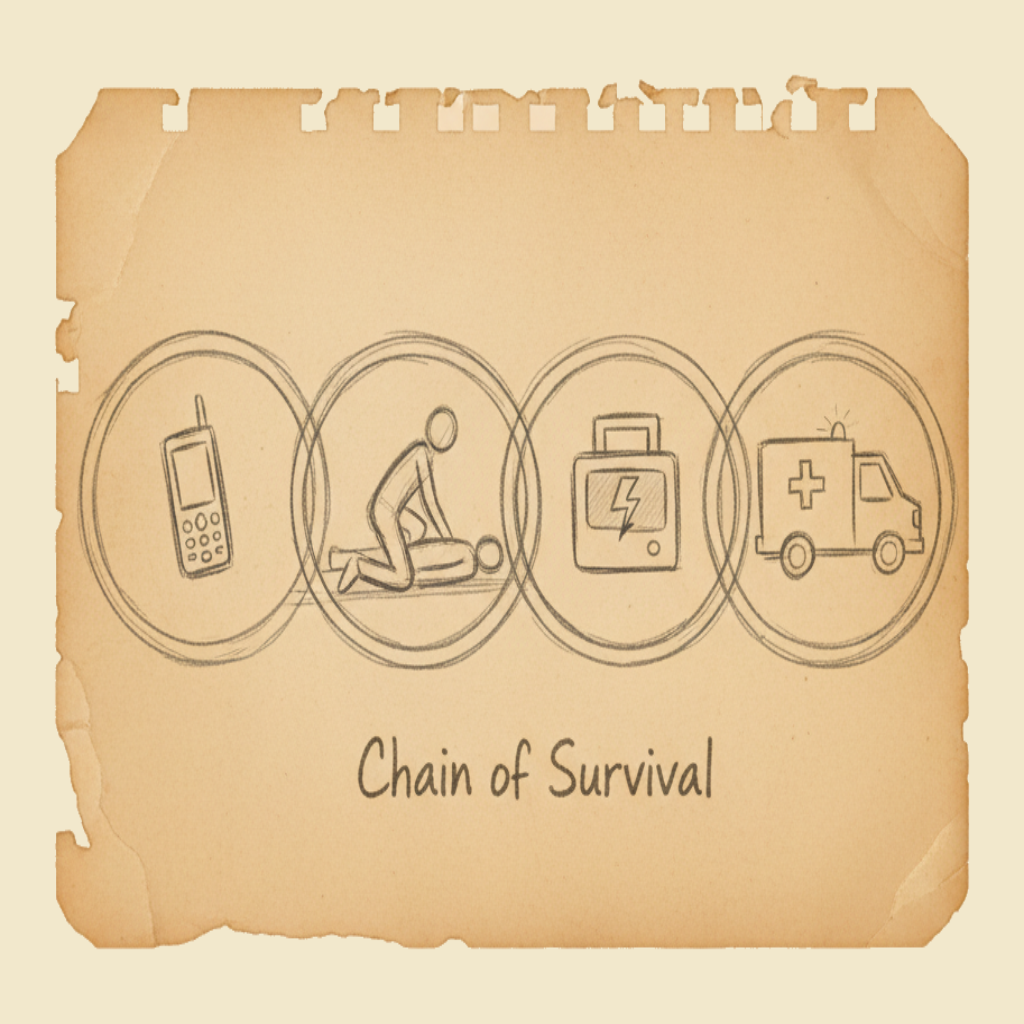
What the chain is, and why it's a chain
The chain of survival is the public-health framework ANZCOR uses to describe the sequence of events that need to happen, in order, for a casualty in out-of-hospital cardiac arrest to walk out of the hospital alive. It is called a chain because it has the property that a chain has: each link is only as useful as the link that follows it. Excellent CPR with no defibrillation is not enough. A perfect AED with no CPR before it is not enough. Either of those without the ambulance and the hospital is not enough. The casualty's outcome depends on the whole sequence happening, fast, in order. G2 G8
ANZCOR's chain has four links:
- Early recognition and call for help.
- Early CPR.
- Early defibrillation.
- Early advanced life support and post-resuscitation care.
Each link is the responsibility of a different actor — the bystander, the first aider, the AED-equipped responder, the paramedic and hospital — and each is gated by time. The single most important variable in cardiac arrest survival is how quickly all four links come together, and the first aider's job is to make sure the first three happen as fast as possible.
§ Instructor's note
The teaching point of this chapter is to show learners where they fit in a system that is bigger than them. A first aider cannot, alone, save a casualty in cardiac arrest — but they can be the link that starts the chain, and a chain that doesn't start has no chance. The chain framing also helps explain why CPR is worth doing even when it feels futile: the first aider isn't trying to fix the casualty's heart, they are holding the bridge for the AED, which is holding it for the paramedic, which is holding it for the hospital. Each link only buys time for the next one.
Link 1 — Early recognition and call for help
The chain starts when somebody — a bystander, a colleague, a family member, the first aider themselves — recognises that a cardiac arrest is happening and calls 000.
Recognition is harder than it sounds. The classic Hollywood image of cardiac arrest — a casualty clutching their chest and falling to the ground — is sometimes accurate, but the more common reality is messier. The casualty may have collapsed without warning while doing nothing in particular. They may have appeared to faint and then not woken up. They may be gasping (agonal breaths) in a way that fools observers into thinking they are still breathing. They may be discovered alone on a couch or in bed, with no clue as to when the arrest happened. The bystander's job is to:
- Check responsiveness — shout, shake, no response.
- Open the airway — see the upper airway chapter.
- Check breathing — for up to 10 seconds, looking for normal regular breathing. Anything else is not breathing normally and is a cardiac arrest until proven otherwise. See the recognising unconscious not breathing chapter.
- Recognise that this is a cardiac arrest.
Calling for help is the next breath. The instant the recognition happens, somebody needs to be summoning the ambulance. In a workplace or a public place that means dialling 000 (or the workplace's internal emergency number). In a home it means the same. Where there are multiple people present, this is when you point at one specific person and give them the job: "You — call 000, tell them adult cardiac arrest at this address, come back to me." See the accessing emergency services chapter for the script.
If there is only one person on scene, the order changes slightly:
- For an adult, the prioritised order is to call 000 first (so the ambulance is on its way) and start CPR immediately afterwards. If there is no phone available, start CPR and reassess after a minute.
- For a child or infant with witnessed collapse from a presumed cardiac cause, the order is the same as for an adult.
- For a child or infant whose collapse appears to be from a respiratory cause (drowning, choking, asthma, anaphylaxis), or who collapsed unwitnessed, the recommendation is 2 minutes of CPR first, then call 000 if you are alone. The reason is that the underlying problem is often hypoxia, and 2 minutes of CPR with rescue breaths can sometimes restore spontaneous circulation before the call is even completed.
In all cases, the call has to happen as part of the recognition — it is not a separate step that comes "later".
The call itself starts the chain because it puts the next two links into motion. The 000 dispatcher will:
- Confirm the address and dispatch the ambulance.
- Coach a non-trained bystander through CPR if needed.
- Tell the caller where the nearest publicly registered AED is.
- Stay on the line until paramedics arrive.
Link 2 — Early CPR
Once recognition and the call have happened, the next link is chest compressions, started immediately, and continued without significant interruption until the next link arrives. This is the link the first aider is most directly responsible for.
The mechanism by which CPR helps was covered in the CPR duration and cessation chapter — it doesn't restart the heart, it manually circulates a small but life-saving amount of oxygenated blood to the brain and the heart muscle while the casualty waits for the next intervention. The reason early CPR is so important is twofold:
- It buys time. Without compressions, brain cells start to die within 4–6 minutes of arrest. With compressions, the brain receives enough perfusion to keep going for substantially longer — sometimes long enough for the AED or paramedics to arrive.
- It improves the chance that the next link works. A casualty whose heart has been receiving blood and oxygen via CPR is more likely to be in a shockable rhythm when the AED arrives. A casualty who has had no CPR is more likely to have deteriorated into asystole (a flat line), which the AED cannot fix.
The take-home: start early, do not stop, swap rescuers if you can, and trust that you are buying time the casualty desperately needs. The technical detail (compression depth, rate, hand position, ratio of compressions to breaths) is in the cpr_techniques chapters elsewhere in this unit.
The single biggest improvement in out-of-hospital cardiac arrest survival in the last 20 years has come from bystander CPR — getting compressions started before paramedics arrive. Communities where bystander CPR rates are high have substantially better survival rates than communities where they are low, and the difference is not subtle. Every first aider is a potential bystander, and every bystander who starts compressions is the second link in the chain that the third and fourth links depend on.
Link 3 — Early defibrillation
The third link is using an AED as soon as one becomes available. The detail of how is in the AED use chapter, and the maintenance side is in the AED safety and maintenance chapter. The purpose of having it as a separate link in the chain is to highlight two things:
- The AED is the intervention that actually fixes the underlying problem in most adult cardiac arrests, which are caused by ventricular fibrillation. CPR keeps the casualty alive; the AED corrects the rhythm.
- The window for defibrillation is short. Survival from VF arrest decreases by about 10% per minute of delay in defibrillation. After about 8–10 minutes without defibrillation, the chances are very poor regardless of how good the CPR has been. The aim is to deliver the first shock within the first few minutes, and the only way to do that is to have AEDs distributed widely and to have rescuers willing to fetch and use them.
The third link is the link that makes the difference between a casualty whose heart eventually stops despite CPR (a poor outcome) and one whose heart restarts and they walk out of hospital weeks later (a good outcome). It is the highest-leverage link in the chain.
Link 4 — Early advanced life support and post-resuscitation care
The fourth link is what happens after paramedics arrive. Paramedics carry equipment and skills that a first aider doesn't:
- Advanced airway management — supraglottic airways, intubation in some services, mechanical ventilation.
- Intravenous access — to give resuscitation drugs.
- Resuscitation drugs — adrenaline, amiodarone, atropine, calcium, others depending on the cause.
- Manual defibrillator with rhythm interpretation, allowing more nuanced decisions than an AED can make.
- Mechanical CPR devices (in some services) for prolonged or transport CPR.
- Targeted temperature management initiation in some services.
- Transport to a cardiac-receiving hospital with the right facilities — coronary catheterisation lab, intensive care, post-cardiac-arrest care pathway.
The receiving hospital then provides the post-resuscitation care that determines whether the casualty recovers neurologically intact: targeted temperature management, intensive care, treatment of the underlying cause (often a coronary artery occlusion that needs urgent stenting), and rehabilitation. None of this is the first aider's job; all of it depends on the first aider getting the casualty to that point in the best possible condition.
The fourth link is the longest in time — it can last days or weeks — but it is gated by what happened in the first 5–15 minutes. A casualty who arrived at hospital in good shape has a real chance of walking out; a casualty who arrived after a long, ineffective response doesn't.
The first aider's place in the chain
A first aider responding to a cardiac arrest is the bridge between the first three links of the chain — and the chain doesn't move forward without them. Concretely:
- Link 1: the first aider is often the person who recognises the arrest and calls (or directs the call). Even when a bystander is the recogniser, the first aider often confirms and structures the response.
- Link 2: the first aider is the person doing CPR, and continuing it through swaps until the next link arrives.
- Link 3: the first aider is the person operating the AED — fetching it, applying it, delivering the shocks.
- Link 4: the first aider hands over to paramedics and steps into a supporting role.
The first three links are the first aider's domain. The fourth is the paramedic's. The chain framing is what makes it clear that the first aider's job ends with a clean handover, not with the casualty's recovery. You are not responsible for fixing the casualty; you are responsible for delivering them to the next link in the best possible state.
For a casualty who collapses in a public place where no first aider is present, the chain still has to start — and the people who start it are bystanders. The reason public-access AEDs, dispatcher CPR coaching, and community CPR training exist is to make the chain available even when there is no trained first aider on scene. Every member of the public who knows how to recognise an arrest, call 000, do compressions, and operate an AED is a node in the community's chain of survival. If you teach one person what you have just learned in this chapter, you have made the chain stronger.
Why the chain matters as a frame
The chain framing solves a number of problems that bedevil cardiac arrest first aid:
- It explains why each step is worth doing. A first aider sometimes hesitates to start CPR because "it probably won't work". The chain framing reframes CPR as link 2 of a 4-link sequence — the casualty's outcome depends on the whole chain, and CPR is the link that makes the next link possible.
- It makes coordination explicit. Cardiac arrest response involves multiple people doing different things at the same time. The chain gives each role a name and a place in the sequence.
- It exposes the time pressure. Every link has a clock attached to it, and the chain visually emphasises that delays in any link compound into a worse outcome.
- It puts the first aider's role in proportion. Not the whole job, but a critical, irreplaceable part of the job. Most of the leverage on outcome lives in links 1 to 3, which is exactly where the first aider works.
- It motivates community-level investment. A community that invests in training, AED placement, dispatcher protocols and ambulance response time is investing in all four links, and the chain framing makes that investment legible to the people who fund it.
The single most important number in cardiac arrest survival is the time from collapse to defibrillation. Every minute of delay in defibrillation reduces the casualty's survival chance by about 10%. After 8 to 10 minutes with no defibrillation, the chances are very small. This is the reason ANZCOR repeats "early" four times in the four links — not for emphasis, but because every link is a clock, and the clocks are short. The first aider's job is to compress every clock as much as possible.
How long does the chain take?
In an ideal scenario:
- Recognition and call: 30 seconds.
- Bystander CPR started: within 60 seconds of collapse.
- AED on the casualty and first shock delivered: within 3–5 minutes of collapse (this is the gold standard for public-access AED programmes).
- Paramedics on scene: 8–12 minutes from the call (typical urban response time).
- Casualty arrives at receiving hospital: 20–40 minutes from collapse.
In a less-than-ideal scenario the times stretch — the casualty is found later, no AED is available, the ambulance has further to come — and survival drops accordingly. The first aider's contribution is to compress the early times as much as possible: a casualty who has had bystander CPR from minute 1 and an AED on at minute 4 has a meaningful chance even with a long ambulance ETA.
The chain of survival describes the sequence of actions that need to occur for a casualty of out-of-hospital cardiac arrest to have the best chance of survival: early recognition and call for help, early cardiopulmonary resuscitation, early defibrillation, and early advanced care. Each link in the chain is dependent on the others, and the strength of the chain depends on the speed and quality with which each link is performed. First aiders play a critical role in the first three links and should be supported to act decisively when an arrest occurs.
What not to do
- Do not treat any link of the chain as optional. Each one only works if the next one comes.
- Do not delay calling 000 to "try CPR for a bit first" — for an adult the call is the first link.
- Do not wait for paramedics before starting CPR. CPR starts immediately.
- Do not wait for an AED before starting CPR. CPR continues until the AED is applied, and then both run together.
- Do not stop CPR after a shock to "see if it worked". Resume immediately.
- Do not assume "the paramedics will fix it". The paramedics are link 4; they need links 1–3 to have happened first.
- Do not underestimate the role of the bystander. Most of the leverage on cardiac arrest survival lives in the first 5 minutes, and the bystander is the only person on scene for most of those minutes.
You will run a full chain-of-survival scenario from "casualty collapses" to "paramedic handover" with multiple roles — recogniser, caller, compressor, AED operator, paramedic. The aim is not to test individual technique (that gets its own time elsewhere); it is to feel how the four links connect into a single sequence, and how each role has to know what the others are doing. By the end of the day, you should be able to walk into a real cardiac arrest, identify which link needs you next, and step into it without hesitation.
The chain of survival is the most important framework in resuscitation. It tells the first aider: you cannot save the casualty alone, but you can be the link that starts the chain, and the chain that doesn't start has no chance. Recognise, call, compress, defibrillate, hand over. Four links, one casualty, one chance.
— ANZCOR Guideline 2 (introduction to first aid)