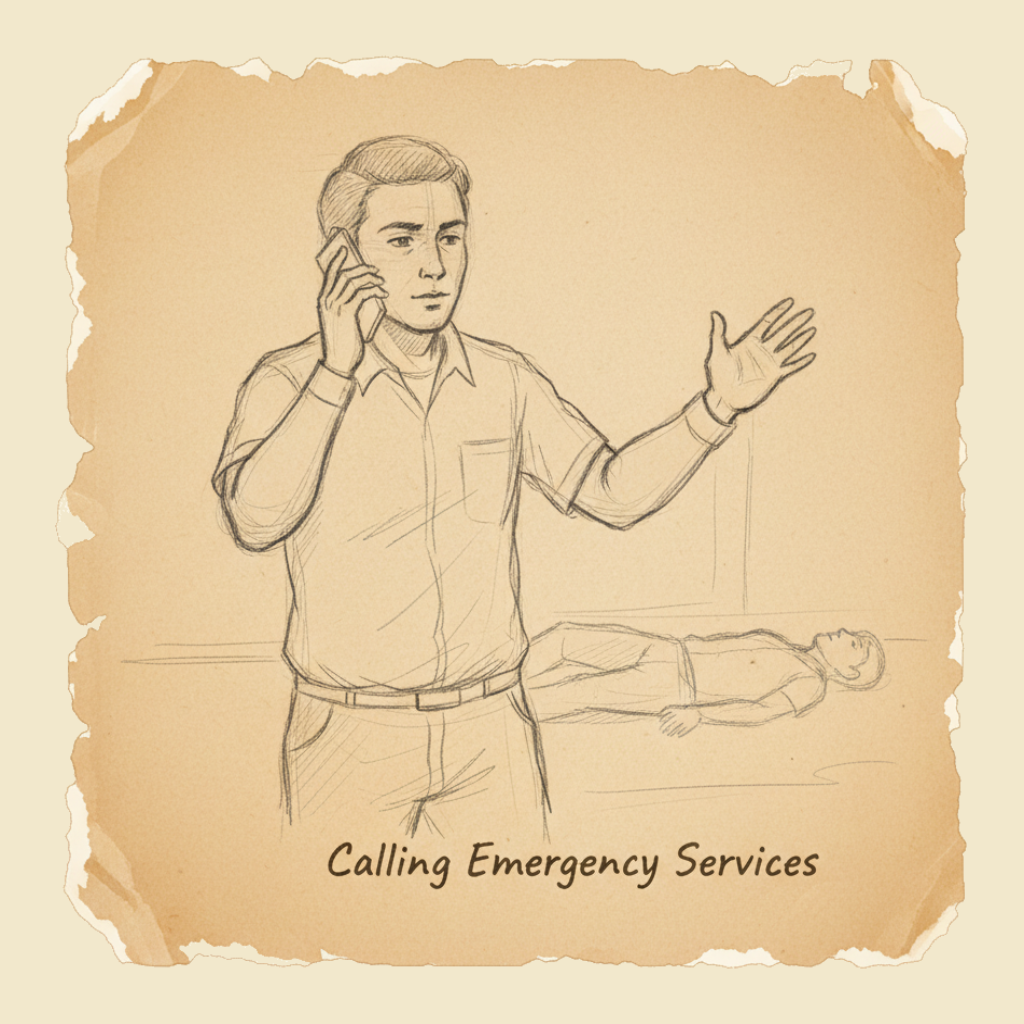
Why this is its own chapter
For most first aiders, calling 000 is the first thing they do at any significant incident, and the moment that determines whether everything else they do has anywhere to hand over to. The call seems trivially simple — three digits, ask for an ambulance, give the address — and most of the time it is. But there are enough variations, common mistakes, and special situations that getting comfortable with the call before you ever need to make one is part of being prepared. G2
The number of bystander first-aid responses that go badly because the call to 000 was confused, incomplete, or misdirected is small but real. The answer is to walk through the call in advance, so that when the moment comes, the script is already in your head and the panic doesn't get to write it for you.
§ Instructor's note
Learners are often surprised that this is its own chapter. The point of teaching it explicitly is that "calling an ambulance" is one of those things people assume they know how to do until they have to do it under stress, with adrenaline running, holding a phone in one hand and pressure on a wound with the other. The drill is the same as for CPR: rehearse the script in calm conditions so that the panicked version is automatic.
The three numbers — and which to use
Australia has three different ways to summon emergency services, depending on the circumstances and the device you have:
- 000 is the primary national emergency number, used by everyone, on landlines and mobiles, anywhere in Australia, in any situation. This is the number you call. It is free, it works on any phone (mobile or landline) regardless of credit, network, or carrier, and it is the number every Australian first aider should default to.
- 112 is the GSM/3G international emergency number, which works on a mobile phone in Australia even when your own carrier has no signal — the call will be carried by any available network. It connects to the same dispatchers as 000, and is worth knowing for the specific case of being out of your carrier's coverage. It does not work better than 000 in normal circumstances; it is only useful in coverage gaps. (And on modern smartphones, dialling 000 will often automatically use 112-style emergency network selection anyway.)
- 106 is the text-based emergency number for people who are deaf, have a hearing impairment, or have a speech impairment. It is accessed via a TTY (teletypewriter) or, increasingly, via the National Relay Service. The text format is the same conversation, just typed.
The default in 99% of situations is 000. The first aider's job is to dial it, ask clearly for the service you need, and answer the dispatcher's questions accurately.
What happens when you dial 000
When you dial 000 from any phone in Australia, the call is routed first to a Telstra-operated Emergency Call Person — the very first voice you hear. The Emergency Call Person asks one question: "Police, fire, or ambulance?" Their job is to triage your call to the right service and connect you. They are not the dispatcher and are not yet recording the details of your emergency.
For a first-aid emergency, the answer is almost always "ambulance". There are situations where you may want both ambulance and another service (a road accident with a fire, a domestic incident with injuries, a workplace injury caused by hazardous chemicals), and the Emergency Call Person will conference in the relevant additional service after they connect you to ambulance. You can ask: "Ambulance please, and I think I might also need fire."
Once connected to the ambulance dispatcher (one of the state ambulance call centres — the dispatcher is a trained clinician or a triage operator who can make dispatch decisions and give first-aid advice over the phone), the conversation that follows is a structured triage. The dispatcher's questions are designed to do three things at once:
- Decide what to send. A car? A double-crewed ambulance? A rescue helicopter? A specialist team? The decision is made on the basis of the casualty's symptoms and the address.
- Get the address right so the responding unit can find the casualty.
- Give you instructions on what to do until they arrive — including dispatcher-coached CPR if needed.
The dispatcher will not hang up on you, will not stop you from doing what you need to do, and will stay on the line as long as you need them. You can put the phone on speaker, set it down, and continue first aid while keeping the call open.
The script — what to say, in order
The information the dispatcher needs, in roughly the order they will ask for it:
- The address. Where is the emergency? Street number, street name, suburb, state. If you don't know the exact address (e.g. you're in a park, on a road, in a remote area), give the best landmark you can — "the eastbound side of the M1, about 2 km past the Wahroonga exit", "in the gardens behind the museum, near the south fountain", "GPS coordinates are X". Most modern smartphones can read out your GPS coordinates from the maps app — useful in remote situations.
- The phone number you are calling from. In case the call drops and they need to reach you back.
- What is wrong with the casualty. A short, plain-language description: "I have an unconscious adult, not breathing." "Snake bite to the leg, casualty conscious." "Suspected stroke, casualty can't move their right side." Stick to facts you observed; don't speculate about cause.
- The casualty's age and sex if known. "Approximately 60 years old, male." "Child, about 4 years old, female."
- What happened, briefly. "He collapsed at his desk about 5 minutes ago." "She fell down the stairs." "He was stung by something near the back fence."
- Any other casualties at the scene. "Just one casualty." "Two adults, both injured."
- Hazards at the scene that the responders should know about. "Live power line down nearby." "Aggressive dog in the yard." "Road still has traffic." "The casualty is in a confined space — please send rescue."
- What you are doing. "I'm a first aider, I have started CPR." "I'm applying pressure to the wound." "I'm with the casualty in the recovery position."
You will not always have all of this information, and the dispatcher will not always ask for all of it in this order. But this is the rough shape of the call, and having the items in mind makes the conversation faster.
A worked example
A reasonable opening for the call (after the Emergency Call Person has connected you):
"Hi, I'm calling from 12 Smith Street, Parramatta. I'm a workplace first aider. I have a male adult, about 45, who has just collapsed in the office. He is unresponsive and not breathing normally. I have started CPR. There is an AED on the wall and a colleague is fetching it. The address is Level 3, 12 Smith Street, Parramatta, and the building entrance is on Smith Street with reception on the ground floor. My phone number is XXXX XXX XXX."
That single paragraph contains every piece of information the dispatcher needs to send the right resources to the right place. You will probably not be that articulate the first time you make the call, and that is fine — the dispatcher will ask follow-up questions and prompt you for anything missing. But notice how much the dispatcher learned in those few sentences:
- The exact address, including the level and the entrance.
- The casualty's age, sex, condition, and the time frame.
- That the rescuer is trained and has started CPR.
- That an AED is being deployed.
- The callback number.
That is enough to dispatch the right ambulance to the right floor, to give the responding crew an accurate sense of what they will find, and to start the dispatcher's CPR coaching protocol if it is needed.
Address — the most important piece
If there is one piece of information the dispatcher absolutely must have, it is the address. An ambulance dispatched to the wrong street, or an ambulance unable to find the building, is an ambulance that doesn't arrive. The dispatcher will repeat the address back to you to confirm, and you should listen for the repeat — if anything is wrong, correct it before the conversation moves on.
Specific guidance:
- In a workplace: know the street address, the building name (if any), the level, and the directions to the relevant area (which entrance, which lift, which corridor). Workplaces should have this written on every phone or wall near a phone, as part of the workplace procedures chapter.
- In a public place: give the street address if you know it, the name of the building, and the closest landmark.
- Outdoors with no street address: give the name of the park, beach, trail, or geographic feature, and the entry point or landmark you are nearest to. GPS coordinates from your smartphone are useful as a backup.
- On a road: give the road name, the direction of travel, and the nearest exit, intersection, or kilometre marker.
- In a remote area: GPS coordinates are essential. The dispatcher can also locate your mobile phone via the network's emergency-services location service, but this is approximate and slow.
Whatever address you give, send someone to meet the ambulance at the gate or street entrance if at all possible. A rescuer waving down the ambulance and leading the crew straight to the casualty saves precious minutes that would otherwise be spent searching for the right door.
Special situations
Cardiac arrest — dispatcher CPR coaching
If the casualty is in cardiac arrest and the rescuer is not trained, the ambulance dispatcher can coach the rescuer through CPR over the phone in real time. The protocol is well-established and effective: the dispatcher walks the bystander through compression rate, depth, and what to do until the ambulance arrives. If you are with an untrained bystander and a casualty in arrest, put the phone on speaker and let the dispatcher do the talking — your hands are on the casualty.
If you are the trained rescuer, you can tell the dispatcher "I'm a first aider and I have started CPR" — the dispatcher will skip the coaching and concentrate on getting the ambulance to you. Stay on the line.
Multiple casualties
For an incident with multiple casualties (a road accident, a workplace explosion, a fall at a sports event), tell the dispatcher up front: "I have three casualties, two with serious injuries and one walking wounded." This triggers a different dispatch — usually multiple ambulances and possibly a medical team or rescue resources. Be as accurate as you can about the number and apparent severity.
Stroke — say "stroke"
If you suspect a stroke, say so explicitly in the call: "I think this is a stroke." Stroke is one of a small number of conditions where modern treatment is gated by a hard time window from symptom onset, and the dispatcher will route the call differently — to a stroke-capable hospital, with the receiving stroke team alerted en route. The phrase "I think this is a stroke" triggers the stroke protocol; "I think she's just confused" doesn't. See the stroke chapter.
Suspected heart attack — say "chest pain"
The phrase "chest pain" or "I think this is a heart attack" similarly triggers a cardiac protocol on dispatch — different ambulance, different receiving hospital (one with a coronary catheterisation lab), and pre-arrival team activation. See the cardiac conditions chapter.
Anaphylaxis — say "anaphylaxis"
The word triggers a dispatch that includes additional clinical resource and earlier hospital alerting. See the anaphylaxis chapter.
Road accident — say "MVC" or "car crash"
This triggers fire and rescue dispatch alongside the ambulance, in case extrication is needed.
Hazardous incident — say what's there
If there is fire, smoke, chemical exposure, electrical hazard, confined space, or any other hazard at the scene, tell the dispatcher. The right rescue resources will come along with the ambulance, and the responding paramedic crew will know not to walk into a hazardous scene unprepared. See the incident hazards chapter.
Mental health crisis
For a casualty in psychological distress, an active suicide attempt, a self-harm incident, or a psychotic episode that is making them a danger to themselves or others, the call to 000 may result in both ambulance and police dispatch. Tell the dispatcher what is happening as accurately as you can; they will make the dispatch decision. Stay with the casualty if it is safe to do so.
Workplace internal numbers
Many workplaces — schools, hospitals, large offices, hotels — have an internal emergency number that routes through the switchboard or security office before reaching 000, often for the purpose of also dispatching the workplace's own first-response team. Know what your workplace's number is, and use it if your workplace's procedure says to. The internal call adds a few seconds; in return it triggers in-house resources that get to the casualty before an external ambulance can.
If the internal number is unfamiliar, slow, or unavailable, dial 000 directly — the workplace number is an addition to 000, not a replacement. If in any doubt, dial both: 000 first, then ask a colleague to call the internal number.
If you can dial 000 but cannot safely speak — domestic violence, hostage situation, intruder, severe asthma making speech impossible — the operator is trained to recognise silent calls and will ask yes/no questions. Press any key to indicate you are there. On a mobile phone, you can also use the SMS-based 106 service if you have access to a TTY or relay app, and modern Apple and Android phones have an "Emergency SOS" feature that, when activated by holding the side button, dials 000 automatically and shares your location. Know how your phone's emergency feature works before you need it.
After the call
Once the call has been made and you have given the dispatcher all the information they need, do not hang up unless you have to. Put the phone on speaker, set it down within reach, and return to the casualty. The dispatcher will:
- Stay on the line for as long as is useful.
- Coach you through any procedure you need help with.
- Update you on the ambulance's progress if you ask.
- Take any new information you have for them as the situation evolves.
You can ask the dispatcher questions: "How long until they arrive?" "Should I move the casualty?" "Should I give him aspirin?" The dispatcher is part of the response, not just an order-taker.
When the ambulance arrives, the call ends naturally and the verbal handover begins (see the duty of care chapter for the handover).
Common mistakes to avoid
- Hanging up before the dispatcher tells you to. Stay on the line.
- Giving the wrong address — too vague, wrong suburb, missing the level or building number. Confirm the dispatcher has it right.
- Speculating about cause instead of describing observation. "I think he's having a stroke" is fine; "I think he's faking" is not useful. Stick to what you can see.
- Not telling the dispatcher about hazards. If the scene is dangerous, the responding crew needs to know before they walk in.
- Forgetting the callback number. Most phones will provide it automatically, but tell the dispatcher anyway in case the call drops.
- Failing to send someone to meet the ambulance. Even on a clearly-numbered street, a person on the kerb waving is a substantial improvement over a rescuer trying to find a building blind.
- Calling on a personal phone when a landline is available. Landlines give the dispatcher the address automatically; mobiles only give an approximate location.
Recent iPhones and Android phones can be set to share your precise location with the emergency services automatically when you dial 000 — Apple's Emergency SOS and Google's Emergency Location Service. Both are on by default in Australia. If you are in a location where the address is unclear, the location data is often the fastest way to get it to the dispatcher. Knowing how to invoke the emergency-call feature on your specific phone (typically holding the side button or a power-button combination) is a small piece of preparation that pays off in a panic.
Early activation of emergency medical services is a critical step in the response to any serious illness or injury. The rescuer should call for help as soon as the need is recognised, give the dispatcher accurate information about the location and the casualty's condition, and follow any instructions provided. Where the rescuer is alone with a casualty in cardiac arrest, the call should be made before commencing CPR for adult arrests; for paediatric arrests of presumed respiratory cause, two minutes of CPR may be performed first if a phone is not immediately to hand.
What not to do
- Do not delay calling 000 to "see if it gets better". When in doubt, call.
- Do not assume someone else has called. Confirm explicitly: "Has anyone called 000?"
- Do not speculate or editorialise to the dispatcher. Stick to facts.
- Do not hang up before the dispatcher says it's okay.
- Do not call on a personal mobile when a landline is available — landlines give automatic address.
- Do not forget to send someone out to meet the ambulance and lead them in.
- Do not be afraid to call back if the situation changes — you can always update the dispatcher.
You will rehearse a 000 call as part of every full scenario you run, with a partner playing the dispatcher. The aim is for the call script to feel automatic — address, casualty, what happened, what you are doing — so that when the real call comes you don't have to think about how to start. The dispatcher is your ally; the call is the bridge to the rest of the response.
Calling 000 is the cheapest, fastest, most leveraged thing a first aider does. Three digits, half a minute, the right address — and the people with the resources you don't have are on their way. Every other intervention you do is built on top of that call. Make it early, make it clear, and stay on the line.
— ANZCOR Guideline 2 (introduction to first aid)