n. · a glossary entry from the working vocabulary.
Upper airway.
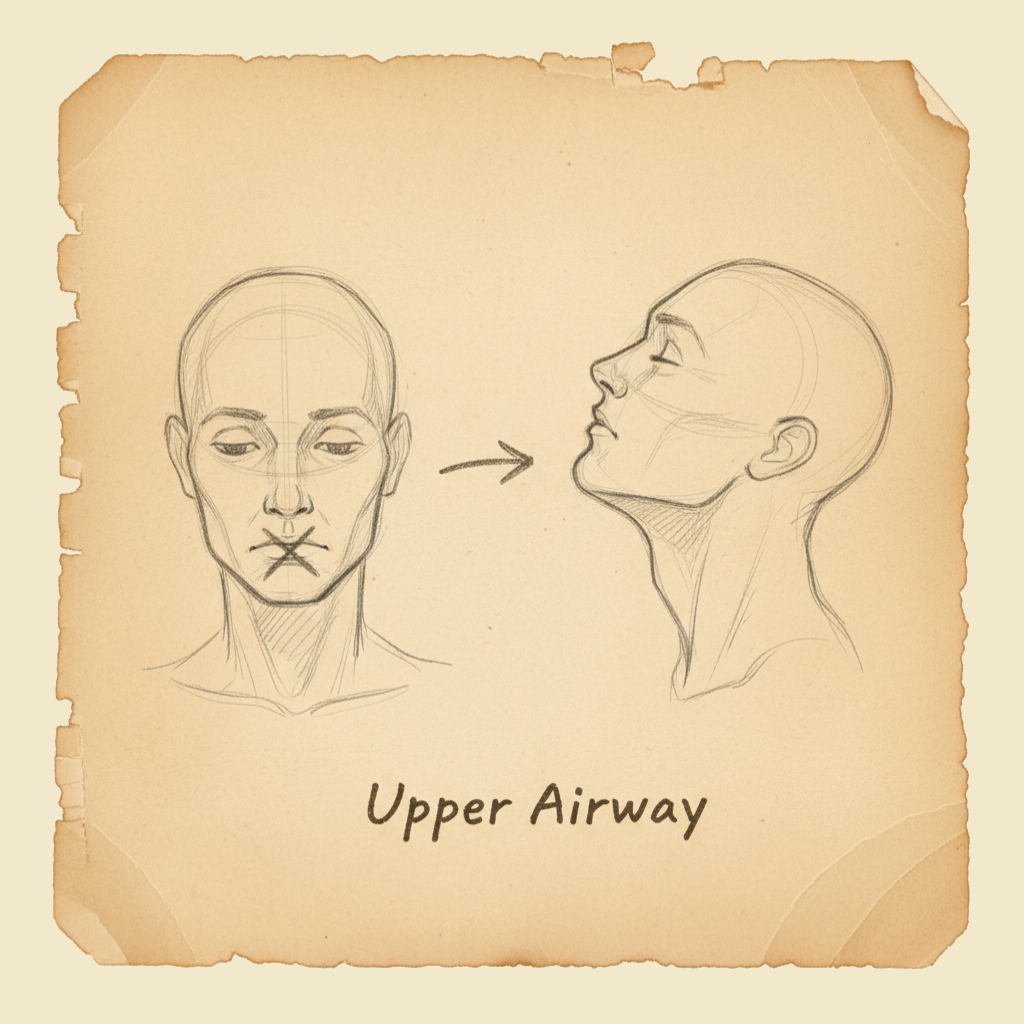
§ short definition
The passage from the nose and mouth down through the throat and voice box to the top of the windpipe — the part of the breathing system most likely to become blocked.
§ long definition
The upper airway is the route air takes from the outside world to the lungs: nose and mouth, the back of the throat (the pharynx), the voice box (the larynx), and the very top of the windpipe (the trachea). It is the part of the breathing system the first aider can actually do something about — everything below the windpipe is sealed away inside the chest and out of reach. The upper airway is also the part most likely to fail: it can be blocked by swelling (anaphylaxis, severe burns, infection), blocked by a foreign body (choking), or — most commonly in an unresponsive casualty — blocked by the casualty's own tongue falling backward against the back of the throat.
The two visible signs of upper airway compromise are noise and effort. A normally breathing casualty makes almost no sound; a compromised upper airway makes snoring, gurgling, wheezing, stridor (a harsh high-pitched sound on breathing in), or a hoarse / muffled voice. The casualty is working visibly harder for each breath, ribcage and neck muscles drawn in. A silent upper airway in a casualty who is trying to breathe is the worst sign — no air is moving at all.
First aid for the unresponsive casualty whose airway is closed by their own tongue is the head-tilt-chin-lift manoeuvre: one hand on the forehead, two fingers under the bony point of the chin, gently tilt the head back. This lifts the tongue away from the back of the throat and is the single most important airway intervention a first aider can perform. (For a casualty with a suspected spinal injury, ANZCOR still teaches the same head-tilt if it is necessary to maintain the airway — a lost airway will kill faster than a slightly mishandled spine.) Once the airway is open, check breathing; if normal, place the casualty in the recovery position; if not, start CPR.
§ ANZCOR reference
4